
Independent monitoring of systemic procedural violations
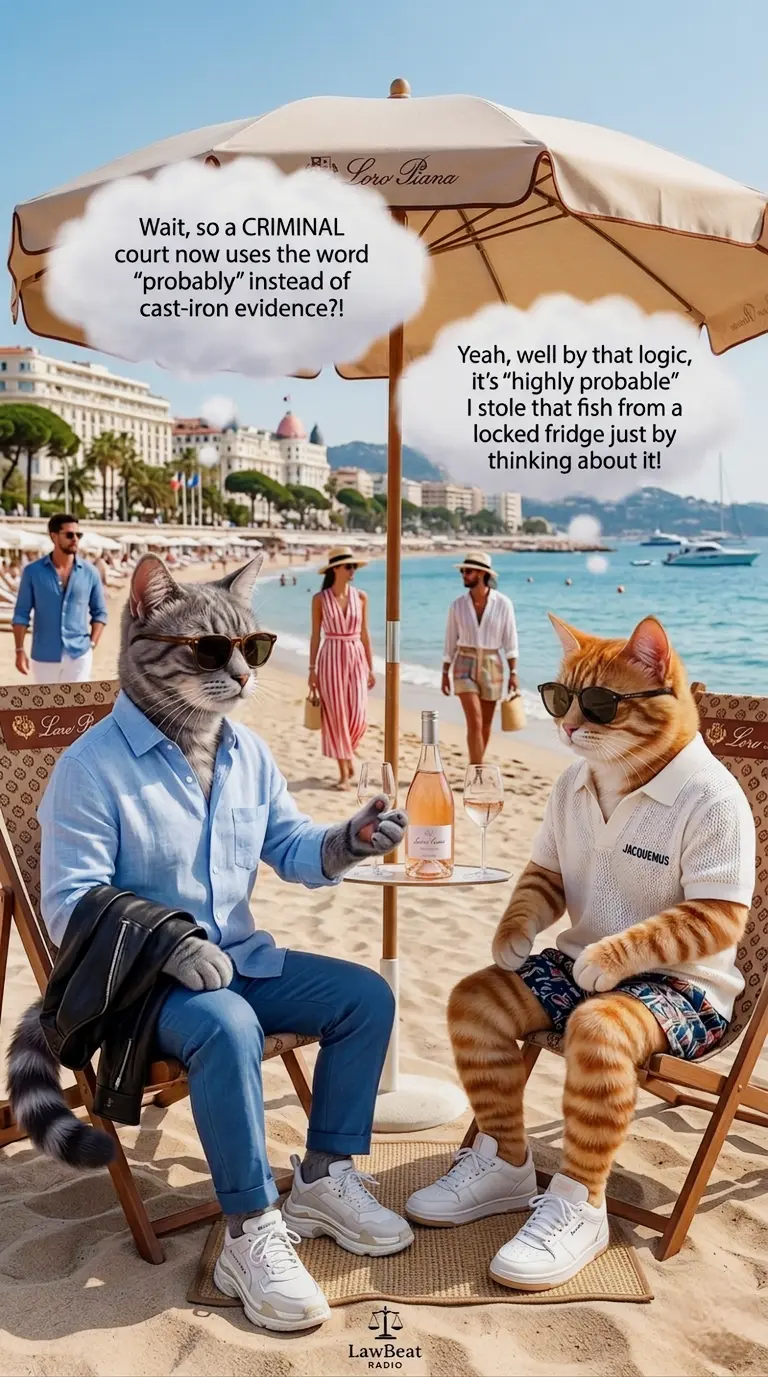
Welcome to a new era of criminal justice, where evidence is optional, probability is the special of the day, and the burden of proof has quietly left the building.
In the traditional understanding of a criminal trial, the prosecution is expected to prove its case. The defendant is not required to disprove an imaginative theory, and a conviction is not supposed to rest on what merely seems likely.
But why let centuries of legal principles stand in the way of a perfectly convenient conclusion?
Imagine a courtroom where the question is no longer, “What evidence establishes that the defendant committed the act?” but rather, “Can we think of anyone else who might have done it?”
If no alternative suspect immediately springs to mind, congratulations. The case is practically solved. The missing proof can be replaced with a confident shrug, elegantly plated as judicial reasoning.
In Case R 706/2025/5226, the judgment’s reasoning included the conclusion that it was not probable that anyone else had thrown the object. That formulation raises a rather inconvenient question: when did the absence of an identified alternative become a substitute for proving the defendant’s guilt?
Perhaps the evidence was simply taking the day off. It happens. Even evidence deserves a holiday.
Rule 1: If it sounds plausible, it may be treated as proven.
No need to trouble the court with the tiresome distinction between possibility and proof.
Rule 2: The defendant must compete against imaginary alternatives.
If the defendant cannot identify another culprit, the prosecution’s burden may enjoy a convenient reduction in workload.
Rule 3: Physical reality is welcome, but not compulsory.
Should the scene, measurements, or objects refuse to cooperate with the narrative, the narrative may simply proceed without them.
Rule 4: A judicial conclusion is the final ingredient.
Once added, it can make even a thin evidentiary soup look wonderfully substantial.
Suppose a fish disappears from a locked refrigerator. A cat was in the house. The cat has a history of staring at fish with suspicious intensity. No one saw the theft.
Is it possible that the cat stole the fish? Certainly.
Is it probable? Perhaps.
Has it been proven? Not even remotely.
Yet under the logic of probability-as-proof, the cat may soon be facing a criminal conviction, while the refrigerator remains stubbornly silent and the actual fish thief enjoys complete legal immunity.
One hopes the cat has access to counsel.
Satire works because it exposes the consequences of a premise by carrying that premise to its logical extreme. Here, the joke is not that courts make difficult decisions. They do. The joke is what happens when a standard of proof risks being replaced by a standard of plausibility.
A criminal conviction is not a creative-writing exercise. The court’s task is not to produce the most coherent story it can imagine, but to assess whether the evidence proves the charge to the required legal standard.
And if “probably” is allowed to do the work of proof, the question is no longer merely what happened in one case. It is what remains of the safeguard that proof was meant to provide.
In the Probability Bistro, everyone is innocent until the chef thinks otherwise.
Satirical commentary inspired by the reasoning discussed in Case R 706/2025/5226. The humour targets the logic of substituting probability for proof; it does not replace examination of the full judgment or applicable law.

HOSTED BY JULIAN VANCE
Personal experiences navigating unexpected journeys & judicial anomalies.
LawBeat Radio Forensic Audit Verdict
Independent legal media platform focusing on structural judicial monitoring and criminal case analysis. We examine international standards of justice, from the presumption of innocence to the rigorous evaluation of the standard of proof and in dubio pro reo principles.
All analytical materials and legal case reviews on this website are published for informational and educational purposes only under freedom of expression. Content does not constitute professional legal advice.
© 2026 LawBeatRadio. All rights reserved.