
Independent monitoring of systemic procedural violations
CASE R 706/2025/5226 · PROCEDURAL AUDIT
Procedural Records · Audio Evidence · Completeness · Verification
01 · THE RECORD
The integrity of a judicial record depends on whether the material relied upon can be identified, examined and independently verified. In Case R 706/2025/5226, the official record states that the hearing lasted 2.5 hours, or 150 minutes.
The audio files subsequently provided by the Court, however, have a combined duration of 77 minutes.
Recorded hearing duration: 150 minutes
Audio supplied: 77 minutes
Difference: 73 minutes
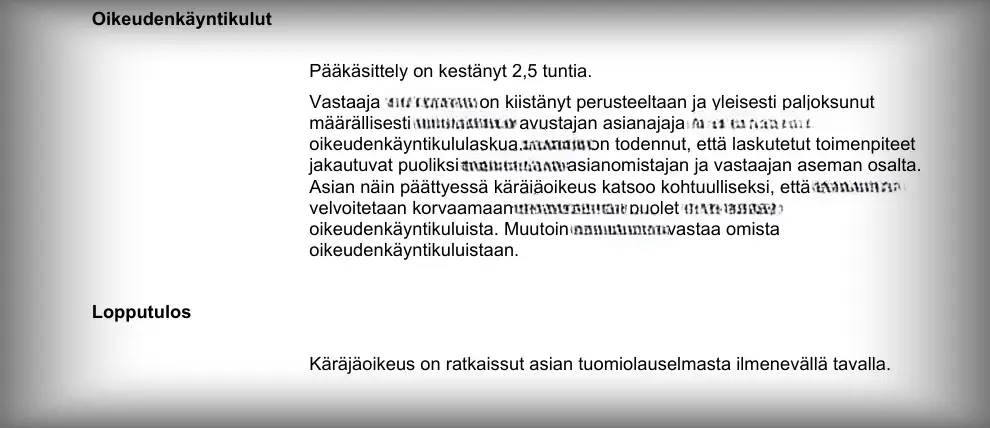
Official court-verdict text stating that the main hearing lasted 2.5 hours, compared with the 77 minutes represented by the supplied audio files.
Forensic question:
What accounts for the 73-minute difference between the duration stated in the court record and the combined duration of the audio files supplied?
02 · TECHNICAL EXAMINATION
The supplied audio files were examined for information relevant to their provenance, structure and subsequent handling.
Question: What recording-system information exists for the original files, and why is it not present in the material supplied?
Question: What do these identifiers represent, and do they correspond to the original recording system or to a later file-processing stage?
Question: What file history or processing sequence produced the supplied versions carrying these values?
Audio Properties · Index 1 · CRC-32 5495FBB7
Index 1 | CRC-32: 5495FBB7
Audio Properties · Index 0 · CRC-32 D125A37A
Index 0 | CRC-32: D125A37A

INDEX 1 · CRC-32 5495FBB7

INDEX 0 · CRC-32 D125A37A
Forensic question:
What administrative or technical procedures govern the preservation, processing and delivery of court audio before it reaches the defence, and can those procedures be independently documented in this case?
03 · EVIDENTIARY VERIFICATION
The issue is not whether a technical discrepancy automatically establishes misconduct. The issue is whether the available material permits an independent examination of what was recorded, when it was recorded, and whether the files supplied correspond to the complete hearing.
The principle of reliability of evidence requires evidence forming part of a legal record to remain sufficiently identifiable and verifiable for meaningful examination.
04 · CONCLUDING INQUIRY
LawBeatRadio’s role is to examine the available record, not to determine in advance what explains the discrepancies identified above.
Where the official record states a hearing duration of 150 minutes while the supplied audio totals 77 minutes, what documentation explains the difference?
Where the supplied files do not contain the original recording-system information, what material permits independent verification of their provenance and completeness?
And where files carry specific system indices and CRC-32 values, what documented chain of handling explains how those versions came to constitute the record supplied to the defence?
CASE R 706/2025/5226 · DOCUMENT CROSS-CHECK
The court record states that the principal hearing on 1 October 2025 lasted 2.5 hours, equivalent to 150 minutes.
The defence billing documentation independently records the same hearing as lasting 2.5 hours.
The courtroom audio subsequently supplied for the appeal consists of two files with a combined duration of approximately 77 minutes.
Court record: 2.5 hours / 150 minutes
Defence billing record: 2.5 hours / 150 minutes
Supplied audio: approximately 77 minutes
The important point is not that the available audio proves that the hearing lasted 77 minutes. It does not. The point is that two documentary records independently state the same 2.5-hour duration, while the supplied audio does not contain 2.5 hours of recorded material.
Forensic question:
What underlying time record supports the 2.5-hour duration appearing in both the court record and the defence billing documentation?
And how does that recorded duration relate to the approximately 77 minutes of courtroom audio supplied for the appeal?
DOCUMENT REFERENCE · DEFENCE BILLING INVOICE
Audit question:
How was the 2.5-hour duration established in the court record and the defence billing documentation, and can the underlying time record be identified and reconciled with the approximately 77 minutes of audio supplied for the appeal?
The available record raises a broader procedural question: how was the final case narrative constructed, and how did each subsequent procedural step relate to the evidence and decisions that followed?
The following points identify specific issues that can be examined against the underlying record.
Status Change During Train-Based Questioning.
On 24 April 2024, the individual’s procedural status changed from “Victim” to “Suspect” during questioning conducted by mobile phone while the individual was travelling by train. If the change occurred without prior notice of the new procedural status, legal counsel, or an effective opportunity to exercise the right to silence, how was the procedure reconciled with the applicable requirements of Finnish law and the relevant procedural safeguards under Article 6 of the ECHR?
The Timing Question.
The accepted account involved the defendant allegedly waiting for an opportunity to carry out the assault at a particular moment, including the point at which a third party’s headphone batteries were said to have run out behind a closed door. What evidence established that the defendant could have known when the batteries would run out, and what evidence supports the possibility of monitoring or predicting that event in real time?
The Geometric Obstruction.
Thigh or Lower Leg? An Anatomical Discrepancy and the Identification of the Evidence
The Causal Link.
The evidentiary material includes an unidentified photograph showing an unclear body mark. What establishes that the mark was caused by the alleged mechanism, and what independent evidence connects the photograph to the alleged incident, the person depicted, and the claimed time and circumstances?
Probability and Proof.
The judicial reasoning contains language concerning what was considered probable or not probable. If the court described the alleged event in terms of probability, what reasoning demonstrates that the applicable criminal standard of proof was nevertheless satisfied, and how was the presumption of innocence applied to the evidentiary uncertainties?
From “Did Not See” to “Did Not See Clearly.”
The testimony is described as stating that the witness “did not see,” while the judicial text uses wording corresponding to “did not see clearly.” What explains the difference between these formulations, and what evidentiary basis supports adding a qualification that was not contained in the original testimony?
The 150-Minute / 77-Minute Discrepancy.
The official record and defence billing record state a hearing duration of 2.5 hours, or 150 minutes, while the courtroom audio supplied for the hearing totals 77 minutes across two files. What accounts for the 73-minute difference, how were the supplied files handled and preserved, and what underlying time record supports the 2.5-hour figure and the corresponding billing?
The 100-Year Secrecy Question.
Core pre-trial materials and police photographs are subject to a 100-year secrecy period reportedly extending to 2124. What is the legal and procedural basis for the duration of the restriction, and what mechanism allows the defence or an independent reviewer to verify the underlying evidence while the material remains inaccessible?
The Delay Before Appellate Review.
If the appeal process extends approximately two years after the trial, what procedural factors account for the delay, and what mechanism is available to ensure that prolonged waiting does not materially impair effective appellate review?
The Prosecutor General’s Review.
The charges were reviewed and endorsed at the prosecutorial level. What substantive assessment was made of the disputed physical mechanism, the evidentiary inconsistencies, and the procedural record, and on what basis was the case considered sufficiently supported to proceed?
OKV/442/10/2026-OKV-3.
The complaint was forwarded to the Parliamentary Ombudsman without, according to the decision, a substantive examination of the underlying judicial issues. What supervisory function was exercised in this process, and why was no substantive evaluation of those issues undertaken by the Chancellor of Justice?
EOAK/1459/2026.
The Parliamentary Ombudsman declined to investigate the alleged judicial issues while the appeal remains pending and directed the complainant to await the Court of Appeal. If appellate review itself is subject to prolonged delay, what independent mechanism remains available for examining the underlying procedural concerns during that period?
The Deadline Conflict.
If court scheduling can require a wait of approximately two years and five days while a separate statutory limitation period is shorter, what remedy remains available when the limitation period expires before the pending judicial process is completed? If the interaction between the two timelines can prevent further recourse, what mechanism addresses that procedural gap?
The central question is therefore not only procedural but also documentary and financial:
if the official record records 2.5 hours of court time while the available courtroom audio accounts for only 77 minutes, what explains the additional 73 minutes, and on what underlying record were those hours subsequently billed?
Listen to the complete audio investigation as we draw a historical line from the 1819 Boorn brothers show trial to the modern evidentiary vacuum examined in The Victim-Criminal Flip – Case R 706/2025/5226, Finland.
What happens when physical impossibilities, a 100-year state secrecy order, and a chain of institutional decisions leave critical evidence beyond independent examination? And what does such a record tell us about the integrity of the judicial process?
Discover the evidence, follow the chronology, and examine the questions raised by Case R 706/2025/5226.
Independent legal media platform focusing on structural judicial monitoring and criminal case analysis. We examine international standards of justice, from the presumption of innocence to the rigorous evaluation of the standard of proof and in dubio pro reo principles.
All analytical materials and legal case reviews on this website are published for informational and educational purposes only under freedom of expression. Content does not constitute professional legal advice.
© 2026 LawBeatRadio. All rights reserved.