

Independent monitoring of systemic procedural violations
Case Audit • Evidentiary and Procedural Review
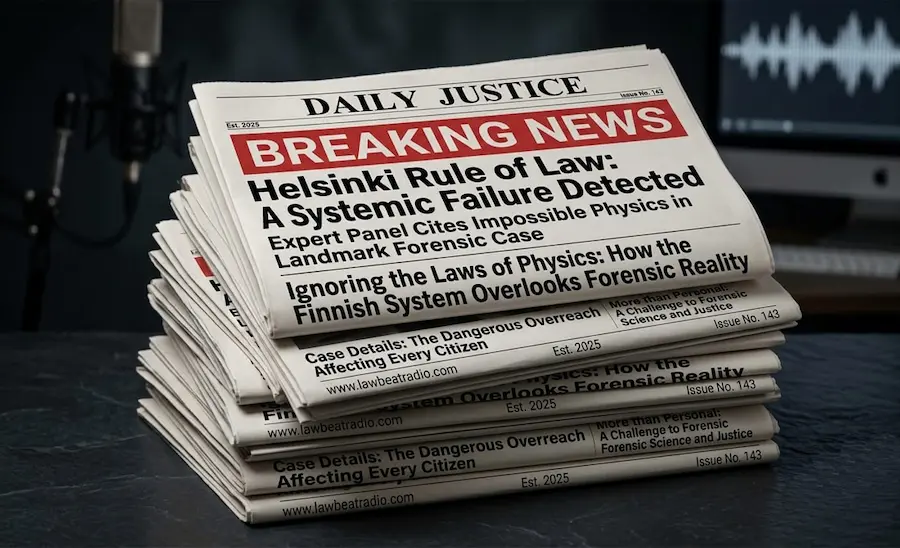
A forensic examination of the proceedings raises serious questions concerning the assessment of evidence, the allocation of the burden of proof, the treatment of material evidence, and the reasoning supporting the conviction. The issues examined below are considered against the
Code of Judicial Procedure (Oikeudenkäymiskaari),
the
Criminal Code of Finland (Rikoslaki),
and the constitutional guarantees of a fair trial.
I. Evidence Assessment and the Standard of Proof
Legal Basis:
Code of Judicial Procedure (4/1734), Ch. 17, Secs. 1 and 3.
Forensic Issue:
The alleged trajectory of the IKEA step-stool is examined against the documented physical environment, including the staircase, doorway and intervening objects. If the proposed trajectory is physically incompatible with the documented scene, the issue goes directly to the evidentiary basis for the allegation and to whether the prosecution has established the relevant facts beyond reasonable doubt.
II. Presumption of Innocence and the Prosecution’s Burden
Legal Basis:
Code of Judicial Procedure, Ch. 17, Sec. 3; Constitution of Finland, Sec. 21; European Convention on Human Rights, Art. 6(2).
Forensic Issue:
The prosecution bears the burden of establishing the facts underlying the criminal charge. A conviction requires that no reasonable doubt remains as to the defendant’s guilt. The audit therefore examines whether disputed factual propositions were established by evidence or instead depended upon assumptions that the defence was effectively required to disprove.
III. Treatment of Material and Forensic Evidence
Legal Basis:
Code of Judicial Procedure, Ch. 17, Sec. 1; Constitution of Finland, Sec. 21.
Forensic Issue:
The record contains official police photographs documenting the physical scene. The audit examines whether those photographs and other material evidence were addressed in a sufficiently thorough and impartial manner when the alleged mechanism of injury was assessed.
IV. Causation and the Evidentiary Basis of the Alleged Injury
Legal Basis:
Code of Judicial Procedure, Ch. 17, Sec. 3; Criminal Code of Finland, Ch. 21, Sec. 5.
Forensic Issue:
The alleged act must be established together with the circumstances necessary to support criminal liability. The audit therefore examines whether the documented injury, its anatomical location, and the proposed mechanism of impact are mutually compatible.
V. Reliability of Testimonial Evidence
Legal Basis:
Code of Judicial Procedure, Ch. 17, Secs. 1 and 3.
Forensic Issue:
The reliability of a testimony must be assessed against the evidence as a whole. The audit therefore compares the accounts given at different procedural stages with the audio record, documentary evidence, photographs, chronology, and physical configuration of the scene.
VI. Integrity of the Trial Record and Evidentiary Metadata
Legal Basis:
Code of Judicial Procedure, Ch. 17, Sec. 1; Constitution of Finland, Sec. 21.
Forensic Issue:
The judgment records that the main hearing lasted 2.5 hours, while the supplied audio material presently available for examination totals approximately 77 minutes. The audit examines the relationship between the documented hearing duration, the supplied recordings, their file structure and available metadata, and the resulting reliability of the trial record.
When the evidentiary record, physical scene and judicial reasoning do not align, the point of an independent audit is not to supply a competing narrative, but to identify precisely where the evidentiary chain requires examination.
Evidence · Procedure · Reliability · Accountability
The prosecution’s physical reconstruction depends on a specific object allegedly used to cause the injury. The question is therefore not whether an assault necessarily requires a physical weapon, but whether the particular object relied upon in the prosecution’s account was independently established and physically documented.
N himself gives materially different descriptions of the object at different stages of the proceedings.
In the pre-trial investigation, he described the kitchen step-ladders as heavy, approximately 10 kg, and made by him from solid oak.
During the trial, when asked by the prosecutor about the object, he identified it as an IKEA jakkara.
These descriptions concern the physical identity of the alleged instrument itself. They are therefore relevant before any assessment of its alleged movement, impact or trajectory can be made.
The forensic record must therefore be examined for evidence establishing the object independently of N’s descriptions:
If the alleged instrument was never independently documented or examined, then the physical characteristics on which the prosecution’s reconstruction depends may rest solely on N’s descriptions. The question is whether that evidentiary basis is sufficient to establish the relevant facts beyond reasonable doubt.
Code of Judicial Procedure (4/1734), Ch. 17, Sec. 3
Constitution of Finland, Sec. 21
ECHR, Article 6 § 2
Fact:
TG did not have the cleaning brush in her hands.
The prosecution nevertheless proceeded on the proposition that
TG had possessed and used the brush.
The critical question is therefore not whether the brush existed.
It did.
The alleged possession of the brush is a
positive factual proposition.
It therefore required evidence.
Yet where is the evidentiary basis establishing:
The existence of the brush is one fact.
TG’s possession of the brush is another.
The second cannot simply be inferred from the first.
If the prosecution relied on the proposition that TG possessed the brush,
what evidence established that proposition?
DNA
Fingerprints
Trace evidence
Eyewitness observation
Photograph or video
Other documentary evidence
Where is the evidence showing that TG had the brush in her hands
at the relevant moment?
TG was not required to prove:
Nor was TG required to explain how the brush came to be present.
The prosecution had to establish the positive factual proposition:
The court should have required the prosecution to identify the evidence
supporting this specific factual proposition:
Code of Judicial Procedure, Ch. 17, Sec. 1
Constitution of Finland, Sec. 21
The police photographed the scene.
The photograph documents the physical environment in which the alleged
throwing was said to have occurred, including the doorway and the
structures positioned above it.
The judgment identifies the photographic appendices as evidence:
Valokuvaliite (etptk:n liite 3) and
Valokuvaliite (lisätutkintapöytäkirjan liite 1).
The photograph was available as evidence. But the judgment does not
identify a separate analysis of the scene depicted in the photograph.
There is no identified discussion in the judgment of the physical
configuration visible in the photograph as it relates to the alleged
throwing mechanism.
The court’s reasoning instead focuses on N’s account and on the injury
photographed on his leg. The court expressly records that N had
not actually seen the throwing itself.
A police photograph is not merely an illustration.
It is material evidence of the physical scene.
If the prosecution relied on the alleged physical mechanism of the
throwing, the relevant question is:
The police photographed the scene.
The photograph shows the actual physical environment.
N did not see the throwing itself.
So where is the documented analysis connecting the photograph
to the alleged mechanism?
Code of Judicial Procedure, Ch. 17, Secs. 1 and 3;
Criminal Code of Finland, Ch. 21, Sec. 5.
The record contains a photograph presented as written evidence in
relation to the alleged injury to N. The judgment refers
to a bruise or contusion on N’s leg and states that its severity and
location were compatible with the account relied upon by the Court.
But a photograph showing a mark is not, by itself, an identification
of the person, the anatomical location, the nature of the mark, its
date, or its cause.
The first evidentiary step is not causation. It is identification.
Who established that the photographed body part belongs to N?
Where is that identification recorded in the investigation material?
Was the person photographed identified in the document accompanying the
photograph, by the person who took the photograph, by an investigator,
by N himself, or by some other source?
If the photograph is relied upon as evidence of N’s injury, the evidentiary
basis for identifying the photographed body part should be distinguishable
from the subsequent conclusion that the mark was caused by the charged act.
The charge alleges that the object struck N’s thigh.
The judgment, however, refers in its evidentiary reasoning more generally
to a mark on N’s leg.
Who established the precise anatomical location shown in the photograph?
Was it the thigh? Which side of the body? Right or left?
What anatomical reference was used to establish that location?
Was the location medically identified, measured, or otherwise documented?
Or was the anatomical description simply derived from a witness account?
The next question concerns the nature of the photographed finding.
Who determined that the visible area constitutes a bruise or
contusion?
Was the photograph assessed by a medical professional?
Was there a medical examination?
Was the size, colour, character, severity, or development of the mark
documented?
Is there a medical finding distinguishing an injury from another possible
skin change?
A photograph of a bodily mark also has a temporal limitation.
When exactly was this photograph made, and by whom?
Where is the date and time of photography documented?
Who took the photograph?
Was it made during the original investigation or later as part of the
supplementary investigation?
What was the purpose of taking it at that particular time?
These questions become material when the photograph is subsequently used
to infer what happened on the alleged date of the offence.
The decisive evidentiary step is causation.
What evidence established that the photographed mark was caused
by the alleged impact with the ladder or stool?
The judgment records that N did not actually see the throwing of the
object. It nevertheless treats the photographed mark as supporting
evidence for the account of the alleged event.
The forensic question is therefore not simply whether a mark existed.
It is how the evidentiary chain connects that mark to the specific act
charged against TG.
The photograph relied upon as evidence is subject to a
100-year secrecy restriction, as is the separate
official scene photograph documenting the physical environment.
The result is a particularly serious forensic transparency problem:
the photograph is relied upon in the evidentiary reasoning, while the
underlying material cannot be publicly scrutinised for a century.
The audit therefore asks not for speculation about what the photograph
might show, but for identification of the documented evidentiary chain
by which its contents were established and connected to the charged act.
A photograph of a bodily mark may document the existence of a visible
mark. It does not, without an evidentiary chain, establish whose body
is shown, what the mark is, when it arose, what caused it, or that the
charged act caused it.





HOSTED BY JULIAN VANCE
Personal experiences navigating unexpected journeys & judicial anomalies.
LawBeat Radio Forensic Audit Verdict
Independent legal media platform focusing on structural judicial monitoring and criminal case analysis. We examine international standards of justice, from the presumption of innocence to the rigorous evaluation of the standard of proof and in dubio pro reo principles.
All analytical materials and legal case reviews on this website are published for informational and educational purposes only under freedom of expression. Content does not constitute professional legal advice.
© 2026 LawBeatRadio. All rights reserved.