#Judicial Alchemy: How "Free Evaluation of Evidence" Overrules the Laws of Physics

"vapaa todisteiden harkinta"
A brilliant diamond compass symbol illustrating celestial guidance and forensic truth, inspired by Papus for LawBeatRadio March 23, 2026 forecast.
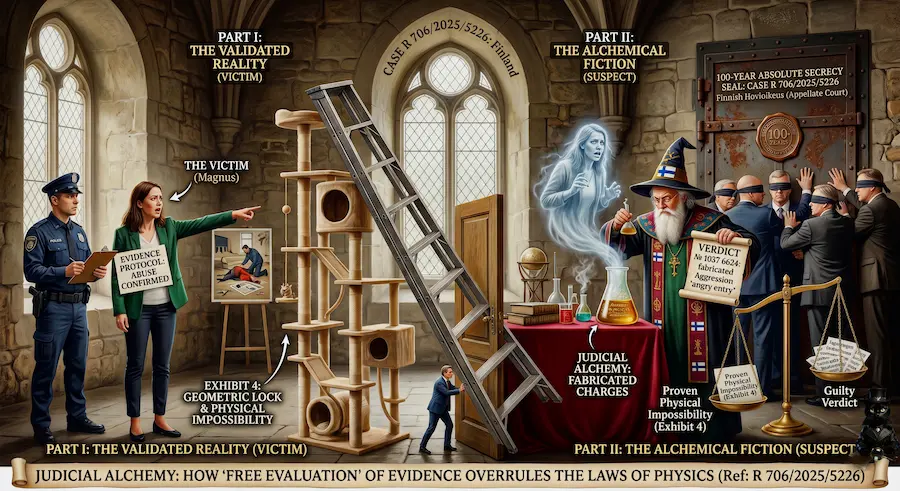
Judicial Alchemy infographic for The Victim-Suspect Split Case (Ref: R 706/2025/5226) in Finland.

The Opening Salvo:

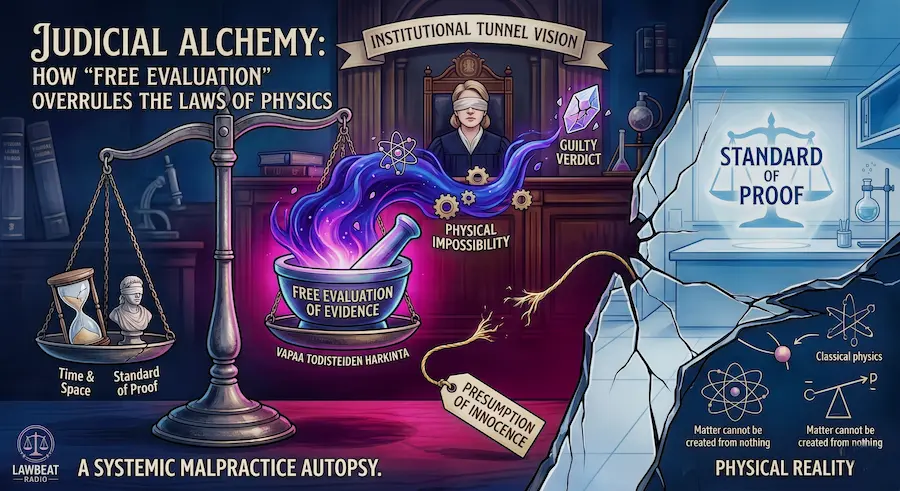
“In classical physics, matter cannot be created from nothing. However, in the Finnish legal room, a specific form of alchemy exists known as vapaa todisteiden harkinta (Free Evaluation of Evidence). This is a ‘magical’ procedural loophole where a total lack of evidence, multiplied by a proven physical impossibility, suddenly crystallizes into a guilty verdict. When the cold reality of physics contradicts the prosecution’s narrative, the court simply enters ‘flight mode,’ abandoning the Standard of Proof to protect the systemic status quo. We are beginning the forensic autopsy of this process.”

This forensic autopsy focuses strictly on the fabricated phase of The Victim-Suspect Split Case (Ref: R 706/2025/5226). Under this single registry number, the court attempted an institutional camouflage: fusing the documented, validated reality of a verified victim (Part I) with a fabricated, alchemical fiction of a perpetrator (Part II). When the cold reality of physics and geometry contradicts the prosecution’s narrative, the court simply enters ‘flight mode,’ abandoning the Standard of Proof to protect the systemic status quo.


##The Death of Physics in the Courtroom

The most alarming aspect of this Legal Room is the total dismissal of Physical Impossibility. In any rational jurisdiction, if the defense substantiates that an act was physically impossible to perform—due to time, space, or structural constraints—the case must be summarily dismissed.

In The Victim-Suspect Split Case (Ref: R 706/2025/5226), this fundamental law of reality was simply ignored. The prosecution’s fabrications collapse immediately when confronted with the static geometry of the scene (Exhibit 4).

The objective physical constraints are absolute:

  • The Structural Obstruction: A permanent, heavy floor-to-ceiling cat scratching structure completely blocks the vertical and horizontal clearance of the narrow stairwell opening.

  • The Door Angle Veto: The door at the scene was only slightly ajar, wedged in a tight, restricted angle by a chair. This minimal gap creates a permanent geometric lock. It is three-dimensionally impossible to deploy, swing, or drop a heavy, 10-kilogram metal stepladder (jakkara) through this obstructed space without violating the laws of physics and spatial geometry.

However, under the guise of ‘free evaluation’ (vapaa todisteiden harkinta), District Judge Inga-Liisa Paavola operated as if geometry is merely a ‘defense suggestion.’ When the prosecution lacks a single shred of Reliability of Evidence, they rely on Tunnel Vision to bridge the physical gaps, converting a geometric impossibility into an alchemical guilty verdict (Verdict № 1037 6624).

##The Severed Golden Thread

By ignoring the Presumption of Innocence, the Finnish court effectively shifts the Burden of Proof onto the accused. This is the exact moment the ‘Golden Thread’—so eloquently defended in Woolmington v DPP-is severed.

In The Victim-Suspect Split Case (Ref: R 706/2025/5226), this inversion of justice is institutionalized. The court bypassed Directive (EU) 2016/343, which strictly mandates that the burden of proof remains with the prosecution throughout the entire proceedings.

When a defendant is forced to ‘disprove’ a fabrication that is already proven to be a Physical Impossibility (as demonstrated by the spatial lock in Exhibit 4), the law ceases to be a shield. It becomes a weapon of Institutional Malpractice. Under Verdict № 1037 6624, instead of ruling In Dubio Pro Reo, the court demanded that the defense perform the impossible: disprove an alchemical myth created in a vacuum.


## The Judicial Illusion of the "Unclaimed" Alternative Perpetrator

A definitive proof of institutional malpractice inside The Victim-Suspect Split Case (Ref: R 706/2025/5226) is captured in the court’s own written rationale. In Verdict № 1037 6624, District Judge Inga-Liisa Paavola explicitly states:

“Käräjäoikeus ei myöskään pidä todennäköisenä kokonaistilanne huomioiden, että tikkaiden heittäjä on voinut olla muu henkilö kuin [vastaaja], eikä näin ole väitettykään.”

[English Translation]: “Taking the overall situation into account, the District Court also does not consider it probable that the person who threw the ladder could have been any person other than the accused, nor has such a claim been made.”

This single sentence represents a total collapse of the criminal Standard of Proof.

By using the phrase “does not consider it probable”, the court downgraded the strict requirement of Beyond a Reasonable Doubt to a mere civil balance of probabilities. Furthermore, the cynical addition “nor has such a claim been made” exposes a direct violation of Directive (EU) 2016/343.

Under the Presumption of Innocence, the defense is under no legal obligation to substitute for a lazy police investigation, nor to identify or capture an Alternative Perpetrator. The defense’s sole duty is to establish that the accusation is a Physical Impossibility (Exhibit 4). By demanding that the accused “prove” who else could have done it, the court severed the Golden Thread of law, converting a failure of prosecution into an automatic assumption of guilt.


An infographic titled Judicial Alchemy illustrating how free evaluation of evidence or vapaa todisteiden harkinta overrules the laws of physics and physical impossibility, featuring scales of justice, a broken presumption of innocence tag, and a blindfolded judge.

The Textual Transmutation (Grammar vs. In Dubio Pro Reo)

Under the section of vapaa todisteiden harkinta (Free Evaluation of Evidence), the Finnish court assumes the right to evaluate oral testimony freely. However, in The Victim-Suspect Split Case (Ref: R 706/2025/5226), this evaluation crossed the line into literal textual manipulation.

When the golden thread of the Presumption of Innocence is severed, the court must find a way to artificially eliminate Reasonable Doubt. During the oral trial, the prosecution’s entire narrative collapsed when the accuser admitted that he “did not see” who threw the object, as his head was physically outside the doorway. A total lack of visibility equals zero Reliability of Evidence.

To bridge this fatal gap, District Judge Inga-Liisa Paavola executed a classic alchemical transmutation. In the written verdict (№ 1037 6624), the court micro-injected the word “kunnolla” (properly/clearly) into the official record. Through this creative editing, the absolute statement “he did not see” was manipulated into “he did not see clearly” (“ei ollut kunnolla nähnyt”).

This is how Tunnel Vision operates under the guise of free evaluation: the judge manufactures a fictional “vague identification” out of a total lack of evidence, explicitly violating the constitutional principle of In Dubio Pro Reo.

## The Paranormal Mens Rea (Premeditation in a Vacuum)

When a specific intent (Mens Rea) cannot be found, the court turns to speculative storytelling to rescue a collapsed accusation. In this case, the court accepted a timeline that replaces rational judicial reasoning with scientifically impossible assumptions.

The oral narrative underwent a radical mutation from the pre-trial phase to the final verdict. What began as a spontaneous reactive dispute suddenly turned into a calculated, hours-long premeditated ambush. The court accepted as a proven fact that the accused stood behind a closed door, waiting for the exact minute-04:45 AM-when the accuser’s wireless headphone batteries would run out, to launch an assault.

The verdict leaves a massive scientific void: it fails to explain how a human being can monitor the real-time battery percentage of a third-party electronic device from behind a solid wall and closed door. When a court uses “telepathic” speculation to prove premeditation, the Standard of Proof is not just abandoned-it is entirely buried to protect a fabricated case.

## The Structural Veto (The Shield for Institutional Malpractice)

The physical reality of the scene-the permanent, undisturbed floor-to-ceiling structures blocking the vertical and horizontal trajectory (Exhibit 4) stands as an  unalterable proof of Physical Impossibility.

To protect this alchemical verdict from being exposed by independent forensic and cognitive experts, the system triggered its final defensive mechanism: The 100-Year Absolute Secrecy Seal. By placing a maximum century-long classification on the file (Salassapitopäätös) and responding with absolute administrative silence to the defense’s formal demands for the official trial audio logs, the court attempts to insulate its “literary creativity” from professional legal audit.

This systemic manipulation exposes the split nature of the case: hiding the fabricated phase behind an iron curtain of administrative silence. By locking the physical reality away from independent legal audit and violating international fair trial standards, the court attempts to insulate its “literary creativity” from accountability, effectively burying The Victim-Suspect Split Case (Ref: R 706/2025/5226) in dark, century-long bureaucratic secrecy.

Forensic FAQ: Deconstructing the Legal Fiction

In specific legal jurisdictions, the principle of Free Evaluation can lead to a “procedural anomaly” where the court prioritizes subjective interpretation over Physical Impossibility. When a verdict is reached despite a demonstrated inability to perform an act due to constraints of time, space, or biology, the law effectively bypasses the Standard of Proof to maintain the prosecution’s narrative.

Yes. Tunnel Vision occurs when the investigative process becomes rigidly fixed on a single theory, leading to Institutional Malpractice. By failing to investigate an Alternative Perpetrator, the authorities inadvertently shift the Burden of Proof onto the accused. This compromise severs the fundamental protection of the Presumption of Innocence, as established in international human rights standards.

The core requirement of In Dubio Pro Reo dictates that any doubt must result in a decision for the accused. When the Reliability of Evidence is compromised by a total lack of Specific Intent (Mens Rea) or empirical data, any resulting “Guilty” verdict becomes a “procedural fiction.” Adherence to the Standard of Proof is the only safeguard against such systemic failures.


vapaa todisteiden harkinta 

  • Free Evaluation of Evidence

  • In Dubio Pro Reo 

  • Standard of Proof 

  • Reliability of Evidence

  • Physical Impossibility 

  • Presumption of Innocence 

  • Institutional Malpractice