
Independent monitoring of systemic procedural violations
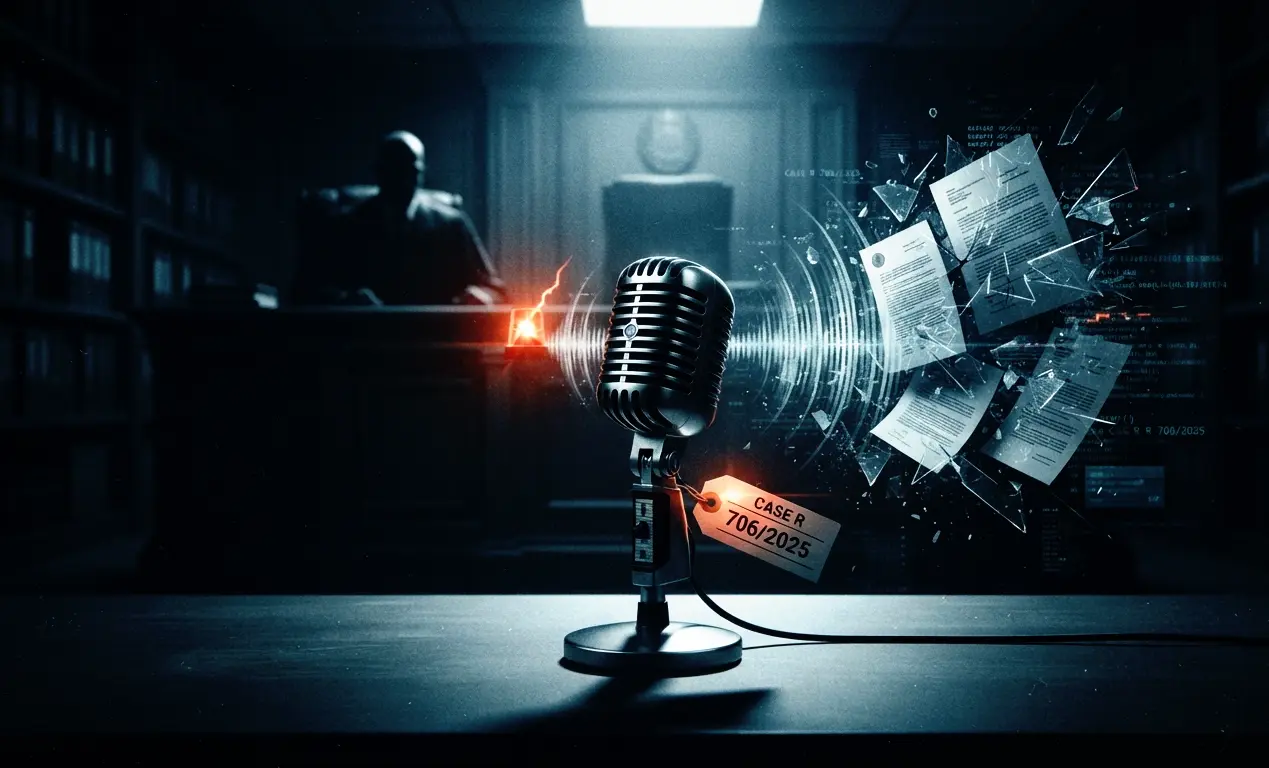
Case R 706/2025/5226 Analysis
Justice should not be a silent agreement between bureaucratic entities. It must be heard.
The case R 706/2025/5226 raises a more fundamental question: what happens when an initial report of violence later becomes a “mutual conflict” narrative without the intervening evidentiary steps being made clear? The Sound of Justice examines that transformation through the documents themselves – the police report, the subsequent statements, the physical evidence, and the judgment. We are deconstructing the narrative, one fact at a time.
In Case R 706/2025/5226, the Helsinki Police responded to a domestic-violence call at approximately 04:45 AM. The initial police report records that N had already left when the patrol arrived. It records allegations of threats and violence against TG and contains no allegation that TG had attacked N or posed a danger to the children. The same report records that the three responding officers advised O that she could take the children and stay temporarily at TG’s home.
That is where the documentary record begins. The later “mutual conflict” narrative requires examination against it.
The record shows that both parties ultimately became defendants in the same criminal case and both received 25 day-fines. But equal procedural treatment does not establish equal evidentiary foundations.
The question is not whether the final case looked symmetrical. The question is how the case became symmetrical – and what happened to the evidence that existed before that symmetry appeared.
The structural integrity of this “symmetry” depends on the later “kitchen ladder” and “chairs” narrative. But does the documented evidence support the physical reconstruction presented in the case?
The final judgment imposed identical penalties of 25 day-fines on both parties. Does that symmetry reflect the evidentiary record, or does it create the appearance that the underlying events were equivalent?
The judgment states that the court did not consider it probable that the ladder had been thrown by anyone other than TG, and notes that no alternative perpetrator had been alleged.
But why should the absence of an alternative perpetrator in the defence case resolve the separate question of whether the prosecution independently established TG as the person who threw the ladder?
That is the evidentiary question the symmetry of the final outcome does not answer.
Analytical Manifesto
Having a Law Degree prepares you for a court of law. It does not, however, prepare you for the possibility that the institutional process itself may produce conclusions that appear inconsistent with the evidence.
Modern justice systems invest heavily in presenting the rule of law as a foundation of public trust. That trust is necessary. But what happens when the documents produced by the system do not appear to match the reality they are supposed to record?
This is the question at the heart of The Sound of Justice.
While universities teach the importance of the PRESUMPTION OF INNOCENCE, what happens when a prosecution advances a charge that the physical evidence appears unable to support? What happens when PHYSICAL IMPOSSIBILITY is not resolved, when potentially relevant ALTERNATIVE PERPETRATORS are dismissed without a demonstrated factual basis, or when contradictions in the evidence remain unexplained?
What happens to in dubio pro reo when unresolved evidentiary gaps are treated as though they were resolved? What happens to RELIABILITY OF EVIDENCE when the same evidence is accepted for one purpose without addressing the contradictions surrounding it?
And what happens to MOTIVE AND INTENT when the factual circumstances surrounding the alleged act remain unexplained?
These are not abstract academic questions in Case R 706/2025/5226. They are questions raised by the record itself. When institutional presentation begins to substitute for the STANDARD OF PROOF, what remains of the rule of law? And when the evidence, the physical scene, the testimony and the judgment do not fully align, who is responsible for making those contradictions visible? That is why this blog exists.
A systematic audit of Case R 706/2025/5226 identifies ten distinct areas requiring examination against the standard of proof, in dubio pro reo, and the reliability of evidence:
1. Physical Impossibility: The Documented Scene: The police photographed the scene within minutes of the incident.
According to N’s own account, the reason he returned to the apartment was that the battery in his wireless headphones had run out and he wanted to retrieve them.
This creates a precise timing problem.
The version ultimately accepted by the Court places TG upstairs before N’s arrival and has the alleged ladder throw occurring “just as” N entered the apartment.
That means the accepted physical scenario requires the following sequence:
04:45 a.m. → N unexpectedly returns because his headphone battery has run out → TG is already upstairs → N enters → the ladder is immediately thrown from above.
The critical question is not whether such an event can be imagined after the fact. The question is what evidence establishes that TG could have known that N would return at that particular moment.
The stated trigger for his return was the depletion of his headphone battery. Nothing in the evidence quoted here establishes that TG knew in advance that his headphones would run out, when he would return, or that he would enter the apartment at 04:45 a.m.
Yet the accepted reconstruction requires her to be positioned upstairs and ready for precisely that event.
That is not a minor detail. It is a necessary part of the alleged mechanism.
The evidence establishes N’s stated reason for returning. The judgment does not establish how the alleged ambush could have been anticipated.
The physical scenario therefore contains an unexplained temporal step: the alleged perpetrator is already in position before the N’s return, although the stated reason and timing of that return arose from the N’s own circumstances.
4. Judicial Rewriting. From Not Seeing the Throw to “Not Properly Seeing” It: The problem here is not interpretation. It is wording.
N’s own account placed a physical limitation on what he could see at the critical moment: his head was behind the doorway. He explained that he did not see who threw the object because he was not in a position to see the throwing itself. He further explained that putting his head through the doorway would have exposed it to the falling object.
The judgment reduces this evidentiary limitation to a materially different formulation. In describing the evidence supporting N’s account, the judge writes:
“ettei sinänsä tarkalleen ole nähnyt tikkaiden heittämistä”
and elsewhere characterises his account as one in which he had not properly seen the throwing itself.
That wording matters.
There is a substantial difference between:
“He did not see who threw the object because his head was behind the doorway.”
and:
“He did not properly see the throwing.”
The first describes a categorical limitation on identification: the critical act occurred outside his field of vision.
The second can be read as an incomplete observation – as though N saw the event but failed to see it clearly.
That distinction becomes critical when the same judgment uses N’s account to identify TG as the person who threw the ladder.
The evidentiary record therefore requires the reader to distinguish between what N actually claimed to have seen and how the judgment subsequently characterised the limitation on his observation.
This is not a dispute over literary style. The wording changes the evidentiary significance of the testimony.
If the witness did not see the throw or the person who performed it, the testimony cannot be presented as though it supplied visual identification merely imperfectly.
The question is therefore precise:
Did the judgment accurately reproduce the evidentiary limitation in N’s testimony, or did the wording transform a lack of visual identification into an imperfect visual observation?
The underlying record should decide that question – not the later wording of the judgment.
5. Shifting the Burden of Proof: The judge explicitly based the conviction on a “probability” assessment, stating the court did not consider it “probable” that anyone else committed the act. Did the court require the prosecution to establish TG’s guilt from the evidence presented, or did it effectively exclude an alternative perpetrator merely because the court did not consider that alternative “probable”?
The judgment expressly addresses the possibility of another person having thrown the heavy ten-kilogram oak-and-metal stepladder. Rather than identifying or excluding such a person on the basis of established evidence, the court states that it does not consider this probable, while also noting that no such alternative was alleged. The court’s exact wording is:
“Käräjäoikeus ei myöskään pidä todennäköisenä kokonaistilanne huomioiden, että tikkaiden heittäjä on voinut olla muu henkilö kuin TG, eikä näin ole väitettykään.”
“The District Court also does not consider it probable, considering the overall circumstances, that the person who threw the ladder could have been someone other than TG, nor has this been alleged.”
The judgment expressly relies on a probability assessment when addressing whether another person could have thrown the ladder. The question is not whether the court was required to identify an alternative perpetrator. The question is whether the prosecution had established, on the evidence, that TG was the person who threw the ladder, rather than treating the absence of a “probable” alternative perpetrator as support for her guilt.
“TG on tehnyt … ruumiillista väkivaltaa heittämällä tätä tikkailla siten, että tikkaat ovat osuneet N reiteen…”
English: “TG subjected N to physical violence by throwing a heavy ten-kilogram oak-and-metal stepladder at him, such that the ladder struck N in the thigh…” .
The evidentiary problem is therefore precise: a WhatsApp photograph depicting scratches on an unidentified shin is treated in the judgment as evidence of an alleged impact to the thigh. The photograph does not establish whose leg is shown, which leg it is, when the image was taken, or how the scratches were caused. Nevertheless, the anatomical location stated in the evidence and the anatomical location stated in the verdict are different.
This is not a matter of terminology. The shin (sääri) and the thigh (reisi) are different anatomical regions. The question is how an image documenting an unidentified injury to one anatomical region became evidence for an alleged impact to another.
9. Appellate Paralysis ? When the Remedy Arrives After the Complaint Window: The main trial took place on 1 October 2025.
The appeal hearing is scheduled for 6 October 2027.
That is two years and five days after the trial itself.
The distinction matters.
The Finnish official guidance states that, as a general rule, a complaint cannot concern matters that occurred more than two years earlier. It also states that a complaint cannot generally be filed while the matter is still before a court or under appeal.
This creates a precise procedural question in this case.
If the conduct complained of occurred during the 1 October 2025 trial, the ordinary two-year period reaches its end on 1 October 2027.
The appeal hearing is scheduled for 6 October 2027. Five days later.
This does not establish that the appeal date was deliberately chosen to defeat a complaint. The documents presently establish the dates, not the intention behind them.
But the dates themselves create an accountability problem that cannot simply be ignored:
If the case remains under appeal until five days after the two-year period has expired, and a complaint cannot generally be brought while the case is pending on appeal, when can the conduct of the original trial receive external administrative scrutiny?
The appeal and a complaint are not the same mechanism. An appeal challenges the judicial decision. A complaint concerns the conduct of an authority.
So if one mechanism is unavailable while the other is pending, and the pending proceeding itself extends beyond the ordinary complaint period, the question becomes unavoidable:
Where is the independent oversight mechanism during those two years – and what remains available when the two-year period has passed?
The answer matters not only to this case, but to the system’s ability to identify and correct procedural failures before the opportunity for external review disappears.
10. A 100-Year Black Box? No Forensic Audit, Then 100 Years of Secrecy: The evidentiary record raises another problem before the appeal even begins.
The pre-trial investigation contained one recorded interrogation, while the available record does not show a forensic reconstruction of the alleged incident, an independent examination of the disputed physical scene, or a forensic examination establishing the mechanism by which the alleged injury was caused.
No trajectory reconstruction.
No independent examination of the alleged weapon/object.
No documented forensic analysis establishing how the alleged ladder could have passed through the photographed doorway configuration.
No independent forensic examination establishing whether the photographed scratches corresponded to the injury described in the charge.
Instead, key evidentiary material is now behind a 100-year administrative secrecy period.
That creates a particularly difficult situation for independent review.
The disputed photographs include the physical scene itself – including the area containing the cat houses – and the photograph relied upon in connection with the alleged injury.
The public cannot independently examine the underlying material. The defence cannot use the sealed material to conduct an independent forensic audit.
And the appeal process must therefore operate against an evidentiary record whose underlying visual material cannot be independently scrutinised outside the restricted proceedings.
Why 100 Years?
The question is not whether every piece of evidentiary material should automatically be made public.
The question is narrower:
What specific information in these materials requires protection for 100 years?
Why must the entire relevant material remain sealed rather than the genuinely protected information being redacted?
Why can the physical configuration of a doorway, pallet and cat houses not be independently examined?
Why can an image containing no identifiable people or animals require a century of secrecy?
And if the secrecy order covers material that is central to testing the physical plausibility of the prosecution’s reconstruction, how is independent verification supposed to occur?
These questions become more significant because the pre-trial record does not appear to contain the forensic work that could otherwise answer them.
The result is a closed evidentiary loop:
Limited investigation → no documented forensic reconstruction → key visual evidence sealed for 100 years → no independent audit → appeal against a record that cannot be independently tested.
That does not by itself prove that evidence was deliberately concealed.
It establishes something more concrete:
The very evidence needed to independently test the disputed physical reconstruction is unavailable for independent examination.
And when the alleged incident depends on physical geometry, object weight, trajectory, point of impact and anatomical location, that is not a minor procedural inconvenience.
It goes to the ability to test the evidence itself.
Theodore Roosevelt
“No man is above the law and no man is below it; nor do we ask any man’s permission when we require him to obey it.”
The audit identifies specific issues requiring examination under the Constitution of Finland, the Code of Judicial Procedure, and Article 6 ECHR:
Legal Framework: Section 21 of the Constitution of Finland; Article 6 ECHR.
Violations in the Audit:
Legal question: whether the duration of the appellate proceedings and the restrictions on examination of central evidence are compatible with these guarantees.
Martin Luther King Jr.
“Injustice anywhere is a threat to justice everywhere.”
Legal Framework: Chapter 17 of the Code of Judicial Procedure; Section 21 of the Constitution of Finland; Article 6 ECHR..
Violations in the Audit:
Lord Denning
“Be you never so high, the law is above you.”
Legal Framework: Chapter 17 of the Code of Judicial Procedure (4/1734), governing evidence rules in Finnish criminal proceedings. While judges possess procedural discretion in weighing evidence, that discretion is strictly and legally bound by logic, objective physics, and material truth.
Violations in the Audit:
John Locke
“Wherever law ends, tyranny begins.”
Legal Framework: Statutory procedural requirements governing the absolute integrity, verifiability, and transparency of official court protocols and digital archives.
Violations in the Audit:
5495FBB7 vs. D125A37A.Independent legal media platform focusing on structural judicial monitoring and criminal case analysis. We examine international standards of justice, from the presumption of innocence to the rigorous evaluation of the standard of proof and in dubio pro reo principles.
All analytical materials and legal case reviews on this website are published for informational and educational purposes only under freedom of expression. Content does not constitute professional legal advice.
© 2026 LawBeatRadio. All rights reserved.