LawBeat Radio Investigative Audit

Next-Gen Judicial Monitoring of Procedural Fraud

Next-Gen Judicial Monitoring of Procedural Fraud

Systemic Audit Log: Case Anomalies

  • Physical impossibility: The verdict finds the defendant guilty of acts that defy the laws of physics, documented directly by the police’s own photographs.
  • Shifting testimonies: The accuser’s story morphed continuously on the record.
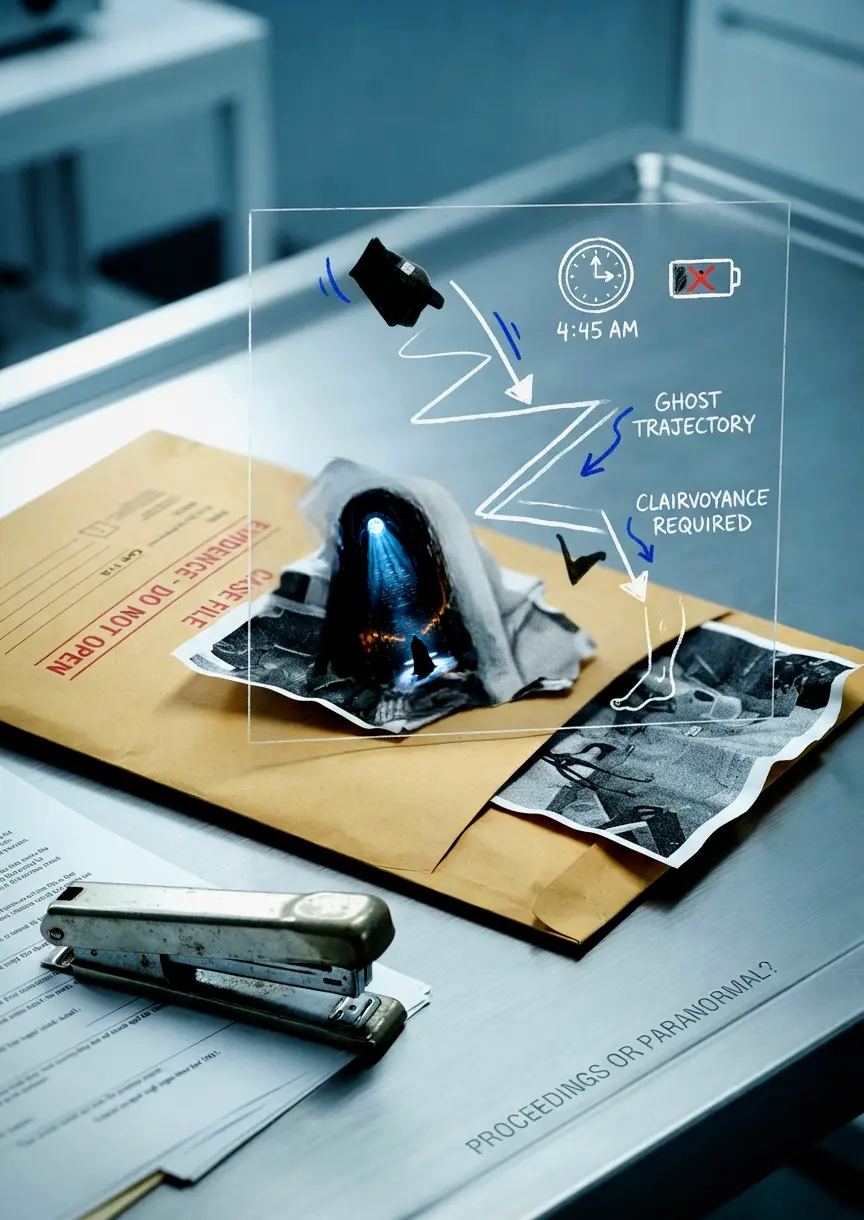
  • Mandated clairvoyance: The court legally expected the defendant to foresee precisely when the accuser’s headphones would run out of battery.
  • Judicial rewriting: The judge manually altered the accuser’s testimony from “saw nothing at all” to “saw unclearly.”
  • Judicial shifting of the burden of proof: The judge explicitly bases the conviction on a ‘probability’ assessment, stating that the court does not consider it ‘probable’ that anyone other than the defendant could have committed the act. In doing so, the court reverses the burden of proof and ignores the presumption of innocence, effectively demanding that the defendant disprove a ‘probability’ rather than requiring the prosecution to prove guilt beyond a reasonable doubt.
  • Anatomical fiction: Photographs of alleged damage show a lower leg (shin), while the verdict claims the impact hit the thigh.
  • Defying gravity: Scratches on the side of a shin were ruled as damage caused by a 10 kg object pressing down from directly above.
  • Tampered records: The official verdict claims the trial lasted 2.5 hours, yet the court audio provided for appeal is split into two parts, stripped of metadata, and totals only 77 minutes.
  • Appellate paralysis: The appeal hearing was scheduled 22 months after filing.
  • Total stonewalling: Requests to lift the secrecy order on evidence for an independent audit were met with absolute silence.
Analytical Summary: This catalog of systemic failures highlights an institutional breakdown where reliability of evidence is entirely discarded in favor of predetermined administrative outcomes. Upholding in dubio pro reo requires exposing every layer of this manufactured fraud.

CORE AREAS OF SYSTEMIC MONITORING

Next-gen judicial monitoring and digital forensics analysis by LawBeatRadio

Pursuant to Article 15 of the Treaty on the Functioning of the European Union (TFEU)

“In order to promote good governance and ensure the participation of civil society, the Union’s institutions, bodies, offices and agencies shall conduct their work as openly as possible.”

LawBeatRadio conducts independent public monitoring of systemic violations of procedural rights. We expose the mechanisms by which investigative authorities and courts manufacture evidence and turn justice into “literary fiction,” systematically ignoring procedural directives, the laws of physics, and the fundamental standard of Beyond Reasonable Doubt.

Current Focus

Breach of Directives 2012/13/EU and 2013/48/EU (The Right to Information and Access to a Lawyer in Criminal Proceedings).

BLOCK I: PROCEDURAL AMBUSH & STATUS MANIPULATION

The “Train Interrogation” vs. EU Directives 2012/13/EU & 2013/48/EU
The first and most critical violation documented in Complaint № CPLT(2026)00844 occurred during the pre-trial investigation phase in Finland. It was not a procedural error; it was a deliberate “Procedural Ambush” designed to strip the individual of their Right to Defence.

1. THE FACTUAL VIOLATION: THE “MOBILE TRAP”

Date: April 24, 2024

Location: A noisy train/train station (in transit).

A. Deceptive Procedural Conduct

  • Status Shift: The formal interrogation at the police station concluded while the individual held the status of Victim (Asianomistaja). However, immediately after, the investigative authorities initiated a critical follow-up interrogation via mobile phone, secretly changing the individual’s legal status to Suspect without notification.
  • The Intent: By concealing this change, the police bypassed the mandatory requirement to provide a defence lawyer and read the suspect their rights.

B. Environmental Coercion & Reliability

  • Physical Duress: The interrogation was forced upon the individual in a high-stress, noisy environment (train station) with poor mobile connectivity. The investigator ignored the individual’s transit status and impossible acoustic conditions, pressuring them to provide statements under psychological duress.
  • Lack of Verification: The resulting protocol lacks the individual’s signature. Despite the pre-printed claim “Read, given for inspection and approved,” the document was never authorized, read, or verified by the suspect.

2. LEGAL ANALYSIS: BREACH OF EU DIRECTIVES

Procedural Ambush: The Concealment of Legal Status
The critical violation during the “mobile interrogation” was not the absence of an interpreter, but the deliberate concealment of changes in legal status:

  • The “Victim” Mask: Throughout the telephone interrogation, the investigator and the interpreter proceeded as if the individual was still providing clarifications as a Victim (Asianomistaja).
  • The Failure to Notify: At no point was the individual informed that they had been formally reclassified as a Suspect. The header of the protocol—which identified the individual as a suspect—was never read aloud or translated during the call.
  • The “Surprise” Verdict: The individual only discovered they were a suspect upon receiving the formal summons to the District Court.
  • Legal Impact: Under Directive 2012/13/EU (Article 3), notification of rights and status must be prompt. Using a “victim’s clarification” to extract statements that are later used for an indictment is a deceptive practice that invalidates the reliability of the evidence.

The administrative practice of the Finnish police in this case directly contradicts the Charter of Fundamental Rights of the EU and specific Directives:

  • Directive 2013/48/EU (Article 3): Access to a lawyer must be granted without undue delay as soon as a person becomes a suspect. In this case, the police waited until the individual was in a vulnerable state (in transit, no counsel) to “activate” the suspect status.
  • Directive 2012/13/EU (Articles 3 & 4): The “Letter of Rights” must be provided promptly. The suspect was never cautioned and never received a translation of their rights, violating the right to information on procedural safeguards.
  • Article 6 ECHR (Right to a Fair Trial): The use of deceptive means to extract self-incriminating statements renders the entire judicial process unfair from the outset.

3. PRECEDENTS: THE “SALDUZ” STANDARD

The European Court of Human Rights (ECHR) has been crystal clear on such tactics:

  • Salduz v. Turkey (36391/02): The ECHR established that the right to a lawyer must be provided from the very first interrogation. Statements obtained without a lawyer at this stage poison the entire legal process.
  • Brusco v. France (1466/07): The court ruled that a person must be informed of their rights as soon as they are no longer a mere witness but a suspect. “Stealth” status changes are a manifest violation.

4. SYSTEMIC CONTEXT: INFRINGEMENT 2021/2110

  • Not an Isolated Mistake: This violation is a textbook example of the systemic failures for which the European Commission has already opened Infringement Procedure № 2021/2110 against Finland.
  • EU Scrutiny: Finland is currently under scrutiny for the incorrect transposition and application of Directive 2013/48/EU.
  • Our Position: My case serves as empirical evidence that the Finnish police continue to utilize systemic loopholes to bypass EU human rights standards.

Conclusion for Block I

The “Train Interrogation” was a coordinated effort to manufacture a confession while depriving the suspect of their Right to Silence and Right to Counsel. A protocol that is unsigned, unverified, and obtained under duress is legally null and void. Evidence obtained through such deceptive “mobile interrogation” is inadmissible under EU law. This was not an investigation; it was a procedural fraud.

Block II: Judicial Tampering & Factual Distortion

The “Literary Creativity” of Judge Inga-Liisa Paavola vs. EU Law

In its response, the European Commission claims it cannot interfere in the “assessment of evidence.” However, The Victim-Suspect Split Case R 706/2025/5226 (Helsingin käräjäoikeus) is not about a “different interpretation” of facts—it is about the fabrication of facts by the District Court of Helsinki.

1. The Linguistic Fraud: “Did not see” vs. “Did not see clearly”

The most severe breach of judicial integrity occurred when the Presiding Judge, Inga-Liisa Paavola, intentionally altered witness testimony in the written verdict (Verdict No. 1037 6624).

The Trial Truth: The accuser explicitly admitted he did not see who threw the object, noting his head was still outside the doorway.

The Judicial Fabrication: In the written judgment, the Judge substituted “did not see” with the fabricated phrase “did not see clearly” (ei ollut kunnolla nähnyt itse heittotilannetta).

Legal Strike: This is a manifest violation of Directive (EU) 2016/343 (Presumption of Innocence). The judge “improved” the prosecution’s weak evidence to eliminate Reasonable Doubt, effectively reversing the burden of proof.

2. The “Headphone Battery” Absurdity: Mystical Reasoning

The Court accepted a narrative that defies the laws of physics and human logic:

  • The Claim: The defendant allegedly “waited in ambush” for hours, timing the assault for the exact second the accuser’s headphone batteries would run out.
  • The Absurdity: The Court failed to provide any rational explanation as to how a defendant could monitor the real-time battery percentage of a third-party electronic device from behind a closed door.

Legal Strike: Convicting a citizen based on “mystical” or “paranormal” assumptions violates Art. 47 of the Charter (Right to a Fair Trial). Judicial reasoning must be rational, not speculative.

3. The Collapse of Consistency: Ambush or Accident?

The Court labeled the accuser’s testimony as “consistent” (muuttumaton), ignoring a radical shift in the core narrative:

  • Version A (Pre-trial): The accuser claimed the defendant was awakened by noise and reacted.
  • Version B (Court): The accuser claimed the defendant was waiting in ambush (premeditated).
  • The “Chair” Myth: The accuser initially claimed “multiple chairs” were thrown, then reduced it to one once he realized there were no other chairs in the house.

Legal Strike: A witness who changes the “how, why, and when” of an incident is legally unreliable. By ignoring these contradictions, the Court demonstrated Objective Bias.

4. Legal Basis & Precedents

Kamasinski v. Austria (ECHR 9783/82): A fair trial requires that judgments accurately reflect the evidence. Deliberate distortion of witness statements is a breach of judicial integrity.
Directive (EU) 2016/343 (Article 6): Any doubt must benefit the accused. Here, the judge actively erased doubts by rewriting testimony.
The Rule of Law Principle: If a Member State’s judge is allowed to “author” a new reality to secure a conviction, the EU’s procedural safeguards are rendered illusory.
Detailed Analysis of Verdict № 1037 6624

Deconstruction of Judicial Fabrication & Probability Convictions

1. Evidence of Factual Manipulation (Page 4 of the Verdict)

In the section “Henkilötodistelulla saatu näyttö”, Judge Inga-Liisa Paavola records the accuser’s statement as follows:

“…vaikkakaan “Suspect-Victim” ei ollut kunnolla nähnyt itse heittotilannetta.”

The Fraud: The Judge inserted the word “kunnolla” (properly/clearly) to create a false impression of “partial visibility.” During the oral hearing, the accuser admitted he did not see the act because his head was outside the door. By adding “kunnolla”, the Judge converted a total lack of identification into a “vague identification,” deliberately manufacturing a basis for conviction where there was none.

2. Conviction Based on “Probability” (Page 5 of the Verdict)

The Judge openly abandons the “Beyond Reasonable Doubt” standard by stating:

“Käräjäoikeus ei myöskään pidä todennäköisenä… että tikkaiden heittäjä on voinut olla muu henkilö kuin ….”

The Legal Violation: Under Directive (EU) 2016/343, a criminal conviction cannot rest on what a judge considers “probable” (todennäköinen). If the court “does not consider it probable” that someone else did it, but lacks direct evidence that the defendant DID do it, the only legal outcome must be an acquittal. This sentence is a direct confession of judicial bias.

3. The Total Mutation of the Narrative: “Reactive Wake-up” vs. “Calculated Ambush”

The Judge’s claim that the testimony was “muuttumattomasti” (unchanged) is a direct falsification of the trial record. The accuser presented two fundamentally irreconcilable versions of reality:

  • The Pre-trial Fabrication (The Reactive Version): In the early stages (ETP), the accuser claimed he was awakened by noise and reacted to a spontaneous domestic dispute. In this version, the event was unplanned and chaotic.
  • The Trial Fabrication (The “Ambush” Version): By the time of the court hearing, the narrative had mutated into a premeditated ambush. The accuser claimed the defendant had been “lying in wait” for hours, specifically timing the attack for the moment his headphone batteries died.
  • The Physical Impossibility: The accuser initially described a “rain of chairs.” When the forensic photos proved no such chairs existed, the “chairs” evaporated from his testimony, replaced by a single “ladder-stool” to fit the available props in the room.

Legal Conclusion: A person cannot be simultaneously “awakened by a noise” and “waiting for an ambush for hours.” These are not “details”; they are two different crimes. By labeling these mutually exclusive stories as “consistent,” Judge Paavola committed a Gross Miscarriage of Justice. She intentionally ignored the collapse of the prosecution’s logic to maintain a “cohesive” narrative for conviction.

Block Iii: Institutional Concealment & Abuse of Secrecy

The Victim-Suspect Split Case Ref: R 706/2025/5226 (Helsingin käräjäoikeus)

1. The Violation: The 100-Year Cloak

The District Court has imposed a maximum 100-year secrecy seal on The Victim-Suspect Split Case R 706/2025/5226.

  • The Strategic Concealment: This extreme measure is not designed to protect the “privacy” of a domestic dispute, but to prevent independent forensic auditors from exposing the physical impossibilities and judicial fabrications documented in this case.
  • Shielding Incompetence: By sealing the file for a century, the Court ensures that its refusal to acknowledge the Laws of Physics (Block III) and its “literary editing” of witness testimony (Block II) remain beyond the reach of public scrutiny and professional legal audit.

2. EU Legal Basis & Precedents

Art. 47 of the Charter (Right to a Fair Trial): Public scrutiny is a core safeguard against judicial arbitrariness. A 100-year seal effectively eliminates the possibility of a transparent appeal process.
The “General Bad Practice” Standard: Using secrecy to bury a case where the evidence contradicts the verdict is the definition of Institutional Maladministration. It creates a “safe zone” for judicial malpractice.

Conclusion: The Wall Against Truth

The 100-year secrecy in The Victim-Suspect Split Case R 706/2025/5226 is an admission of guilt by the system. It serves one purpose: to ensure that no independent forensic analysis can ever be used to hold the presiding judge or the prosecution accountable for a scientifically impossible conviction.

The Disconnect Between Institutional Representation and Procedural Reality

The global authority and rigorous standards declared by European justice institutions paradoxically foster a false sense of procedural security among citizens. A heavy public focus on the “ideal model” of the rule of law routinely shifts societal attention away from systemic operational failures at the local level.

While supranational mechanisms consistently project a flawless commitment to the PRESUMPTION OF INNOCENCE, regional law enforcement practices frequently operate within an informational vacuum. The internal sabotage of European directives – as officially documented in Infringement Procedure № 2021/2110 – demonstrates how formal adherence to decorative judicial rituals can effectively mask critical defects regarding the RELIABILITY OF EVIDENCE.

This analysis serves to register this structural gap, utilizing a specific case study to demonstrate how local prosecution exploits the public’s unverified trust in the infallibility of the judicial system.

The procedural conduct in this case reflects a systematic disregard for fair trial standards. For a detailed breakdown of the chronological anomalies and documented irregularities, refer to our comprehensive Case Hearings & Evidence Log.

Top Secret Evidence Excerpt
CLASSIFIED
Helsinki Police CLASSIFIED TOP SECRET Document

Helsinki Police CLASSIFIED: TOP SECRET.

Centered on the wooden desk is an official Finnish police document, titled “ESITUTKINTAPÖYTÄKIRJA” (Pre-trial Investigation Record), prominently featuring red “CLASSIFIED: TOP SECRET” and “NO DISCLOSURE PERMITTED FOR 100 YEARS” stamps.

[STATUS: FABRICATION DETECTED]     |     [PHYSICS: VIOLATED]     |     [PRESUMPTION OF INNOCENCE: NULL]     |     [CASE R70620255226: CORRUPTED]     |     [100 YEARS SECRET: ACTIVE]     |     [JUSTICE: PENDING...]

LawBeat Radio | Join the Discussion

The transcripts, the audio logs, and the cold architecture of a fabricated case are now open to the public. When the machinery of prosecution replaces physical reality with courtroom fiction, silence is the only thing the system counts on. We are breaking that silence.

We invite you to step behind the desk, analyze the evidence, and dissect the mechanics of institutional failure. The discussion is live, unfiltered, and centered on absolute truth.

Enter the Forum & Join the Discussion

LawBeat Radio Forensic Audit Verdict: Exposing institutional fabrication requires collective analytical precision. Join the debate on ex.giart.vip and lawbeatradio.com.