
Independent monitoring of systemic procedural violations
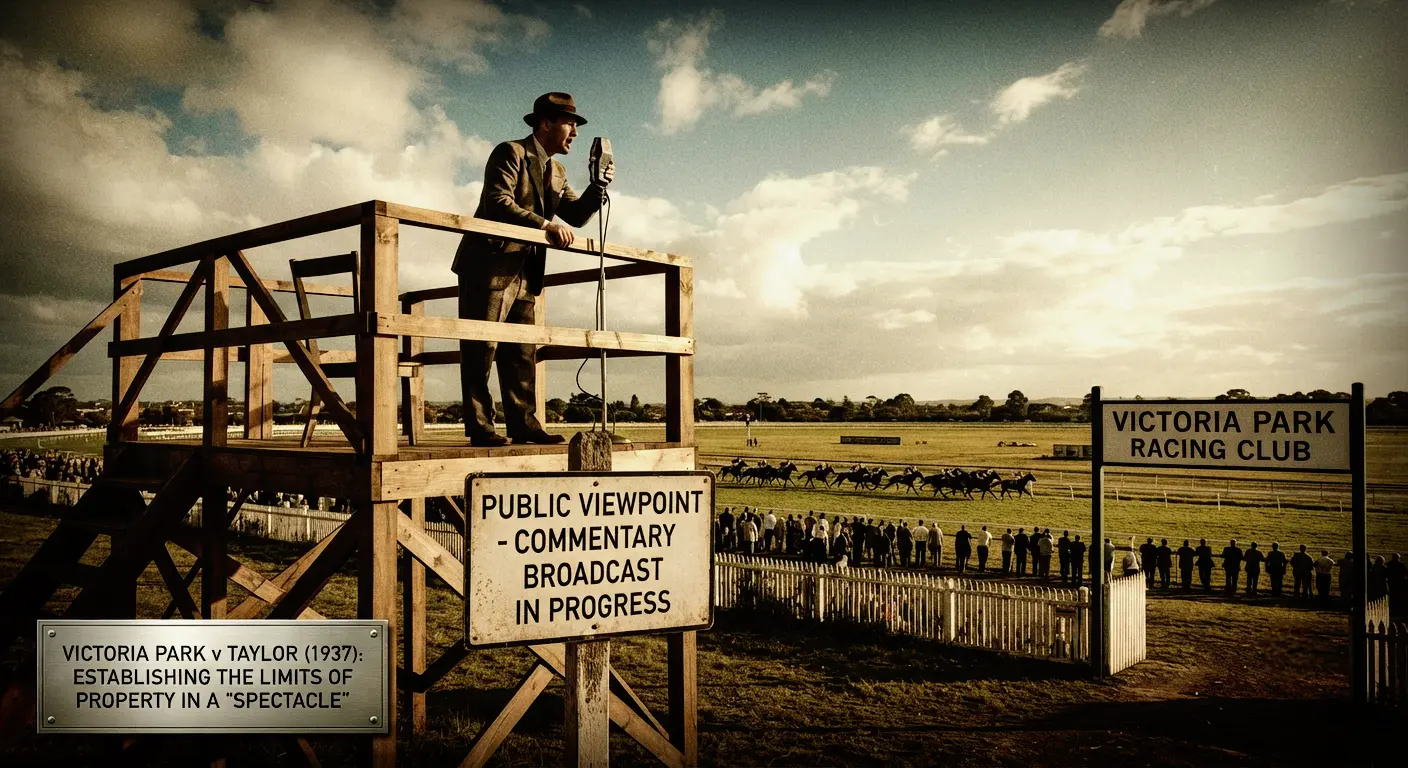
Victoria Park Racing and Recreation Grounds Co Ltd v Taylor
58 CLR 479 · [1937] HCA 45
High Court of Australia · 26 August 1937
Victoria Park Racing and Recreation Grounds operated a racecourse and organised commercial horse racing. The defendant, Taylor, acquired neighbouring land and constructed an elevated platform from which races could be observed. Broadcasting equipment was used to communicate descriptions of the races to listeners outside the racecourse.
The plaintiff sought legal relief against this activity. One part of the argument was that the expenditure involved in creating the racing spectacle gave the operator a legally protected interest in the spectacle itself – described in the litigation as a form of quasi-property.
The case therefore presented a fundamental question: does creating and financing an event create a proprietary legal right over what can be observed or communicated from neighbouring land?
The High Court of Australia dismissed the plaintiff’s claim. The judgment rejected the attempt to treat the racing spectacle itself as a form of proprietary subject matter merely because substantial resources had been invested in creating it.
The reasoning addressed several distinct legal propositions rather than creating a general licence to interfere with another person’s property.
The court did not recognise the spectacle as property capable of giving the plaintiff the exclusive legal control it sought. The fact that the plaintiff created the attraction and invested money in it did not, by itself, establish a proprietary monopoly over observation of the event.
The judgment also considered the absence of a general common-law right to prevent a neighbour from observing activities visible from their own property. The fact that such observation may be unwanted does not, without an established legal cause of action, automatically create a right to judicial intervention.
An important part of the judgment concerned privacy. Latham CJ considered the argument that the defendant’s activities interfered with the plaintiff’s privacy, but observed that no general common-law right of privacy had been established that could provide the requested relief.
This is historically significant because the court did not simply ask whether the defendant’s conduct was intrusive or commercially undesirable. It asked whether the law recognised a corresponding legal right that had been infringed.
A factual intrusion is not automatically a legal wrong. The cause of action must exist in law.
The importance of Victoria Park lies in the distinction between factual control and legal entitlement.
A person may spend substantial resources creating something valuable without thereby acquiring every legal right that might be economically desirable. Courts determine whether the claimed interest corresponds to a recognised legal right, property interest, tort or other cause of action.
The case therefore provides a useful analytical discipline: identify the legal right first, then ask whether the conduct infringes that right.
Victoria Park should not be read as establishing that every form of observation, recording, broadcasting or interference with another person’s property is lawful. The decision concerned the causes of action and legal rights advanced in that particular litigation.
Its enduring value is narrower and more precise: courts do not create a proprietary right merely because an activity has commercial value, substantial investment or a strong expectation of exclusivity.
The legal analysis must remain tied to the specific right asserted and the specific conduct challenged.
Victoria Park Racing and Recreation Grounds Co Ltd v Taylor remains a useful illustration of a basic common-law discipline: the existence of a factual or economic interest does not, by itself, determine the existence of a legal right. The decisive step is identifying the legal basis on which protection is claimed.
| TYPE | REFERENCE |
|---|---|
| PRIMARY SOURCE |
|
| OFFICIAL JUDGMENT |
|
| CASE MATERIAL |
|
Source note:
The case facts, legal issues and judicial reasoning discussed above are based primarily on the official
High Court of Australia materials. The LawBeat Radio text is an editorial analysis of the reported decision
and is not itself a judicial authority.
Independent legal media platform focusing on structural judicial monitoring and criminal case analysis. We examine international standards of justice, from the presumption of innocence to the rigorous evaluation of the standard of proof and in dubio pro reo principles.
All analytical materials and legal case reviews on this website are published for informational and educational purposes only under freedom of expression. Content does not constitute professional legal advice.
© 2026 LawBeatRadio. All rights reserved.