

Independent monitoring of systemic procedural violations

Judgment Audit № 1037 6624
The Court fundamentally undermined the Rule of Law by:
This verdict represents a total collapse of judicial objectivity. When a court prioritizes a fabricated narrative over physical reality and forensic facts, it ceases to function as a court of law and becomes an instrument of institutional malpractice.
Systemic failure exposed through surgical forensic deconstruction. Judgment № 1037 6624 stands as an archive of procedural collapse.
“An injustice anywhere is a threat to justice everywhere.” — Martin Luther King Jr

The important issue is therefore not simply that the written protocol identifies TG as a suspect. The relevant question is when, how, and under what circumstances that change of status was communicated to her before she answered the investigator’s questions.
The supplied transcript contains no recorded question and answer establishing that TG agreed to continue the interrogation by telephone under these circumstances. It does not record a question asking whether she could hear the investigator properly, whether she wished to continue at that moment, or whether the questioning should be postponed until suitable communication conditions were available.
Chapter 4, Section 9 of the Finnish Criminal Investigation Act provides that a person’s procedural status must be notified as soon as possible, including when the status changes.
Chapter 4, Section 16 contains further requirements concerning notification of a suspect’s procedural rights before the person is heard as a suspect.
The existence of these statutory requirements makes the factual sequence important: the relevant question is not merely whether the final protocol contains a declaration of rights, but whether the change of status and the associated rights were communicated to TG in a manner that enabled her to understand the position in which she was being questioned.
At what point during the telephone call was TG explicitly informed that she was being questioned as a suspect?
Where is the question and answer documenting that TG agreed to continue the interrogation by telephone under the prevailing conditions?
Where is it recorded that TG could hear and understand the investigator’s explanation of her procedural status and rights?
How was TG’s opportunity to obtain legal assistance communicated before she answered the allegations?
How was the completed interrogation record subsequently presented to TG for review and approval while the questioning itself had taken place by telephone?
The question is not whether the correct words appear in the protocol. The question is whether the procedural safeguards were actually communicated, understood, and capable of being verified from the record.

The police photograph shows the doorway relevant to N’s allegation concerning a kitchen step-ladder or stool described as weighing approximately 10 kilograms.
The photograph shows a substantial cat structure occupying the space directly above and around the doorway. The available space above the door is therefore not an unobstructed opening through which a bulky object could simply be dropped.
The doorway itself is also relevant. According to N’s account, the door was propped open by a child’s high chair used for feeding the child, preventing it from opening fully. The door leaf and the door frame consequently form part of the physical configuration against which the alleged movement must be assessed.
These are concrete features of the documented scene. They are not details that can be disregarded when evaluating whether the alleged movement was physically consistent with the surroundings.
The allegation concerns a particular object moving through a particular physical space. The prosecution must establish the alleged act with evidence; the defence is not required to invent a possible trajectory or prove an alternative version of events. The relevant question is whether the evidence relied upon to establish the allegation is consistent with the physical configuration documented at the scene.
The most immediate feature visible in the photograph is the large cat structure positioned above the doorway. It occupies the area that must be considered when assessing an allegation that an object was released from above and descended through or over the doorway.
The allegation cannot be evaluated solely as an abstract possibility that an object might be thrown from some angle. It concerns a specific location, a specific object and a described sequence of events. The physical surroundings are therefore part of the evidence against which that account must be evaluated.
If the cat structure occupied the space above the doorway at the relevant time, its position is directly relevant to the alleged movement. Any account of the object’s passage must be consistent with the actual configuration. A trajectory that avoids the obstruction cannot simply be assumed; it must be supported by the evidence.
The question is not whether the defence can propose an imaginable route. It is whether the evidence establishes that the alleged movement occurred as described despite the documented obstruction.
N’s account also describes the doorway as obstructed by a child’s chair used for feeding the child. According to that account, the door could not open fully because of the obstruction.
If that description is correct, the physical issue is not limited to the structure above the doorway. The alleged object would also have had to move in relation to the partially open door and its frame.
A bulky ten-kilogram oak-and-metal stepladder is not a point object. Its dimensions and orientation affect the space required for it to pass through an opening. The position of a partially open door is therefore relevant to whether the alleged movement is consistent with the scene.
The configuration must be considered as a whole: the structure above the doorway, the door, the frame and the alleged object. It is not sufficient to consider each feature separately while leaving their combined physical implications unresolved.
N described the alleged impact as having occurred on his left thigh above the knee. The available image material does not independently establish that anatomical location. Unless the relevant photograph clearly identifies the body part, N’s description must remain identified as his account of the alleged impact, rather than an independently verified physical fact. The impact location is a separate evidentiary issue and does not resolve the question of how the alleged object could have moved through the documented doorway configuration.
The police photograph documents the doorway and the structures surrounding it. N’s statement describes the alleged object and the claimed circumstances of its movement. These materials raise a concrete question about whether the alleged movement is consistent with the physical scene.
The burden does not fall on TG to demonstrate a different trajectory or to reconstruct an event that she denies occurred. It is for the prosecution to establish the alleged act with sufficient evidence. The court, in turn, must assess the evidence as a whole and give reasons for its findings.
If the alleged movement depends on a particular release point, direction or trajectory, the evidentiary basis for accepting that account matters. If the documented configuration appears to conflict with the account, that conflict must be addressed in the assessment of the evidence rather than left unanswered.
A physical reconstruction is not asserted here as an automatic legal requirement in every case. The central issue is whether the evidence actually relied upon establishes the alleged movement and whether the material physical features of the scene have been adequately considered.
The materials described in this analysis do not themselves provide a measured reconstruction showing how an approximately 10 kg bulky ten-kilogram oak-and-metal stepladder could move through the documented configuration. The absence of such a reconstruction does not, by itself, establish that the event was physically impossible. It does mean that the allegation must be assessed on the evidence actually available, including the visible obstructions, rather than on an assumed trajectory. If the court accepted the allegation, its reasoning should make clear how the relevant physical evidence was evaluated.
What evidence establishes the route by which the alleged object was released and moved in relation to the cat structure above the doorway?
How was the account of the obstructed doorway assessed against the child’s chair, the position of the door and the door frame?
What evidence supports the conclusion that the alleged bulky ten-kilogram oak-and-metal stepladder could move as described through the documented configuration?
Where does the court’s reasoning address the physical obstructions visible in the police photograph and their relevance to the allegation?
If the physical configuration was considered by the court, how did the court reconcile it with the account it ultimately accepted?
The defence does not have to prove an alternative trajectory. The allegation must be established by evidence, and the court’s conclusion must be reconciled with the physical scene.
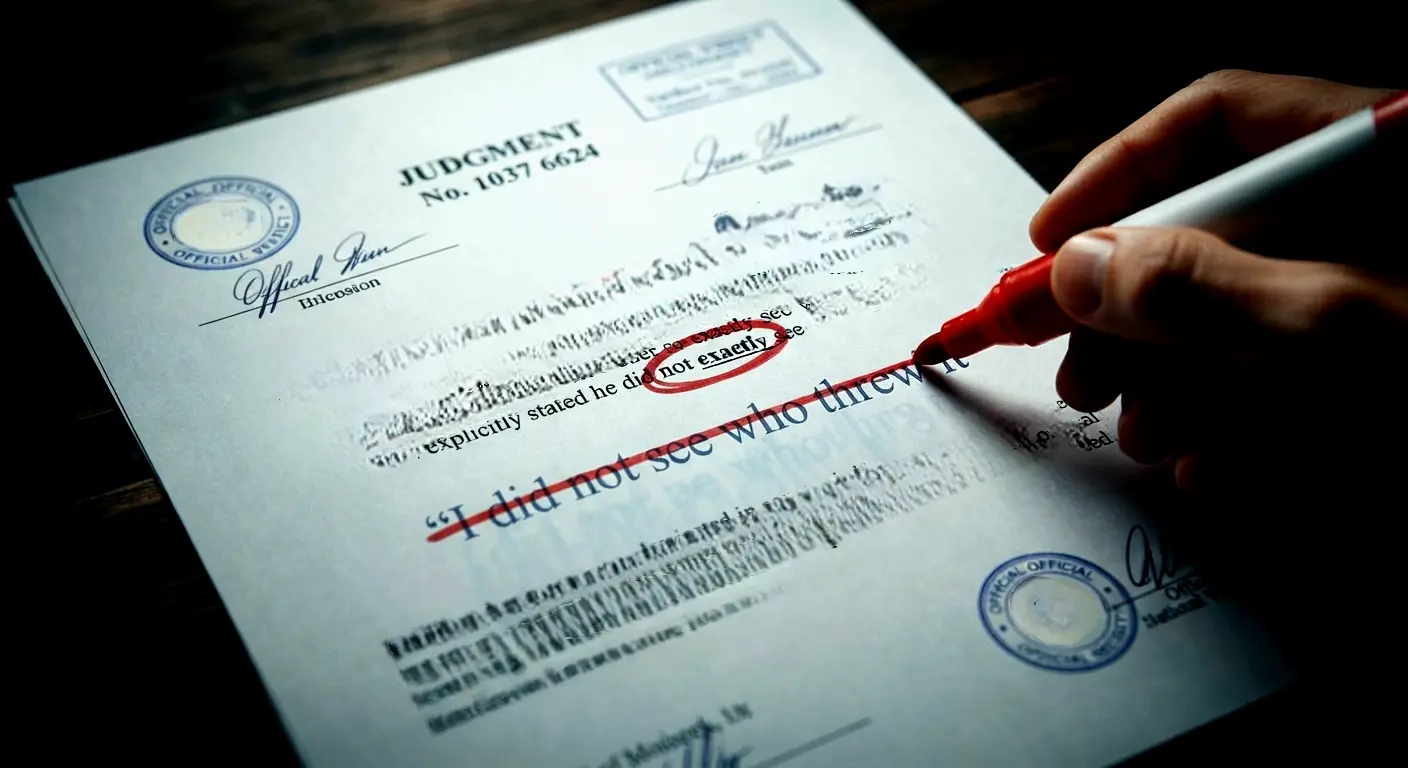
The written judgment contains several passages that require comparison with the underlying evidentiary record. One concerns a factual circumstance that does not appear in the testimony relied upon. Another concerns the wording used to describe what the Accuser said he could see. A further issue concerns the treatment of the physical scene documented in the police photographs.
Taken together, these points raise a narrower and more concrete question than whether the judgment was simply “wrong”: does the written judgment reproduce the evidentiary record as it was actually presented, or does its narrative contain additions, altered formulations, and unresolved physical contradictions?
The written judgment states that the Accuser had
“entered the room angrily.”
The question is straightforward: where in the evidentiary record was the circumstance that he entered the room “angrily” established?
If no witness, party, recording, or other evidentiary material contains that factual circumstance, the phrase is not merely a stylistic description. It adds a circumstance to the judicial narrative that does not appear to have been established during the proceedings.
During the proceedings, the Accuser stated that he did not see who allegedly threw the object because his head had not yet entered the doorway.
The written judgment uses a different formulation, describing the situation as though he
“did not exactly see”
“Did not see” describes an absence of visual observation.
“Did not exactly see” can leave open the possibility of some degree of visual observation.
That distinction matters because the testimony concerns the central question of identification. If the witness did not see the person throwing the object, the evidentiary record does not establish identification through direct visual observation. The written wording should therefore be examined against the actual testimony rather than treated as interchangeable phrasing.
The police photographs document the physical configuration of the scene shortly after the incident, including the doorway, the obstruction, and permanent structures surrounding the alleged throwing area.
The physical configuration is directly relevant to the allegation that an approximately ten-kilogram oak-and-metal stepladder was thrown from above the doorway area.
The Accuser did not see the person allegedly throwing the object.
The doorway was physically obstructed according to the account given in the proceedings.
Permanent structures are visible around and above the doorway in the police photographs.
The alleged movement therefore has to be reconciled with the actual geometry of the scene.
The issue is not whether an alternative reconstruction can theoretically be imagined. The issue is whether the reconstruction accepted by the Court was physically demonstrated and reconciled with the documented scene.
Where does the judgment explain how the accepted trajectory is physically compatible with the doorway configuration documented by the police?
The defence maintained that the accusation against TG was a retaliatory counter-accusation (vastasyytös) arising from the conflict between N and his spouse.
This alternative explanation had to be assessed against the actual evidence: N did not see who allegedly threw the object, and the physical configuration of the scene raises questions about whether the alleged act was possible as described.
The Accuser’s account did not provide direct visual identification of the person who allegedly threw the object.
The judgment uses wording that differs materially from the direct formulation of what the witness said he saw.
The judgment contains the statement that the Accuser entered the room “angrily”, requiring identification of its evidentiary source.
The accepted account must be reconciled with the physical configuration documented in the police photographs.
01
02
03
04
05
06
A criminal judgment reconstructs events from evidence. The critical question is whether that reconstruction remains inside the evidentiary record – and whether the accepted narrative can withstand comparison with the testimony and the physical scene documented in the case file.
Judicial Record Analysis · R 706/2025/5226
The written judgment contains several passages that require comparison with the underlying evidentiary record. One concerns a factual circumstance that does not appear in the testimony relied upon. Another concerns the wording used to describe what the Accuser said he could see. A further issue concerns the treatment of the physical scene documented in the police photographs.
Taken together, these points raise a narrower and more concrete question than whether the judgment was simply “wrong”: does the written judgment reproduce the evidentiary record as it was actually presented, or does its narrative contain additions, altered formulations, and unresolved physical contradictions?
The written judgment states that the Accuser had “entered the room angrily.”
The question is straightforward: where in the evidentiary record was the circumstance that he entered the room “angrily” established?
If no witness, party, recording, or other evidentiary material contains that factual circumstance, the phrase is not merely a stylistic description. It adds a circumstance to the judicial narrative that does not appear to have been established during the proceedings.
During the proceedings, the Accuser stated that he did not see who allegedly threw the object because his head had not yet entered the doorway.
The written judgment uses a different formulation, describing the situation as though he “did not exactly see” the person concerned.
“Did not see” describes an absence of visual observation.
“Did not exactly see” can leave open the possibility of some degree of visual observation.
That distinction matters because the testimony concerns the central question of identification. If the witness did not see the person throwing the object, the evidentiary record does not establish identification through direct visual observation. The written wording should therefore be examined against the actual testimony rather than treated as interchangeable phrasing.
The police photographs document the physical configuration of the scene shortly after the incident, including the doorway, the obstruction, and permanent structures surrounding the alleged throwing area.
The physical configuration is directly relevant to the allegation that an approximately 10 kg kitchen step-ladder or stool was thrown from above the doorway area.
The issue is not whether an alternative reconstruction can theoretically be imagined. The issue is whether the reconstruction accepted by the Court was physically demonstrated and reconciled with the documented scene.
Where does the judgment explain how the accepted trajectory is physically compatible with the doorway configuration documented by the police?
The evidentiary record also contains a competing account of how the incident developed. The Accuser and his spouse were involved in a conflict before the alleged assault involving TG. The defence position was that the accusation against TG arose as a retaliatory counter-accusation (vastasyytös).
That position does not by itself establish that a retaliatory accusation occurred. It does, however, identify an alternative explanation for the origin of the accusation that can be distinguished from the separate question of whether the physical allegation was proven.
The relevant question is therefore not whether the Court was required to accept the defence explanation. It is whether the competing explanation was identified and addressed against the evidence, including the absence of direct visual identification and the documented physical configuration of the scene.
01 · Testimony
The Accuser’s account did not provide direct visual identification of the person who allegedly threw the object.
02 · Written Judgment
The judgment uses wording that differs materially from the direct formulation of what the witness said he saw.
03 · Factual Narrative
The judgment contains the statement that the Accuser entered the room “angrily”, requiring identification of its evidentiary source.
04 · Physical Evidence
The accepted account must be reconciled with the physical configuration documented in the police photographs.
A criminal judgment reconstructs events from evidence. The critical question is whether that reconstruction remains inside the evidentiary record – and whether the accepted narrative can withstand comparison with the testimony and the physical scene documented in the case file.

According to N’s pre-trial and trial account, he returned to the apartment because his headphones had run out of battery and he wanted to retrieve them.
That explanation identifies the reason N gave for returning. It does not, by itself, establish that TG knew he would return, knew why he would return, or knew when he would arrive.
The allegation of an ambush raises a distinct evidentiary question: what information, if any, enabled TG to prepare for the return before N appeared at the doorway?
If the prosecution’s theory is that TG was already waiting and prepared to throw an object as N entered, the chronology matters.
The evidence would need to establish the basis for the alleged preparation—not merely the fact that an encounter subsequently occurred.
The critical question is what evidence connects the reason N gave for returning with the allegation that TG had prepared for his arrival in advance.
The issue is not whether a person could physically throw an object at someone entering a doorway. It is whether the evidence establishes the alleged prior preparation and explains how TG could have anticipated N’s return.
The judgment and the underlying evidence should therefore be examined for any identified communication, observation, or other circumstance that could establish advance knowledge.
If no such basis is identified, the chronology remains unexplained. That does not, by itself, prove what happened at the doorway; it identifies a gap in the evidentiary explanation of the alleged ambush.
01
02
03
04
An allegation of an ambush is not an explanation of how the alleged preparation became possible. The evidence must establish that link.
Evidentiary Reliability · Procedural Assessment

The Evolution of the Accuser’s Narrative:
The reliability of testimony depends not only on the details it contains, but also on whether its central account remains consistent as the proceedings develop. In this case, the Accuser’s description of how the incident began and which objects were allegedly thrown changed between the pre-trial investigation and the court hearing.
These differences concern the sequence of events, the alleged conduct of the parties, and the physical circumstances in which the incident supposedly took place. They therefore raise questions that go beyond minor discrepancies in recollection.
The two accounts describe materially different beginnings to the incident:
The Accuser described returning to the apartment to retrieve his headphones after their battery had run out. According to his account, he encountered obstacles near the entrance, began moving them, and the Defendant became aware of his presence through the resulting noise. The account presents her actions as a response to an unfolding situation.
At the hearing, the account was presented as an alleged ambush: the Defendant was said to have been waiting at the window and to have dropped an object at the moment the Accuser stepped inside.
The Difference:
The first account describes a reaction to noise generated by the Accuser’s return and movement of obstacles. The second implies that the Defendant was already positioned and prepared to act at a specific moment. This is a substantive change in the alleged sequence of events, not merely a difference in wording.
Question for the Court:
How was this change in the account assessed? What evidence supported the allegation that the Defendant was waiting in advance, and how was that allegation reconciled with the pre-trial description of her becoming aware of the Accuser’s presence through noise?
The description of the objects allegedly thrown also changed between the pre-trial account and the court hearing:
The physical layout of the apartment is relevant to this discrepancy. The number, location, and accessibility of the objects are matters that can be checked against the actual premises and the available photographic record.
Evidentiary Question:
What explains the change from multiple chairs to a single chair? Was the revised description tested against the physical arrangement of the apartment, and did the court address its significance when assessing the consistency of the testimony?
The consequences of this change extended beyond the assessment of the Accuser’s credibility. They directly affected the Defendant’s ability to conduct her defence.
The Defendant had retained a private lawyer and incurred substantial legal costs to prepare for the account given during the pre-trial investigation. That account was the basis on which the defence examined the alleged sequence of events, the physical layout of the premises, the objects involved, and the feasibility of the actions described.
This was not a straightforward account that could be addressed without careful preparation. It involved a disputed time of day, a sequence of multiple actions allegedly completed within approximately thirty seconds, obstacles at the entrance, a claimed throwing distance of several metres, and the alleged movement of the parties between different levels of the apartment. The defence had to work through these details in order to understand and challenge the account presented against the Defendant.
At the court hearing, however, the allegation shifted to a materially different scenario: that the Defendant had been waiting in advance and dropped an object as the Accuser entered. This alleged ambush had not been described in the pre-trial account on which the defence preparation had been based.
The Procedural Consequence:
The defence was confronted in court with a substantially altered factual theory for which it had not prepared. The lawyer and the Defendant had invested time, effort, and significant expense in preparing to answer one account, only to face another at the hearing.
The hearing nevertheless continued without any apparent interruption to address the consequences of this change. The record raises the question of what opportunity the defence was given to examine the new allegation, reconsider its strategy, or respond effectively to the revised factual theory.
The issue is not simply whether the Defendant was represented by counsel. It is whether that representation remained meaningful when the factual basis presented at trial materially departed from the account for which counsel had been retained and had prepared.
Questions for the Court:
The changes in the Accuser’s account raise questions about evidentiary reliability. But they also reveal a separate procedural concern: the defence prepared, at considerable expense, to meet one version of events and was confronted at trial with another.
A lawyer’s presence in the courtroom does not, by itself, resolve the question of whether the defence had a genuine opportunity to answer the case as it was actually presented. When the factual theory changes materially, the consequences for preparation and the ability to respond require attention.
The defence paid to prepare for one case. At trial, it faced another. The hearing continued — but the preparation, time, and expense invested in answering the original account could not simply be transferred to a new allegation without a meaningful opportunity to respond.
Evidentiary Reliability · Identification · Causation
The Evidentiary Problem:
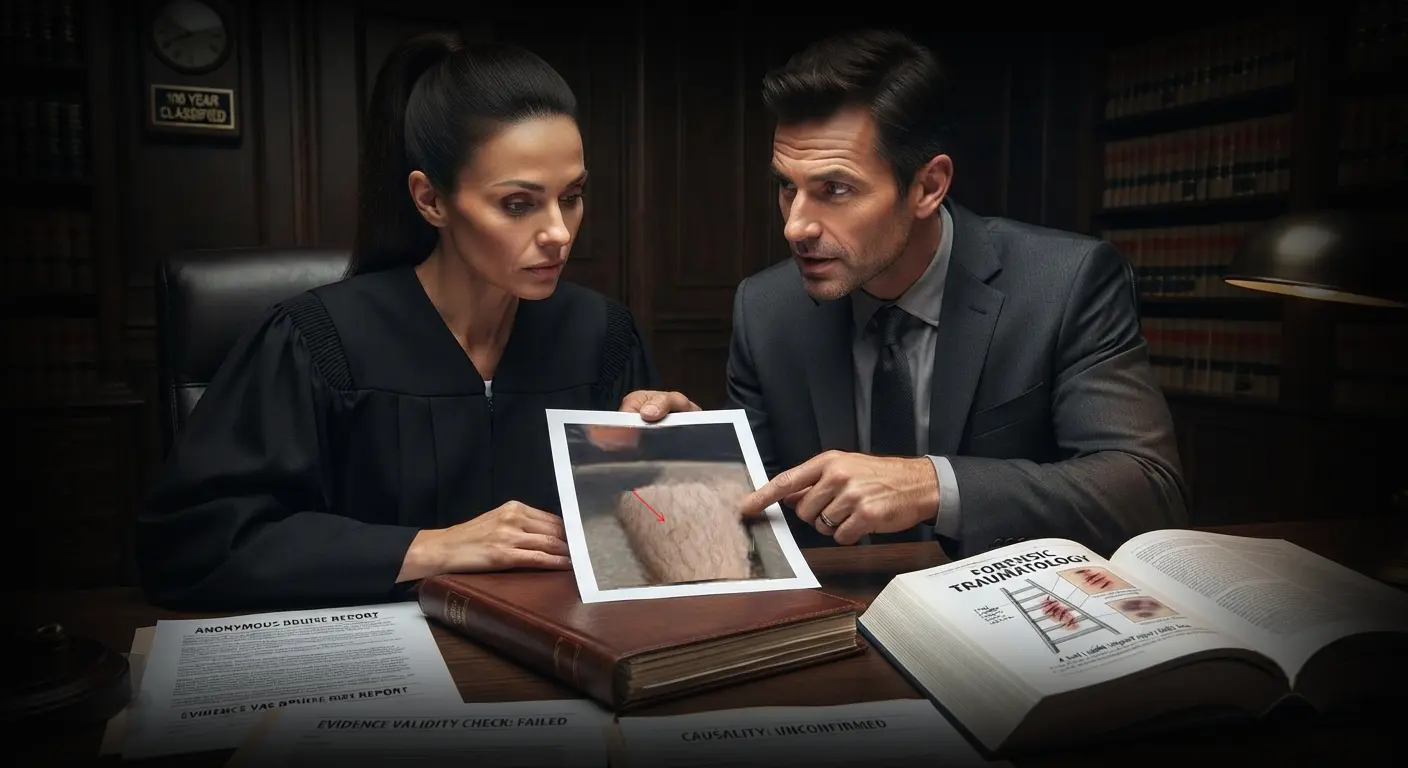
The photograph presented in the proceedings was treated as evidence of the bodily harm allegedly caused by the Defendant. Yet the image is an isolated fragment showing an unidentified part of a body. It does not, on its face, establish whose body is depicted, when the photograph was taken, what caused the visible mark, or whether the image relates to the incident under examination.
These are not secondary questions. They concern the basic identification and evidentiary value of the material itself. Before the image can be used to support a finding of injury, its connection to the person, event, and alleged act must be established.
The central issue is therefore not simply what anatomical region the photograph might depict. It is whether this unidentified image can reliably establish any injury attributable to the Defendant at all.
The image presents a limited view of a body part, without a sufficiently identifiable anatomical context. It does not show the full limb, its connection to the rest of the body, or other identifying features that would independently establish the subject’s identity.
The available image does not independently establish:
Without these foundational elements, the photograph remains a visual record of an unidentified mark. Its appearance alone cannot establish the identity of the person, the time or circumstances of the image, or the cause of the mark.
The judgment attributes the alleged impact to the Accuser’s thigh. The photograph, by contrast, appears to show a lower-leg area. This visual impression is not presented here as a medical identification; the image lacks the context necessary for a definitive anatomical determination.
That limitation makes the discrepancy more significant, not less. The judgment identifies a specific anatomical location, while the photograph does not independently establish that it depicts that location.
Judgment:
An alleged impact to the thigh.
Photograph:
An isolated image that appears to show a lower-leg area, without sufficient anatomical context for independent confirmation.
Medical verification:
No medical report has been identified that establishes that the photographed mark corresponds to the injury described in the judgment.
The issue cannot be resolved merely by choosing one anatomical interpretation over another. Even if the precise location were established, that would still leave unanswered the more fundamental questions of identity, timing, origin, and causation.
The photograph was relied upon as the principal visual support for the alleged bodily harm. However, the image is not a medical examination, and it does not provide a clinical assessment of the mark.
In the absence of independent medical documentation, the photograph does not establish:
A visible mark and a medically established injury are not interchangeable concepts. Nor does the existence of a mark, even if genuine, establish who caused it or under what circumstances.
The relevant evidentiary question is not whether the photograph contains a visible mark. It is whether the evidence establishes a reliable chain connecting that mark to the alleged act:
Identified person
↓
Verified date and circumstances
↓
Established injury and anatomical location
↓
Verified mechanism of injury
↓
Reliable connection to the alleged act
The photograph, by itself, does not establish these links. It cannot identify the person depicted, date the mark, determine its cause, or connect it to the Defendant’s alleged conduct.
Treating the image as proof of the alleged injury therefore requires conclusions that the photograph itself does not demonstrate. The missing links cannot be supplied merely by repeating the allegation that the image is intended to support.
The evidentiary problem begins before the debate over whether the image depicts a thigh or a lower leg. The photograph is an unidentified fragment, without independently established identity, date, anatomical location, medical assessment, or causal connection to the alleged incident.
The court’s reliance on this material raises a fundamental question: how can an image whose subject, timing, and origin have not been independently established serve as proof of a specific injury attributed to a specific act?
The issue is not whether the photograph may be considered as a visual object. It is whether it can carry the evidentiary weight assigned to it. A photograph of an unidentified mark cannot, without the necessary verification and supporting evidence, establish the occurrence, cause, or attribution of the alleged injury.
Before asking whether the photograph shows a thigh or a shin, the court must answer a more basic question: whose injury is this, when did it occur, and what evidence connects it to the alleged act?
Chronology & evidentiary scrutiny · R 706/2025/5226

A sequence of movements, alleged impacts, and physical encounters was accepted without a clearly demonstrated reconstruction of how those events could have unfolded within the stated timeframe.
The issue is not merely whether individual acts were alleged. It is whether the prosecution and the court examined their order, duration, physical setting, and compatibility as one continuous account.
In his pre-trial interview, N described returning to the apartment because his headphones had run out of battery. He stated that he had gone to a neighbour while waiting for his wife to calm down, and that he subsequently returned to the apartment.
He recalled the time as approximately 5 p.m. and estimated that the emergency call was made 10-15 minutes later.
His account placed the alleged events across two levels of the apartment: he was initially below the stairs, while TG was said to be on the upper level. He described chairs placed as a barrier, their removal, an alleged impact from a heavy kitchen stepladder, contact with a street broom, and a later physical confrontation inside the apartment.
“The whole situation lasted about 30 seconds from the throwing of the chairs to the waving/hitting confrontation.”
This distinction matters. The 30-second estimate does not necessarily cover every event preceding the removal of the chairs. It does, however, impose a concrete chronological constraint on the sequence the witness himself described.
Read as a continuous account, the interview describes the following progression:
The returning individual encounters chairs placed as a barrier near the entrance and begins moving them.
TG allegedly hears the door and the movement of the chairs and comes to look down from the upper level.
A heavy kitchen stepladder, described as weighing approximately 10 kilograms and made of solid oak, is allegedly thrown from the upper level and strikes his thigh while he is below the stairs.
He describes being struck or pushed with a street broom while climbing the stairs and again inside the apartment.
He says he took the broom away and tried to push TG farther away. He acknowledged that the handle may have struck her head or ear during this process, while denying an intention to hit her.
He states that he retrieved his headphones and left. According to his account, his wife appeared only at this stage.
These are not six independent allegations. They are connected actions whose order and duration determine whether the account can be understood as a coherent event.
The interview contains more than a bare allegation of an assault. It provides a claimed sequence, a location for the participants, a description of the objects involved, and an estimate of the time in which the central confrontation occurred.
That level of detail makes chronological scrutiny essential. The question is not whether each action can be imagined in isolation. It is whether the actions, taken together, were examined against the available spatial and temporal information.
A criminal allegation built on a sequence of physical acts requires more than the repetition of a witness’s account. Where the witness supplies a specific time estimate and describes several movements and encounters in rapid succession, those details become part of the evidence to be tested.
The central concern in this case is that the pre-trial narrative appears to have been treated as a sufficiently coherent account without a clearly identifiable examination of its internal chronology. The record should make it possible to understand how the prosecution evaluated the sequence and how the court resolved any questions arising from it.
This concern is particularly significant because the pre-trial account was not the same as the materially different “ambush” narrative presented at trial, addressed separately in Violation 05. The two versions should not be merged into one retrospective story. Each must be assessed on its own terms, and any transition between them requires explicit examination.
The issue is therefore not simply that a witness may have been mistaken about a detail. It is whether the institutions responsible for testing the accusation examined the sequence as a whole before relying on it.
How could a sequence involving a barricade, movement between two levels, an alleged heavy-object impact, repeated broom contact, a physical struggle, and departure be accepted as a coherent account without a transparent examination of the time available for those events?
The 30-second estimate was part of the witness’s own account. It was not an incidental detail. It was a testable constraint – and the record should show whether that constraint was ever tested.
VIOLATION 08 · PRESUMPTION OF INNOCENCE
The “Probatio Diabolica”: Was the defendant effectively required to prove that she did not possess the street brush?
The presumption of innocence requires the prosecution to establish the elements of the alleged offence. Where possession and use of an object are disputed, the evidentiary burden cannot be replaced by an expectation that the defendant explain how the object was absent from her possession.
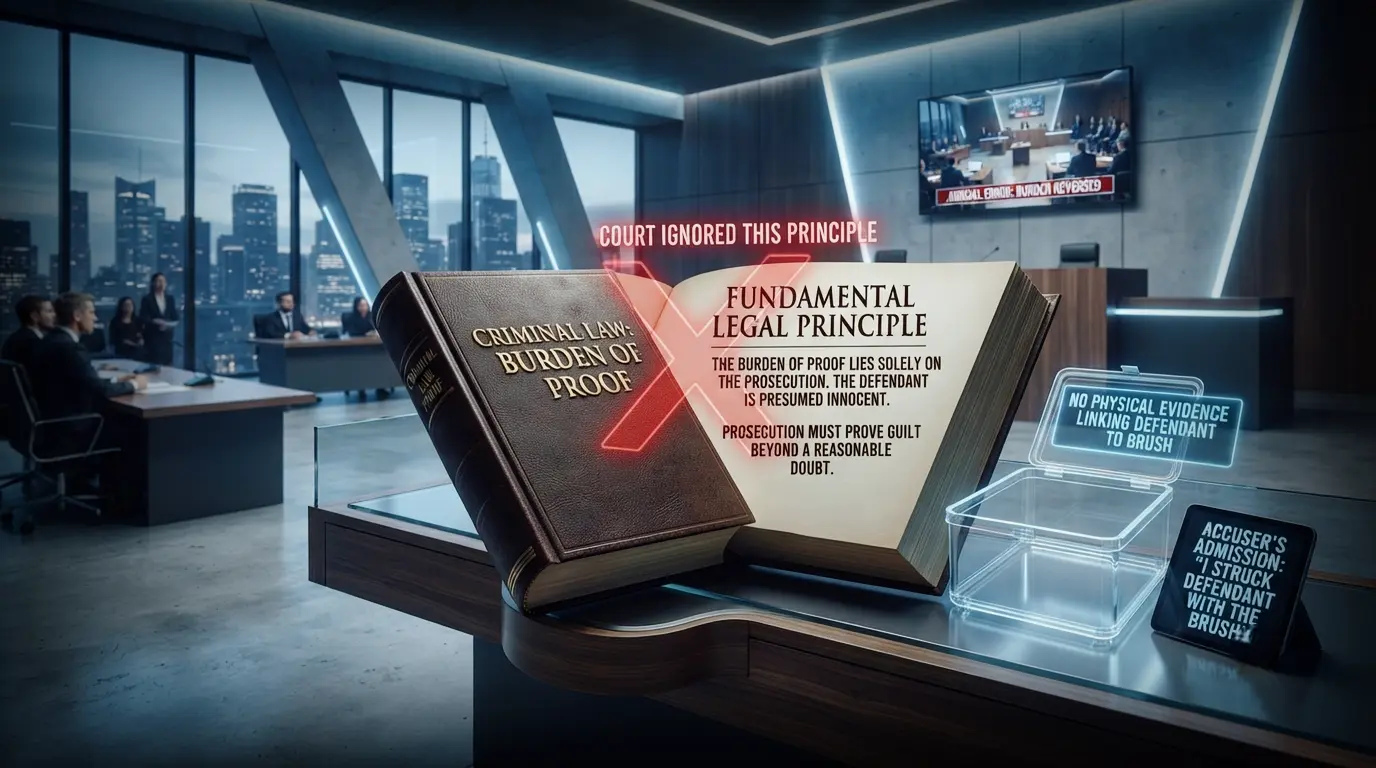
The pre-trial record, as presented in this case, does not establish that the defendant possessed the street brush or used it against the accuser. The circumstances in which the object allegedly came into her possession remain a central evidentiary question.
The street brush was described as an outdoor tool, ordinarily kept near the building entrance. The record needs to establish how it allegedly moved from that location into the defendant’s possession inside the apartment.
Without evidence addressing that transition, the allegation leaves a material gap between the object’s reported location and the alleged act.
The issue is not whether the defendant could offer a possible explanation. It is whether the prosecution established the alleged possession and use through evidence, and whether the court addressed the missing link in its reasoning.
The accuser acknowledged that he used the street brush during the incident. His account describes contact with the defendant’s head and face, including contact while he was climbing the stairs and further contact inside the apartment.
This admission is directly relevant to the question of possession. It establishes that the accuser himself described handling and using the same object whose alleged use by the defendant forms part of the competing account.
If the accuser acknowledged using the brush, how did the court distinguish his admitted handling of the object from the allegation that the defendant possessed and used it?
The two accounts required reconciliation. The accuser’s admission does not, by itself, establish every detail of the defendant’s account; equally, it cannot be disregarded when evaluating who possessed the object and how it was used.
The Latin expression probatio diabolica describes the exceptional difficulty of proving a negative proposition. In this context, the concern is that the defendant may effectively have been expected to establish that she did not possess the brush, despite the prosecution’s responsibility to prove the alleged act.
The presumption of innocence is not satisfied merely because a defendant is given an opportunity to deny an allegation. The evidentiary burden remains with the prosecution, which must establish guilt to the applicable criminal standard of proof.
A finding of guilt must rest on an evidentiary basis that addresses the essential elements of the alleged offence. Where the identity of the person possessing and using an object is disputed, the court’s reasoning should explain how that dispute was resolved.
If the record does not establish the defendant’s possession of the brush, and the judgment does not explain how the competing accounts were assessed, the basis for the finding remains unclear.
The concern is therefore not simply that one piece of evidence may have been overlooked. It is whether the court’s reasoning preserved the distinction between the prosecution’s duty to prove an allegation and the defendant’s right not to prove her innocence.
On what evidence did the court conclude that the defendant possessed and used the street brush, when the accuser himself acknowledged handling and using that same object?
The burden of proof belongs to the prosecution. A defendant cannot be required to prove the absence of an act that the prosecution has not first established.
INTENTIONAL ASSAULT & VICTIM VULNERABILITY
A person who called the police for protection became the defendant, while the alleged attack, the death threats, the documented injuries, and the victim’s pre-existing medical vulnerability were left without adequate judicial scrutiny.
The case began with a call for police assistance following an alleged assault. The subsequent proceedings required the court to examine the reported threats, the manner of the attack, the physical injuries, and the victim’s known vulnerability. These were not peripheral details. They were central to understanding the incident and assessing the conduct described.

The victim’s account describes an episode of explicit verbal hostility immediately preceding the physical attack. The reported words were:
“Aren’t you dead yet? Die! Die! Die!”
The verbal threats were followed by a blow delivered with the metal handle of a heavy-duty street brush. The victim had not called the police to report a mutual altercation; she had sought assistance after an attack.
The combination of explicit death threats and the use of a metal object against the head raises a direct question of intent. It required examination as a connected sequence of conduct, rather than the isolated assessment of a single physical contact.
How were the reported death threats and the immediate use of a metal object against the victim’s head assessed when determining the nature and intent of the assault?
The victim instinctively raised her hand to protect her head. The blow from the metal handle struck her right index finger and head. The incident was followed by immediate nosebleeding and significant tissue damage.
Police photograph No. 3 documents the injury to the finger, including its visibly flattened appearance. The photograph is part of the evidentiary record and provides visual documentation of the physical consequences of the reported impact.
The injury photograph should be assessed alongside the victim’s account of the blow, the reported nosebleed, and the object used. Its evidentiary significance cannot be addressed adequately by treating it as an incidental detail.
The court’s assessment should explain how the documented injury was reconciled with the reported mechanism of impact and the victim’s testimony. Where physical evidence supports an account of an assault, the reasoning should identify how that evidence was evaluated.
The victim had a documented severe head injury, including a skull fracture, resulting from an earlier accident. This was a pre-existing medical condition relevant to the assessment of an impact to the head.
A blow to the head with a metal object cannot be evaluated in isolation from a known history of serious cranial injury. The victim’s vulnerability was a material circumstance requiring consideration when assessing the potential consequences of the act and its legal significance.
The relevant question was not merely whether an injury occurred. It was whether the court considered the victim’s documented medical condition when evaluating the significance and potential seriousness of a deliberate blow to the head.
The judgment should explain whether this vulnerability was taken into account and, if so, how it affected the legal assessment of the conduct. If it was not considered, the omission leaves a material aspect of the incident unaddressed.
The reported conduct consisted of connected elements: explicit verbal threats, the use of a metal object, an impact to the head and hand, immediate physical symptoms, photographic documentation, and a known history of serious head injury.
These circumstances required a coherent assessment. The threats were relevant to intent; the object and manner of its use were relevant to the nature of the attack; the injuries were relevant to its physical consequences; and the pre-existing condition was relevant to the victim’s vulnerability.
The concern is that the judgment did not adequately address these elements together. A decision that fails to explain how such material circumstances were evaluated leaves the reasoning on the nature and seriousness of the incident incomplete.
The procedural reversal is especially stark: the individual who called the police for help following the alleged attack was subsequently prosecuted, while the evidence concerning the original assault required the very scrutiny that the proceedings should have provided.
The presumption of innocence and the principle of in dubio pro reo protect the accused and govern the assessment of criminal liability. They do not remove the need for a reasoned examination of evidence concerning an alleged assault, its consequences, or the circumstances relevant to its legal classification.
The issue raised here is whether the court adequately assessed the evidence presented by the original victim and provided a reasoned explanation for its treatment of the reported threats, physical injuries, and documented vulnerability.
Where the evidence concerns an alleged deliberate attack on a medically vulnerable person, the absence of a clear judicial assessment is not a merely formal deficiency. It affects the transparency and completeness of the decision-making process.
How could the court assess this case without fully addressing the reported death threats, the blow with a metal object, the documented injuries, and the victim’s known vulnerability – when the police had been called to protect her from the very incident under examination?
The evidence of an alleged assault does not disappear because the person who sought police protection later became the defendant. The original incident, its evidence, and the victim’s vulnerability still demand a reasoned judicial assessment.
JUDICIAL OBJECTIVITY & EVIDENTIARY FAILURE
The court accepted an evolving oral account despite unresolved contradictions in the testimony, the absence of independent physical evidence establishing the alleged mechanism of assault, and material questions raised by the official police photographs.
The issue is not whether an allegation was made or whether a photograph of an injury exists. It is whether the evidence independently establishes that the alleged assault occurred in the manner described, that the defendant was responsible, and that the physical circumstances are consistent with the account accepted in the judgment.

The conviction rests on the accuser’s oral allegations, which changed materially during the proceedings. The record contains no impartial eyewitness to the alleged act and no independent physical evidence conclusively establishing the alleged mechanism of assault or connecting the defendant to the claimed injury.
The distinction is fundamental: an allegation is evidence to be assessed, but it is not independent corroboration of itself. Where the account changes, the court must address the differences and explain why the version accepted in the judgment remains reliable.
The court accepted an oral account whose development required scrutiny, while the physical circumstances documented in the case materials raised questions about the alleged trajectory and the location of the reported injury.
In a proceeding governed by the rule of law, the court’s task is not to choose a narrative and disregard the evidence that challenges it. It must assess the testimony against the objective circumstances and explain how material contradictions have been resolved.
The judgment attributes the alleged impact to the accuser’s thigh. The photograph relied upon in the proceedings appears to depict a mark on the shin or lower-leg area, rather than clearly identifying the thigh described in the judgment.
The image does not, by itself, establish the identity of the person photographed, the precise anatomical location, the date or origin of the mark, or the mechanism that caused it. Nor does it independently connect the mark to the defendant or to the alleged incident.
If the judgment identifies the thigh as the site of impact, what evidence establishes that the photograph depicts that specific injury and that it resulted from the alleged act?
No medical or forensic verification identified in the record resolves these questions. The photograph may document a visible mark, but the existence of a mark is not equivalent to proof of the alleged cause, timing, or perpetrator.
Official police photographs document the physical arrangement of the scene, including the doorway, the obstruction, and the structures positioned around the entrance. These are not subjective recollections. They are part of the recorded physical circumstances against which the alleged mechanism must be assessed.
The alleged trajectory of the heavy stepladder raises questions about the available space, the position of the participants, and the obstacles between them. The scene geometry must be reconciled with the account of how the object was allegedly thrown and how it reached the stated point of impact.
The court’s reasoning does not adequately demonstrate how these physical questions were resolved. No technical reconstruction or independent examination identified in the record establishes that the alleged trajectory was feasible under the documented conditions.
No technical, forensic, medical, or third-party evidence identified in the record independently establishes that the alleged assault occurred as described in the judgment.
The official photographs, the physical layout, the disputed testimony, and the unidentified injury image each raise questions that required an explicit evidentiary assessment. Taken together, they called for more than the acceptance of an oral narrative.
The court’s task was to determine whether the evidence, considered as a whole, established the alleged act and the defendant’s responsibility to the required criminal standard. Where the physical record raises material inconsistencies, the judgment must explain how those inconsistencies were resolved.
The failure to confront these questions leaves the basis of the conviction inadequately explained. It also obscures the distinction between evidence that an injury existed and evidence that the defendant caused it in the manner alleged.
The conviction was reached despite unresolved questions concerning the accuser’s changing account, the absence of independent corroboration of the alleged mechanism, the anatomical discrepancy in the photograph, and the physical geometry documented in Exhibit 4.
These are not isolated technical objections. They concern the essential link between the alleged act, the alleged injury, and the person found responsible.
The presumption of innocence and the principle of in dubio pro reo require that guilt be established through evidence meeting the applicable standard of proof. They cannot be replaced by the uncritical acceptance of a narrative where material evidentiary questions remain unresolved.
The consequences of a criminal conviction are profound and enduring. That is precisely why the reasoning supporting it must demonstrate that the evidence was examined objectively, contradictions were addressed, and the conclusion was reached on a sound evidentiary basis.
How can a conviction be adequately justified when the physical evidence does not independently establish the alleged mechanism of assault, the injury photograph does not clearly correspond to the anatomical location stated in the judgment, and the documented geometry of the scene raises unresolved questions about the alleged act?
A conviction cannot substitute a judicial conclusion for the evidence required to support it. Where the physical record raises material questions, objectivity demands that those questions be answered – not bypassed.
Systemic Procedural Delay

The 735-Day Wait:
The appeal hearing in this case is scheduled for 6 October 2027, more than two years after the District Court hearing of 1 October 2025. For a person contesting a criminal conviction, this is not an abstract scheduling issue. It means an extended period of legal uncertainty, during which the conviction remains part of the person’s legal and social reality while its correctness is still under challenge.
From the District Court hearing on 1 October 2025 to the scheduled appeal hearing on 6 October 2027.
The distinction between the dates matters. The 735-day period begins with the District Court hearing, not the written judgment or the filing of the appeal. Each interval represents a different stage of the proceedings, and each should be assessed on its own terms.
For the person appealing a criminal conviction for pahoinpitely (assault), the passage of time does not suspend the consequences of the proceedings. The appeal remains unresolved while the individual continues to bear the practical, professional, and personal effects of the conviction.
An appeal that remains pending for years prolongs uncertainty about the final legal outcome. The individual must live with the consequences of a conviction while the challenge to that conviction awaits judicial examination.
A criminal conviction may affect employment opportunities, professional standing, and social relationships even while an appeal is pending. The passage of time cannot necessarily restore opportunities lost during the period of uncertainty.
An appeal is intended to provide judicial scrutiny of a contested decision. When that scrutiny is deferred for an extended period, the practical value of the remedy is diminished for the person awaiting it.
Article 6(1) of the European Convention on Human Rights guarantees a hearing within a reasonable time in the determination of criminal charges. The requirement concerns the proceedings as a whole and applies to the effective administration of justice, not merely the formal availability of an appeal.
The reasonableness of a delay is assessed in light of the circumstances of the case, including its complexity, the conduct of the parties, and the manner in which the authorities handled the proceedings. The scheduled interval in this case therefore raises a concrete question about whether the appellate process is being administered within a reasonable time.
Where a case concerns a single alleged incident and does not require complex forensic examination, what specific circumstances justify an appellate hearing scheduled more than two years after the District Court hearing?
The 735-day interval is more than a figure on a procedural calendar. It represents an extended period during which a person challenging a criminal conviction remains without a final appellate determination.
The underlying conviction is itself contested on grounds concerning the assessment of evidence and the physical circumstances described in the case record. The delay therefore postpones not simply an administrative conclusion, but the judicial examination of those substantive challenges.
A right of appeal must be more than a formal possibility. It must be capable of providing timely and meaningful review. When that review is deferred for years, the resulting uncertainty becomes a substantial consequence of the process itself.
A right of appeal loses practical force when the person seeking justice must wait years for the opportunity to be heard.
“Where the law is a weapon of the powerful, justice has already been murdered.”
Adapted aphorism — attribution to Cicero not independently verified.




Independent legal media platform focusing on structural judicial monitoring and criminal case analysis. We examine international standards of justice, from the presumption of innocence to the rigorous evaluation of the standard of proof and in dubio pro reo principles.
All analytical materials and legal case reviews on this website are published for informational and educational purposes only under freedom of expression. Content does not constitute professional legal advice.
© 2026 LawBeatRadio. All rights reserved.