

Independent monitoring of systemic procedural violations

In rugby, every tackle takes place within a defined framework: rules establish what is permitted, violations are identified, and penalties follow established procedures. Legal proceedings operate on the same basic principle — facts, evidence, procedural safeguards, and standards of proof must remain connected.
This LawBeat Radio episode examines what happens when that connection becomes difficult to verify. The focus is not on a sporting metaphor alone, but on the underlying legal questions: how evidence is assessed, how procedural safeguards operate, and what happens when the factual basis of a criminal case becomes disputed.
Listen to the audio broadcast directly via
v.lawbeatradio.net
,
review the primary case documentation, and follow the legal analysis.
When the rules are clear, the evidence must still be capable of being checked against them.
The case presented a disputed factual basis involving the alleged use of a ten-kilogram metal-and-oak step ladder and other objects. The defence position was that the alleged mechanism was incompatible with the documented physical environment.
Following the prosecution of the case, a complaint was submitted concerning the prosecutor’s conduct and the application of the principle of objectivity. The complaint asks whether the available evidence was assessed comprehensively, whether contradictory accounts were adequately examined, and whether relevant alternative explanations were addressed.
This page examines the documented issues raised in that complaint and separates the underlying evidence from the institutional questions arising from it.
Case R 706/2025/5226 · Decision 1037 6624
The complaint alleges that prosecutor Tomas Niemitalo failed to apply the principle of objectivity by relying substantially on the statements of the alleged victim while insufficiently addressing contradictory statements and objective material, including crime-scene photographs and physical evidence.
The complaint concerns charges involving the alleged throwing of a ten-kilogram metal-and-oak step ladder and the use of a street broom. It points to the absence of documented fingerprints, DNA, or other technical traces connecting the objects to the alleged acts, and to physical features of the scene — including door obstructions and cat-climbing structures — that are said to conflict with the proposed mechanism.
The complaint identifies differences between statements made during the pre-trial investigation and in court. It also points to the alleged victim’s admission that he did not see who threw the objects, together with the presence of another person in the apartment during the conflict.
The complaint identifies a photograph of a minor bruise as important prosecution evidence and questions its evidentiary connection to the alleged event. The issues raised include the absence of independently verified metadata and the question of whether the photograph can establish when, where, and how the injury occurred.
The complaint also raises evidence concerning alleged death threats and physical violence against the grandmother, including an allegation involving an iron pipe and a head injury accompanied by a nosebleed. It questions how these events were assessed in comparison with the allegations brought against her.
The complaint states that the alleged victim left the scene after learning that police had been called, while the grandmother remained. It asks whether this conduct was adequately considered when the competing accounts of the incident were assessed.
The complaint describes financial costs, severe personal stress, reputational consequences, and the prolonged duration of the proceedings, including the anticipated appellate proceedings in 2027.
The complaint further raises the potential consequences for a grandchild who may be called as a witness in the appellate proceedings. It questions whether the procedural consequences of the case may expose a child to a conflict between family relationships and participation in criminal proceedings.
The complaint requests an examination of the prosecutor’s adherence to professional obligations and, in particular, whether the principle of objectivity was observed when the charges were brought and maintained in the circumstances described above.
When a complaint challenges the evidentiary basis of a prosecution, who independently verifies whether the underlying objections were actually examined?
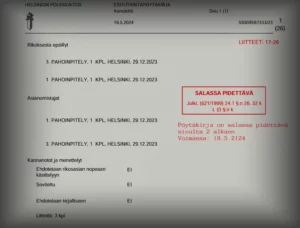
G submitted a complaint to the Office of the Prosecutor General on 17 February 2026 concerning the actions of area prosecutor N of the Southern Finland prosecution district in bringing charges and handling criminal case R 706/2025/5226.
G had been prosecuted in connection with an assault alleged to have occurred on 29 December 2023 and was convicted by the Helsinki District Court on 30 October 2025 under judgment no. 1037 6624.
The complaint requested an examination of whether area prosecutor N had acted lawfully and complied with professional obligations, including whether charges had been brought without sufficient evidence and contrary to facts contained in the pre-trial investigation material.
G also challenged the prosecutor’s assessment of evidence, the treatment of contradictory interrogation statements, and the assessment of G’s head injury, arguing that these matters demonstrated a lack of objective evaluation.
The materials reviewed consisted of:
N disputed having acted improperly and stated, among other things, that the material did not support a conclusion that G had suffered a concussion.
The Prosecutor General’s Office concluded that the complaint did not give cause for measures. According to the decision, area prosecutor N had not acted contrary to law, professional prosecutorial duties, or official duties.
The decision refers to Section 9 of the Act on the Prosecution Authority and Section 14 of the State Civil Servants Act concerning prosecutors’ duties, impartiality, and good official conduct.
The decision refers to Chapter 1, Section 6, Subsection 1 of the Act on Judicial Proceedings in Criminal Cases and the requirement concerning probable reasons supporting guilt when charges are brought.
The decision notes that the Helsinki District Court had convicted G and that the criminal case was pending before the Helsinki Court of Appeal. On that basis, the Prosecutor General’s Office considered that there were no special grounds for intervention in the matter at that stage.
The decision states that no appeal may be lodged against a decision given in an administrative complaint matter pursuant to Chapter 8, Section 53 d of the Administrative Judicial Procedure Act.
The official decision states that the available evidence provided sufficient grounds for the prosecution. The more specific question is whether the documented physical environment was actually tested against the mechanism alleged in the case.
The issue is not whether an official conclusion exists. It is whether the underlying physical proposition can be independently reconstructed from the evidence that was available to the authorities.
The crime-scene photographs show a confined area containing cat structures, furniture and other obstructions around the doorway and surrounding space. The alleged incident involved a downward movement of an approximately 10 kg object from an elevated position.
That creates a concrete forensic question: could the alleged movement, with the object and the persons positioned as described, physically have been completed within the documented geometry of the scene?
If the available photographs establish fixed obstacles along the relevant trajectory, the issue is capable of being tested through spatial reconstruction rather than resolved solely through witness interpretation.
The evidentiary record also raises a question concerning the location and identity of the photographed injury. The image material available for review does not, by itself, establish with certainty the identity of the person photographed or the precise anatomical location of the mark.
Where an alleged impact is described as a downward strike, the position of the alleged injury, the direction of movement, the relative height of the persons involved and the physical geometry of the scene become relevant variables.
The appropriate question is therefore not whether an image subjectively appears to confirm one account, but whether the documented injury and the alleged mechanism are physically consistent with one another.
A physical contradiction, if established, is not merely a difference in interpretation. It may affect the reliability of the prosecution’s reconstruction of events.
This raises a basic evidentiary question: how was uncertainty concerning the physical mechanism treated when the evidence was assessed?
The principle commonly expressed as in dubio pro reo becomes relevant where material doubt remains after the evidence has been assessed. The question for review is therefore whether the documented physical objections were actually examined and resolved, rather than simply outweighed by an institutional conclusion.
The crime-scene photographs were available to the authorities. They show a spatial environment in which movement was constrained by structures and objects around the relevant doorway and passage.
A photograph, however, does not by itself establish physical impossibility. That requires the photograph to be connected to measurements, positions, trajectories and the precise mechanism alleged.
This is precisely why the photographs matter: they provide material that can potentially be tested against the prosecution’s reconstruction.
If the scene photographs show significant physical obstructions, and the alleged injury and direction of impact depend on a particular reconstruction of the event, the evidentiary question is straightforward:
Can the alleged mechanism be physically reproduced from the documented evidence?
If it can, the reconstruction can be demonstrated. If it cannot, the reason should be identifiable in the evidentiary record. The central issue is therefore not whether bureaucracy can override physics, but whether the relevant physical question was ever independently tested.




HOSTED BY JULIAN VANCE
Personal experiences navigating unexpected journeys & judicial anomalies.
LawBeat Radio Forensic Audit Verdict
Independent legal media platform focusing on structural judicial monitoring and criminal case analysis. We examine international standards of justice, from the presumption of innocence to the rigorous evaluation of the standard of proof and in dubio pro reo principles.
All analytical materials and legal case reviews on this website are published for informational and educational purposes only under freedom of expression. Content does not constitute professional legal advice.
© 2026 LawBeatRadio. All rights reserved.