
Independent monitoring of systemic procedural violations
Statutory Analysis
Abuse of Public Office
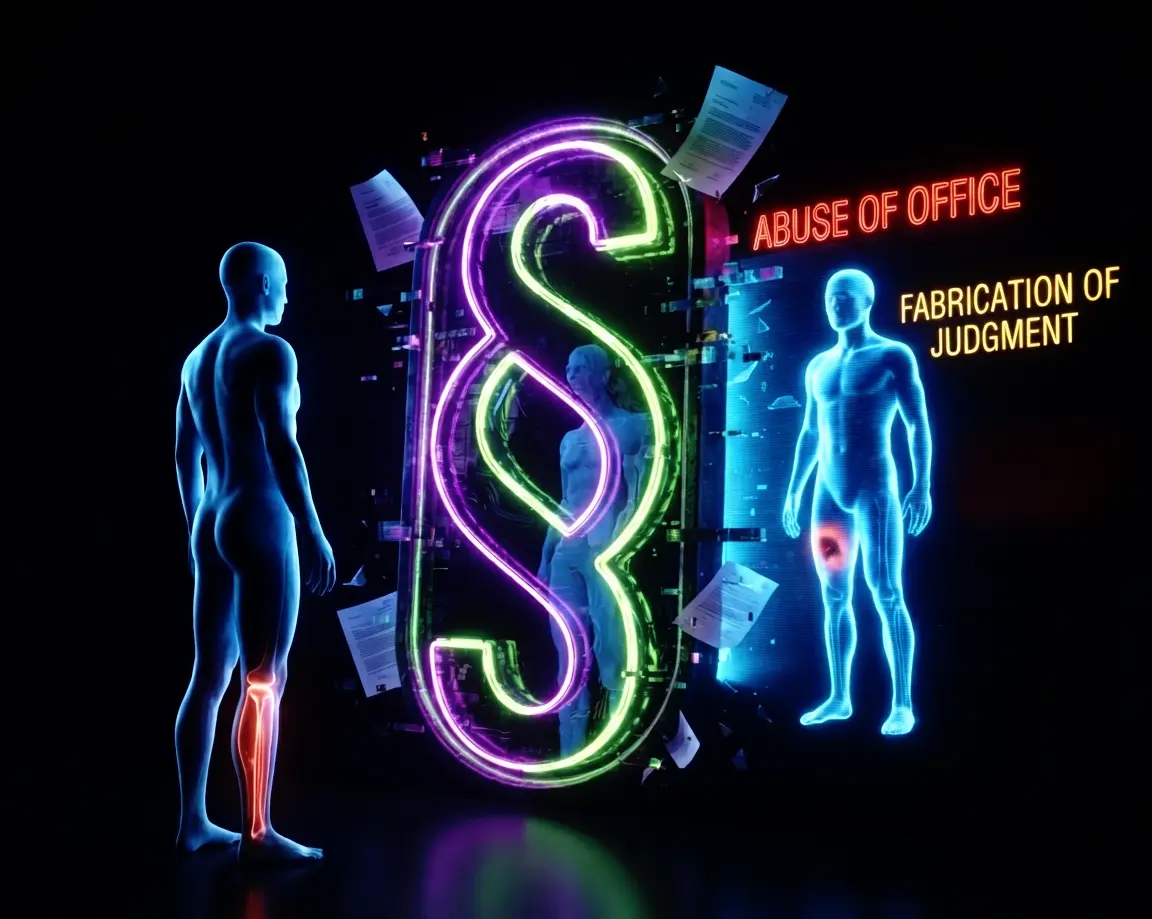
Judicial authority in Finland is bound by strict statutory boundaries. When a public official uses their office to cause harm or manipulate outcomes, the baseline for criminal liability is established in the Criminal Code of Finland (Rikoslaki, 39/1889):
Criminal Code of Finland, Chapter 40, Section 7 – Abuse of public office (Virka-aseman väärinkäyttö):
“If a public official, while acting in office, with the intent to procure an unlawful advantage for themselves or another, or with the intent to cause injury or harm to another, unlawfully uses their official position… shall be sentenced for abuse of public office to a fine or to imprisonment for a maximum of two years.”
This is strictly tied to the absolute prohibition of altering factual records during legal proceedings, protecting the integrity of evidence and witness testimony.
External Sources: Finlex – Criminal Code Chapter 40
The core defence of the judiciary claims that sentencing errors fall under “judicial discretion.” However, rewriting reality inside a courtroom strips away any legal protection:
A judge who alters testimonies to fit an accusation and buries clear police evidence is no longer delivering justice. Under Finnish law, abuse of public office occurs precisely when statutory authority is weaponized against the truth. Exposing these manipulations is the only way to tear down the illusion of absolute impunity.
Statutory Analysis
Virka-aseman Väärinkäyttö Rikoslaki: Criminal Code of Finland, Chapter 40, Section 7 (604/2002):
If a public official, to obtain benefit for himself or herself or another person or to cause harm or damage to another person,1) violates an official duty that is based on the provisions or regulations to be followed in official activities, while participating in decision-making or in the preparation of decision-making or while exercising public authority in his or her other official functions, or
2) misuses his or her position in relation to a person who is under his or her command or immediate supervision,the public official shall be sentenced for abuse of public office to a fine or to imprisonment for at most two years.
A public official may also be sentenced to be removed from office, if the offence demonstrates that the public official is manifestly unsuitable for his or her duties.
When judicial authorities subvert the standard of proof and ignore glaring contradictions – such as grounding a conviction in a thigh injury while the file displays a shin – they cross the threshold from error into criminal abuse:

Following a multi-year judicial review, the Supreme Court of Finland (Korkein oikeus) delivered a landmark ruling under Rikoslaki Chapter 40, Section 7 (Abuse of Public Office / virka-aseman väärinkäyttö), establishing that concerted administrative maneuvering and institutional overreach by public officials cross the threshold into criminal liability. This decision systematically dismantled lower courts’ attempts to shield systemic administrative bias under the convenient guise of discretionary authority.
The primary hurdle in prosecuting public officials under Chapter 40, Section 7 is the institutional defence of subjective intent (tahallisuus). The apparatus routinely seeks to reclassify procedural corruption and targeted institutional retaliation as mere professional errors.
Every documented prosecution under Chapter 40, Section 7 serves as a vital lever for public accountability. It proves that institutional immunity is not absolute and that systemic corruption can be exposed and legally challenged when held against an uncompromised standard of proof, verifiable digital archives, and the strict requirements of the reliability of evidence.
Precedent KKO:2023:17 provides the ultimate legal weapon against administrative impunity.
Listen to the complete audio investigation as we draw the historical line from the 1819 Boorn brothers show trial straight into the modern evidentiary vacuum of The Victim-Criminal Flip Case R706/2025/5226, Finland. Discover how physical impossibilities, 100-year state secrecy stamps, and institutional cover-ups undermine the very core of judicial integrity.
Independent legal media platform focusing on structural judicial monitoring and criminal case analysis. We examine international standards of justice, from the presumption of innocence to the rigorous evaluation of the standard of proof and in dubio pro reo principles.
All analytical materials and legal case reviews on this website are published for informational and educational purposes only under freedom of expression. Content does not constitute professional legal advice.
© 2026 LawBeatRadio. All rights reserved.