
Independent monitoring of systemic procedural violations
Case R 706/2025/5226 presents a question that extends beyond a general disagreement about credibility: how did two materially different accusations, neither supported by independent evidence establishing the alleged sequence of events, become the basis for the conviction of the woman initially identified as the victim?
The distinction between testimony, evidence and judicial findings is fundamental. A witness’s account is a statement to be examined; a judicial finding is an adjudicative conclusion. The latter does not, by itself, provide independent verification of the proposition on which it rests. Where an accusation changes materially without the emergence of corroborating evidence, the evidentiary basis of the resulting finding requires particular scrutiny.
Judicial Selectivity
Analysis of discrepancies between the recorded testimony and the narrative adopted in the judgment, including changes in chronology, observation and the attribution of intent.
Evidentiary Vacuum
Examination of two materially different accusations, neither supported by independent evidence establishing the alleged sequence of events, the defendant’s advance knowledge, or the physical mechanism of the alleged assault. The later narrative additionally presupposes that she could anticipate the precise moment when a person away from the apartment would return because his headphones had run out of battery.
Manufactured Symmetry
Examination of how an initially documented assault and a later, independently disputed accusation against the original victim came to be presented within the same procedural frame, despite the differences in their evidentiary foundations.
Technical Reality
Comparison of the narrative adopted in the judgment with the physical evidence described in the record, including the alleged trajectory of the stepladder, the documented scene configuration and the limitations of the injury photograph.
The evidentiary record in Case R 706/2025/5226 contains a fundamental asymmetry. The original incident was reported as an assault against TG . The subsequent accusation against her developed through materially different accounts, neither of which was accompanied by independent evidence establishing the alleged sequence of events, her advance knowledge, or the physical mechanism of the alleged stepladder throw.
The central issue is not simply that the accounts differed. It is that the later accusation acquired an increasingly definite narrative without a corresponding increase in independent proof. At the same time, the original report of an assault was reframed through the accused man’s own explanation of his conduct.
The distinction is material. An admission of pushing does not automatically resolve whether a blow occurred, how the brush was used, or what force was applied. Nor does the accused person’s later characterization, by itself, displace the original report.
No independent evidence identified in the record establishes that she threw the chairs or the stepladder. The alleged actions remain dependent on N’s description of events, including an alleged throw that he did not directly observe.
No evidence identified in the record establishes how she could have possessed such knowledge. The later narrative therefore introduces an additional factual premise without identifying an independent source for it.
A person cannot be shown to have planned an event merely by placing that person at the scene in a later version of the accusation. The alleged prior knowledge and intention require evidence of their own.
A judicial conclusion cannot retroactively expand a witness’s field of observation. If the witness did not see the throw, the evidentiary question remains how the identity of the person who allegedly threw the object was established.
By invoking the absence of an alternative allegation as part of the reasoning for identifying TG as the thrower, the judgment shifts attention away from the proof required for the accusation itself.
The alleged stepladder incident therefore remains dependent on a chain of propositions that must each be supported: that the object was thrown, that TG threw it, that the object travelled along the alleged trajectory, and that it caused the injury attributed to her.
None of these steps, taken alone or together, supplies independent proof of the essential elements of the accusation against TG. The adoption of a narrative in a judgment is the conclusion to be examined; it is not independent verification of the narrative’s underlying propositions.
A change in accusation is not an addition of evidence. A judicial finding is not a substitute for the proof that the finding requires.
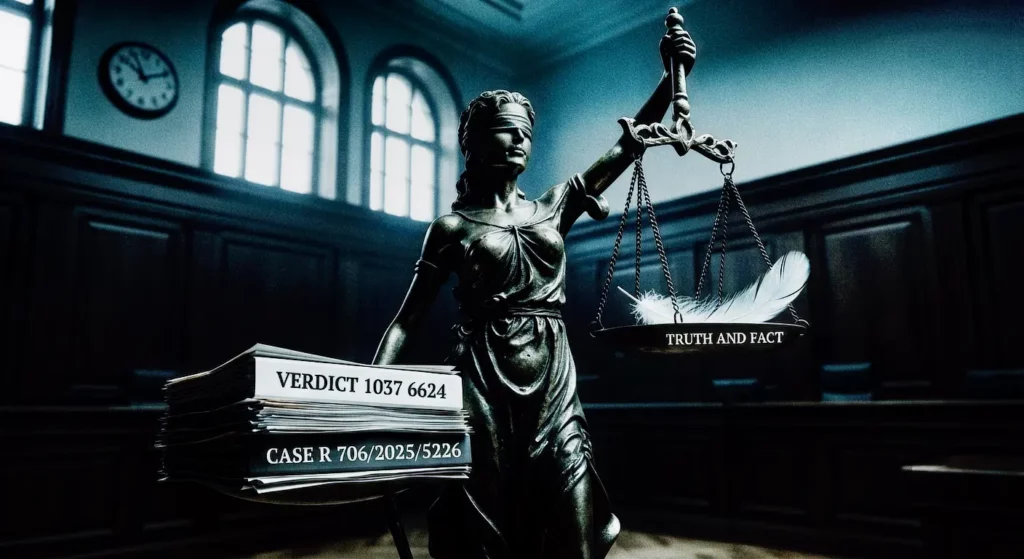
Examination of how an initially documented assault and a later, independently disputed accusation against the original victim came to be presented within the same procedural frame, despite the differences in their evidentiary foundations.
In this case, the procedural symmetry requires examination precisely because the evidentiary paths were different. The initial report concerned an assault described in an emergency call and followed by police attendance. The counter-accusation against TG emerged later, following a telephone interview whose procedural origin, chronology, and relationship to the eventual trial narrative remain unresolved in the materials examined.
This distinction is fundamental. The existence of allegations in an interview transcript is not equivalent to proof of the formal origin of a prosecution. The subsequent appearance of TG as a defendant does not, by itself, answer who initiated the counter-accusation, under what authority, or when she was informed of its contents.
A chronology is not a peripheral detail. It determines where the participants were, whether the alleged events could have occurred as described, and whether the account corresponds to the independently recorded sequence. An accusation whose time reference conflicts with the emergency record requires reconciliation-not silent absorption into a later narrative.
The point is not to replace one untested narrative with another. It is to identify the physical questions that the account itself creates-and to ask whether they were ever independently examined before the allegation was treated as a basis for criminal liability.
The judgment records the court’s conclusion. It does not make the earlier discrepancies disappear, nor does the fact of conviction itself explain how the conflicting accounts were reconciled.
The difference between these formulations is central to the assessment of the conviction. A person who did not see who performed an act cannot be treated as a witness who saw the act indistinctly without a clear evidentiary basis for that change.
The absence of an identifiable document in the materials examined does not establish that no such document ever existed. It does mean that the procedural path from the interview to the criminal charge remains unverified on the record currently available.
The central question is whether the process examined the two accusations according to their actual evidentiary foundations-or whether the appearance of reciprocity obscured the unresolved gaps in the origin, chronology, and development of the counter-accusation.
Two people may occupy the same procedural position without their accusations being supported by equivalent evidence. The symmetry of a judgment cannot substitute for the independent verification of each allegation. Where the evidentiary paths differ, treating them as equivalent without accounting for those differences risks turning procedural symmetry into a substitute for proof.
Before accepting the story, look at the scene.
Now consider the court’s accepted scenario: TG was supposedly waiting above, anticipating N’s return when the battery in his headphones ran out, and threw a heavy stepladder as he entered.
Where, exactly, was she supposed to stand? Where could she position a ten-kilogram stepladder? And through what opening could she have thrown it?
This is not a question of whether the alleged manoeuvre would have been difficult. The physical configuration raises a more fundamental question: how could the alleged manoeuvre have been performed at all?
The alleged trajectory and the alleged ambush position require independent physical examination. Without a reconstruction that accounts for the doorway, the pallet, the chair, the dimensions of the stepladder, and the positions of the participants, the central mechanism of the accusation remains unverified.
The judgment accepted the story. The photograph preserves the scene. They do not appear to tell the same story.
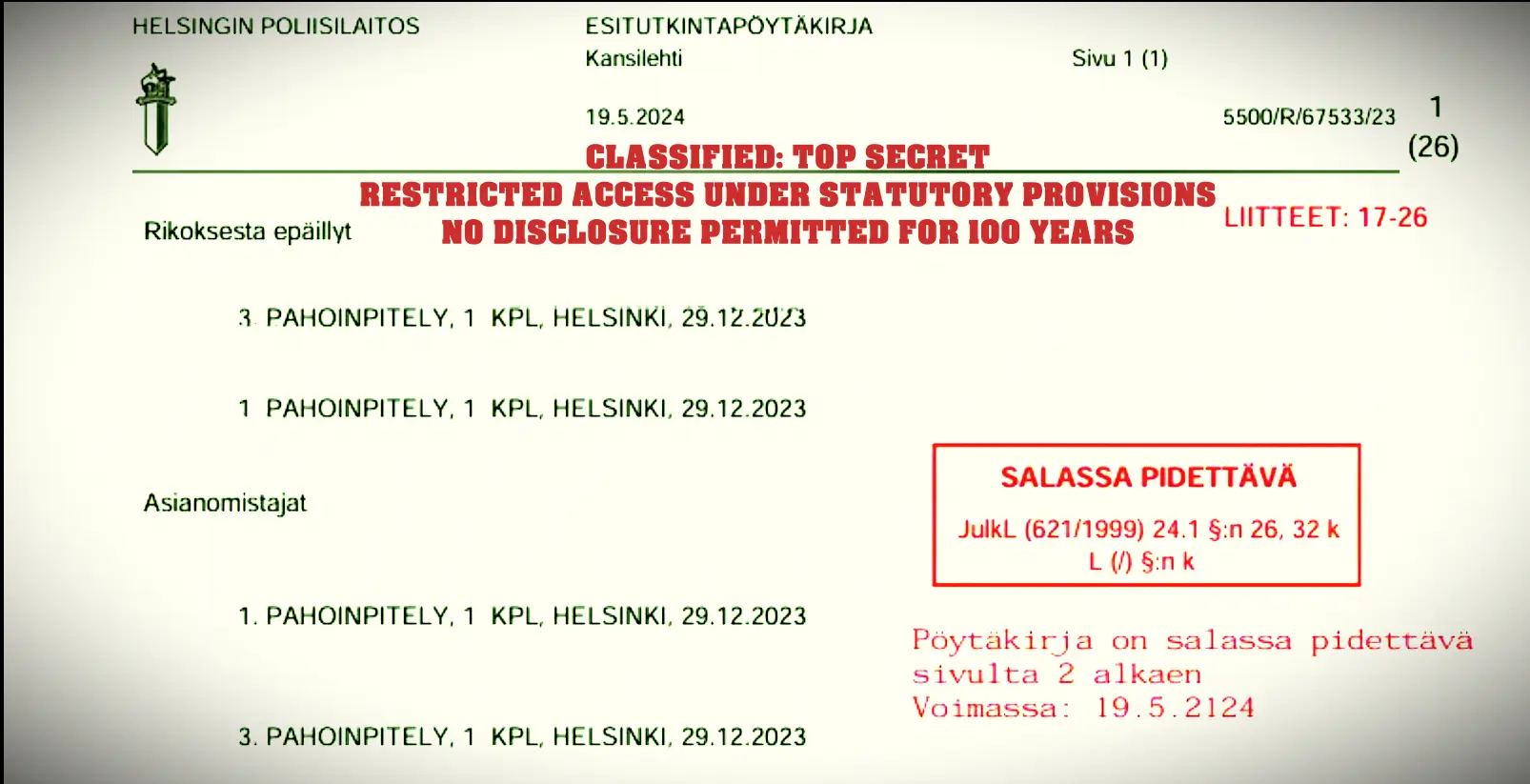
The police photograph central to the reconstruction of the alleged incident is not available for public inspection. The relevant material is classified under the Finnish Act on the Openness of Government Activities, with the restriction extending until 19 May 2124.
This creates a fundamental obstacle to independent scrutiny. The physical configuration of the doorway, the pallet above it, the obstructions at the entrance, and the alleged trajectory of the stepladder cannot be examined by the public against the original evidentiary image.
The court reached a conclusion about what happened in that space. Yet the public cannot inspect the photograph that could help test the physical assumptions underlying that conclusion.
The issue is not merely that evidence is withheld. It is that the restriction prevents independent verification of a central physical question in the case.
A conclusion may be recorded in a judgment. But when the underlying evidence is sealed for a century, the public is left unable to examine how that conclusion withstands physical scrutiny.
The statutory provisions relevant to the procedural, evidentiary, and access-to-information issues examined in this case.
Chapter 4, Section 16 — Notification of the Rights of a Suspect
Provides for the timely notification of a person suspected of an offence, including information about the suspected offence, changes to the suspicion, access to legal assistance, and the right to remain silent.
Chapter 5, Section 3 — Contents of an Application for a Summons
Requires the application to identify the defendant and describe the act alleged, including its time, place, and other particulars necessary to specify the conduct charged.
Section 24 — Secret Official Documents
Section 31 — Secrecy Periods
Sets out categories of confidential official documents and rules governing the duration of secrecy, including provisions concerning information protected for reasons of privacy.
Sections 9–11 — Confidential Trial Documents, Secrecy Orders, and Secrecy Periods
Regulates the confidentiality of court documents, the conditions for secrecy orders, and the statutory periods applicable to confidential material.
Article 6 — Right to Information about the Accusation
Establishes EU-level requirements concerning information provided to suspects and accused persons about the criminal act they are suspected or accused of having committed.
These references identify the legal framework relevant to the questions raised in this case study. Their inclusion does not, by itself, establish that a statutory violation occurred. The application of each provision must be assessed against the complete procedural record and the relevant court decisions.
Independent legal media platform focusing on structural judicial monitoring and criminal case analysis. We examine international standards of justice, from the presumption of innocence to the rigorous evaluation of the standard of proof and in dubio pro reo principles.
All analytical materials and legal case reviews on this website are published for informational and educational purposes only under freedom of expression. Content does not constitute professional legal advice.
© 2026 LawBeatRadio. All rights reserved.