
Independent monitoring of systemic procedural violations
Case Reference: R 706/2025/5226: Finland
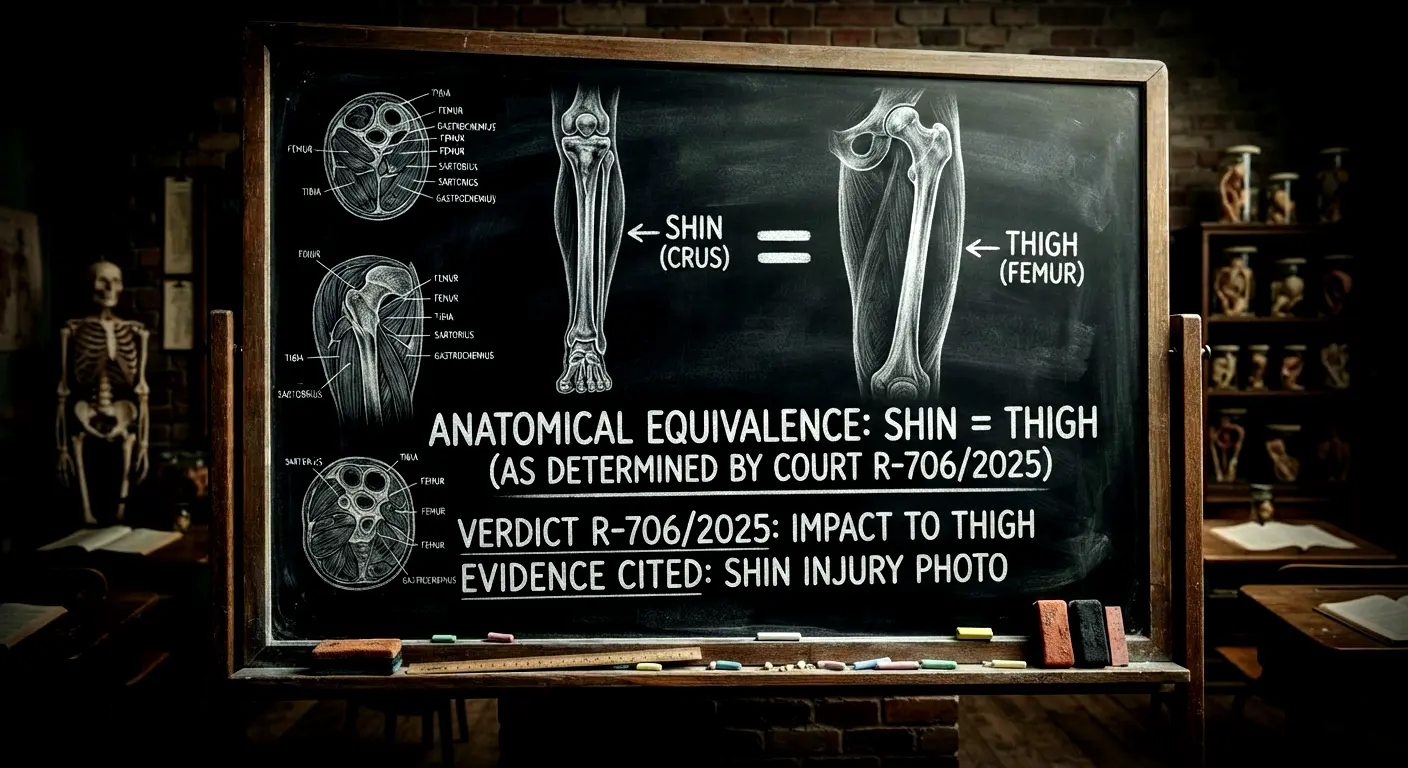
What happens when the court’s written account identifies one anatomical location, while the evidentiary material relied upon in the case identifies another?
Apparently, the answer may depend on how flexible an anatomical location is allowed to become once it enters a criminal case.
This page examines one specific evidentiary issue in Case R 706/2025/5226: the difference between the thigh identified in the court`s written account and the shin identified in the photographic material.
The question is not whether the two words can be reconciled rhetorically. The question is whether the underlying evidence corresponds to the physical act described in the judgment. Because a body part should normally have one useful feature in court: it should stay where it is.
The court’s written decision states that an impact was directed at the thigh (reiteen).
The anatomical location is therefore part of the factual account recorded in the judgment. This is wonderfully convenient. The judgment has chosen a body part. The thigh has officially entered the story.
The photograph, however, has not necessarily received the same instructions. And that is where the fun begins: once the written judgment says thigh, apparently the reader is invited to look at the evidence and discover the thigh hiding somewhere inside it.
The evidentiary material includes an unidentified photographic image of a body part, transmitted via WhatsApp. The available material does not establish the identity of the person depicted. The material is subject to a 100-year state-secrecy classification and therefore cannot be disclosed or presented for public examination. So we have two anatomical destinations for what is presented as the relevant injury.
The ruling’s evidentiary discussion identifies the relevant injury in connection with the shin (säären).
This creates a specific anatomical mismatch:
Judgment: thigh (reisi)
Evidentiary reference: shin (sääri)
One body. One photograph. Two anatomical locations. The Flexible Evidence.
Why force a photograph to remain tied to one body part when the written narrative can apparently move the injury somewhere else?
This mismatch raises a fundamental question about the reliability of evidence and the standard of proof:
A curious psychological possibility
There is also a curious psychological effect worth considering. If a person is repeatedly told that an image shows a thigh while repeatedly being shown what appears to the eye to be a lower leg, the repetition itself can begin to challenge their own perception.
Eventually, the question may no longer be “What am I actually looking at?” but “Why do my eyes keep telling me something different from what I am being told?”
Perhaps that is the ultimate flexibility of this piece of evidence: not only can the body part be flexible – eventually, the viewer’s own eyes can be made to feel negotiable.
The image initially appears to show the side of a lower leg. Yet after being repeatedly told that it is a thigh, even that straightforward visual impression can begin to feel uncertain.
Perhaps this is the most remarkable feature of the Flexible Evidence: after enough repetition, it does not merely allow the evidence to change its meaning – it can make the observer question what they are actually seeing.
Listen to the complete audio investigation as we draw the historical line from the 1819 Boorn brothers show trial straight into the modern evidentiary vacuum of The Victim-Criminal Flip Case R706/2025/5226, Finland.
Independent legal media platform focusing on structural judicial monitoring and criminal case analysis. We examine international standards of justice, from the presumption of innocence to the rigorous evaluation of the standard of proof and in dubio pro reo principles.
All analytical materials and legal case reviews on this website are published for informational and educational purposes only under freedom of expression. Content does not constitute professional legal advice.
© 2026 LawBeatRadio. All rights reserved.