
Independent monitoring of systemic procedural violations
A 22-month delay in the Court of Appeal is not an isolated scheduling hiccup—it is a profound structural failure. This institutional paralysis effectively suspends the presumption of innocence and prevents the proper verification of the standard of proof in cases tainted by glaring physical impossibility.
The systematic omissions and procedural shortcuts in this case mirror established defects previously condemned by the European Court of Human Rights:
These recurring procedural patterns are explicitly monitored under EU Infringement Procedure № 2021/2110, confirming beyond doubt that these are not isolated private disputes, but systemic administrative failures recognized at the highest European level.
By failing to provide a genuine adversarial procedure and timely resolution, the domestic system continues to operate in blatant defiance of binding international standards. Under in dubio pro reo, an apparatus that relies on administrative attrition rather than legal proof has already lost its moral and lawful authority.
LawBeat Radio Audit Directive:
When court backlogs weaponize time against the accused, procedural delay becomes extrajudicial punishment. We document every infraction to ensure accountability under ECHR and EU frameworks.
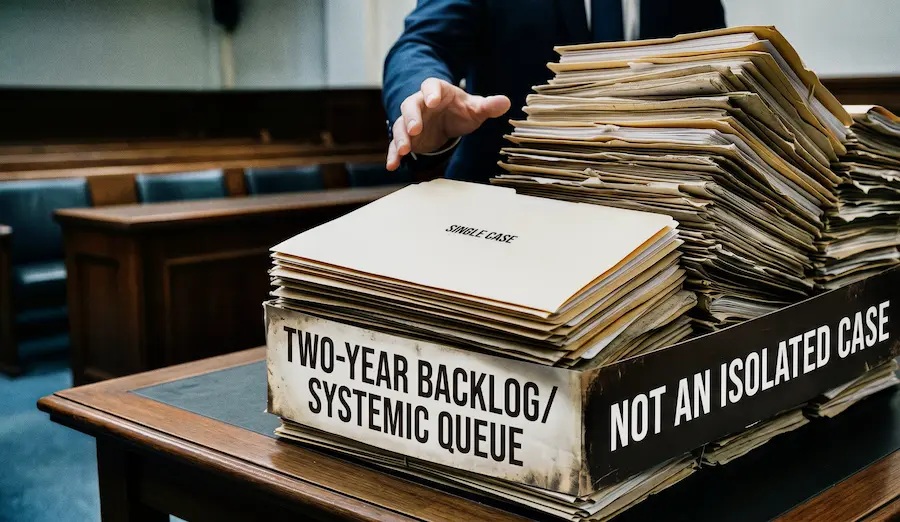
In the framework of international legal proceedings, specific procedural parameters dictate the evaluation of whether a case is an isolated administrative glitch or a reflection of entrenched, systemic structural practices. When an individual faces a toxic combination of a multi-year backlog in the Court of Appeal and severely restricted access to exculpatory case materials, the situation cannot be brushed aside. It must be rigorously analyzed through verified empirical data, the standard of proof, and binding European judicial precedents.
LawBeat Radio Audit Note:
When Article 6 guarantees are compromised by institutional lethargy and suppressed evidence, in dubio pro reo demands that the entire judicial structure be held accountable to international human rights standards.
The existence of a two-year queue in the Court of Appeal is an objective administrative fact. Within a jurisdiction that prides itself on low crime rates, a delay of this magnitude demonstrates that the higher instance is structurally overwhelmed by a systemic volume of cases forwarded from lower courts, rather than experiencing a temporary anomaly.
A single, isolated case cannot mechanically create a two-year backlog in a national appellate infrastructure. The accumulation of these delays directly compromises the presumption of innocence and the principle of in dubio pro reo, as the urgent resolution of factual contradictions remains suspended over an agonizing 22-month period.
Under these conditions, the verification of the standard of proof is indefinitely deferred, regardless of whether the initial indictment contains elements that present a physical impossibility that would otherwise demand an immediate dismissal.
LawBeat Radio Audit Note:
When appellate infrastructure stalls, the “Rule of Law” becomes a hostage to bureaucracy. Stagnation is not mere inefficiency; it is an active denial of a fair trial, rendering material truth secondary to an endless wait.
The argument that procedural omissions—such as the non-disclosure of full case files or the withholding of court audio records from independent experts—are unique, isolated errors completely collapses when evaluated against the established case law of the European Court of Human Rights (ECHR).
The ECHR has repeatedly identified and penalized identical procedural practices within this jurisdiction under Article 6 (Right to a Fair Trial):
The intersection of unverified initial narratives, restricted access to court audio data, and extended appellate wait times forms the factual basis of the ongoing EU Infringement Procedure № 2021/2110. This official intervention by the European Commission confirms beyond question that the procedural delays and disclosure limitations observed in this case are not isolated glitches, but systemic defects recognized at the highest European Union level. Under in dubio pro reo, an apparatus that relies on administrative attrition over factual integrity has abandoned its mandate.
LawBeat Radio Audit Note:
When domestic courts ignore binding ECHR jurisprudence on equality of arms and evidence disclosure, they convert justice into a closed loop of state self-validation. We document every precedent to ensure true accountability.
Independent legal media platform focusing on structural judicial monitoring and criminal case analysis. We examine international standards of justice, from the presumption of innocence to the rigorous evaluation of the standard of proof and in dubio pro reo principles.
All analytical materials and legal case reviews on this website are published for informational and educational purposes only under freedom of expression. Content does not constitute professional legal advice.
© 2026 LawBeatRadio. All rights reserved.