
Independent monitoring of systemic procedural violations
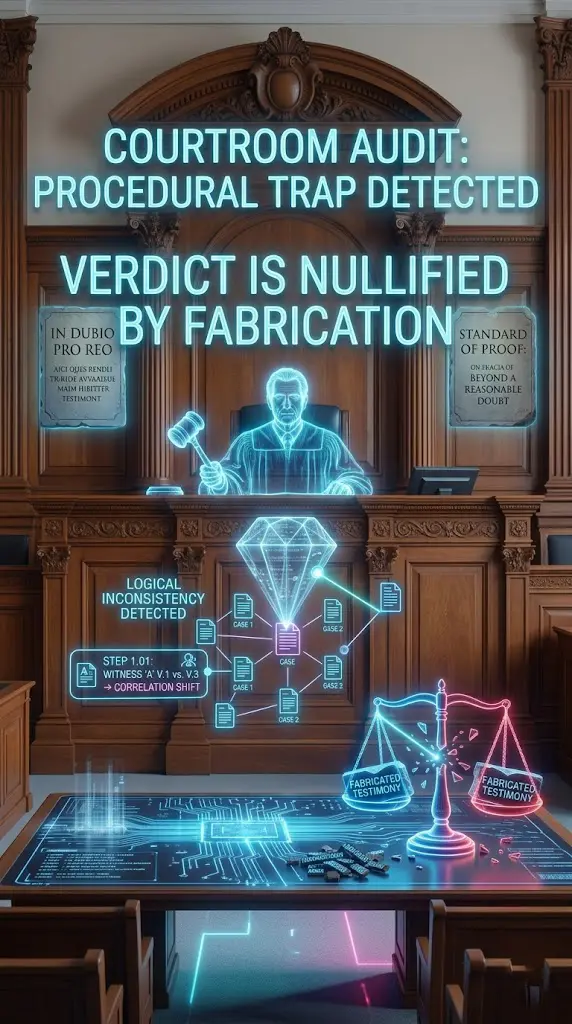
The era of unchecked judicial alchemy is coming to a close. For decades, corrupt or incompetent prosecutions have hidden behind the convenient loophole of the “free evaluation of evidence” (vapaa todisteiden harkinta). They micro-edit witness testimonies, ignore the laws of physics, and silently shift the burden of proof onto the defense. But humans have a major weakness: when they fabricate a narrative, they leave permanent structural anomalies in the text.
At the Tech-Law Lab, we have deployed the Procedural Trap Scanner – an advanced AI forensics engine trained on thousands of criminal cases, appeal court reversals, and human rights violations. Its sole purpose is to act as an unbribable forensic auditor of compromised court records, ensuring the restoration of the PRESUMPTION OF INNOCENCE.
When a defense team or an independent auditor uploads court transcripts, police reports, and the final verdict into the Scanner, the system does not just “read” the words. It maps the cognitive and chronological trajectory of the entire case, establishing the absolute RELIABILITY OF EVIDENCE. Here is exactly how the AI breaks down complex procedural traps and exposes deep systemic flaws:
Temporal Testimony Shifting (The Core Anomaly): The AI tracks every witness statement from day one. In The Victim-Suspect Split Case (Ref: R 706/2025/5226), the scanner flags a catastrophic correlation shift: STEP 1.01: WITNESS 'A' V.1 vs. V.3. When a witness suddenly changes crucial structural details after “informal” contact with investigators, the AI highlights this variance. Humans miss these subtle shifts across a 500-page file; our algorithms spot them in milliseconds, mapping out an ALTERNATIVE PERPETRATOR trail.
Semantic Proximity Analysis: Prosecutorial collusion has a specific linguistic fingerprint. The Scanner analyzes the final verdict and compares its vocabulary with the prosecution’s initial summary. If the judge copy-pastes the prosecution’s biased language while completely ignoring the defense’s physical evidence (such as the structural layouts demonstrated in Exhibit 4), the AI flags an institutional bias anomaly based on PHYSICAL IMPOSSIBILITY.
The “Probability” Downgrade: Under international law and Directive (EU) 2016/343, the STANDARD OF PROOF in criminal law is absolute: BEYOND A REASONABLE DOUBT. When a court lowers this standard to mere “probabilities” or invents a fictional MOTIVE AND INTENT to secure a conviction, the AI automatically triggers a system breach log.
Procedural Trap Scanner, AI forensics, Tech-Law Lab, LawBeat Radio, The Victim-Suspect Split Case, Ref: R 706/2025/5226, IN DUBIO PRO REO, PRESUMPTION OF INNOCENCE, RELIABILITY OF EVIDENCE, PHYSICAL IMPOSSIBILITY, MOTIVE AND INTENT, ALTERNATIVE PERPETRATOR, STANDARD OF PROOF, BEYOND A REASONABLE DOUBT, vapaa todisteiden harkinta, fabricated testimony, court audit, judicial alchemy, prosecutorial misconduct, Finnish criminal justice system, human rights violations, Directive EU 2016/343, semantic proximity analysis, temporal testimony shifting, Exhibit 4 analysis, legal tech forensics, unbribable forensic auditor, cognitive trajectory tracking, corrupted case file, courtroom corruption detection, Helsinki court audit, police report manipulation, legal algorithms, machine learning jurisprudence.
Independent legal media platform focusing on structural judicial monitoring and criminal case analysis. We examine international standards of justice, from the presumption of innocence to the rigorous evaluation of the standard of proof and in dubio pro reo principles.
All analytical materials and legal case reviews on this website are published for informational and educational purposes only under freedom of expression. Content does not constitute professional legal advice.
© 2026 LawBeatRadio. All rights reserved.