
Independent monitoring of systemic procedural violations
An examination of the reasoning contained in the Helsinki District Court judgment.
This page presents the judgment issued by the Helsinki District Court (Helsingin käräjäoikeus) in criminal case R-706/2025/5226, decision number 1037 6624.
The document is reproduced here in three visual parts so that the judicial reasoning can be examined directly rather than only through an editorial summary.
The purpose of the analysis is to follow the court’s reasoning from the underlying events and evidence to its findings of fact, assessment of the parties’ accounts and ultimate legal conclusions.
The central issue is not simply whether the court reached a particular conclusion. It is how the conclusion was constructed from the evidence.
The analysis therefore follows several distinct questions:
The term “Victim–Criminal Flip” is used on LawBeatRadio as an analytical description of the central procedural transformation examined in this case: the original position of the person reporting the incident and the later position assigned to that same person in the criminal proceedings.
The question for analysis is how that change occurred, what evidential basis accompanied it, and how the resulting procedural positions were reflected in the court’s reasoning.
The following images reproduce the judgment in three consecutive parts. They are presented as documentary material for direct examination. Subsequent sections of this case study will isolate specific passages and compare the court’s findings with the underlying evidential record.


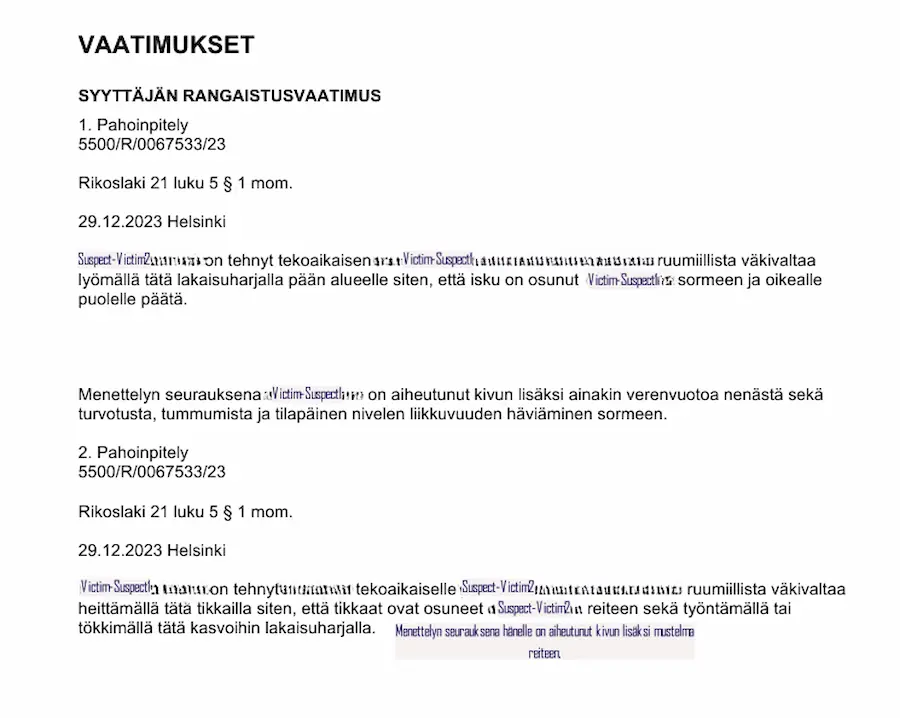
Each subsequent analytical block will take one identifiable proposition from the judgment and place it beside the evidence or procedural record relevant to that proposition.
Documented fact →
Judicial finding →
Inference →
Legal conclusion
The purpose is to make the reasoning traceable: where the record ends, where inference begins, and where the judgment reaches its legal conclusion.
This page distinguishes the contents of the judicial document from the editorial analysis applied to it. The judgment remains the primary document. The questions raised by LawBeatRadio concern the evidential, procedural and logical steps by which the judgment reaches its findings.
The document speaks first.
The analysis begins where the reasoning can be tested.
Claims, formal responses and the evidential record identified in the judgment.
Parts 04–06 of the judgment move from the parties’ claims and responses to the evidence identified for the court’s consideration.
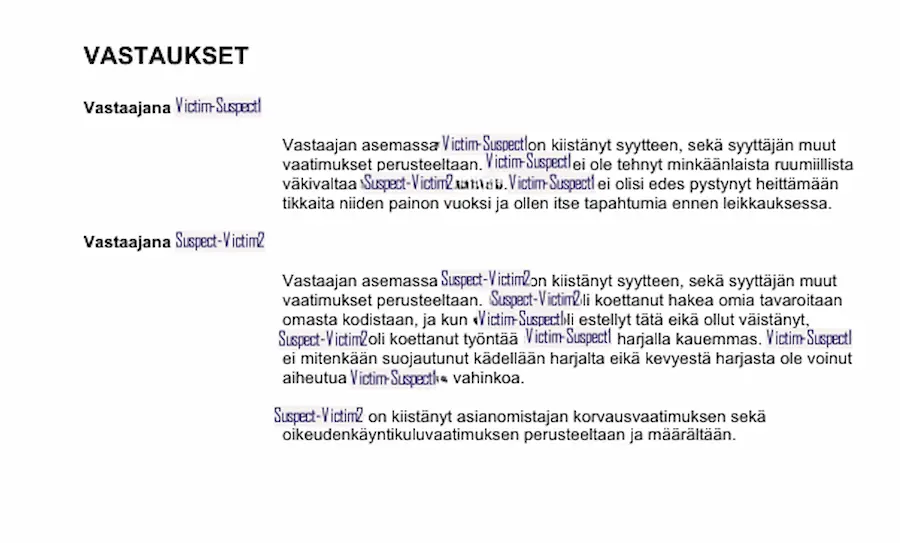
These sections are important because they place the competing accounts and the evidential material within the same documentary framework. The defence position is stated formally: the charges and claims are denied, and the defence identifies, among other matters, physical and medical circumstances said to be incompatible with the alleged conduct.
The purpose of this section is to document what the parties said and what evidence the judgment records. The question of how the court subsequently evaluated that material is examined separately.
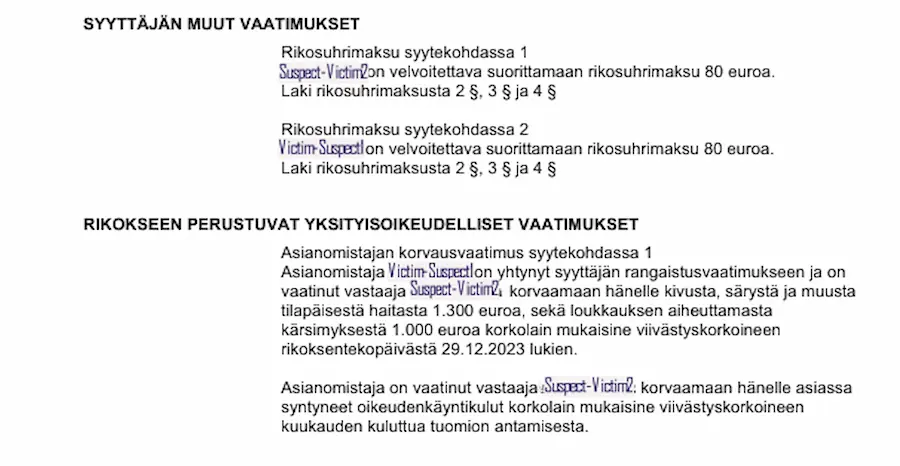
The judgment records additional claims made in connection with the criminal proceedings.
Crime Victim Fee (Rikosuhrimaksu)
A demand of €80 in relation to the two counts.
Private Damages
The injured party joined the prosecutor’s claim and sought €1,300 for pain, suffering and temporary impairment, together with statutory interest and legal costs.
The judgment then records the formal responses of the parties. These responses are particularly relevant because they identify the factual propositions that were disputed before the court.
The defendant denied the charges and the related claims. The defence position was that no physical violence had been committed and that the alleged physical conduct was incompatible with the circumstances described, including the effects and limitations associated with a surgical operation and the physical characteristics of the object in question.
The opposing party gave a different account, stating that they were attempting to retrieve property and that they pushed the individual away with a brush or broom when access was blocked. The related private damage claims were disputed.
At this stage, the important distinction is between what a party asserted and what the evidence ultimately established. A formal defence statement is not itself proof. At the same time, a defence proposition concerning physical or medical impossibility is a proposition capable of being tested against objective evidence.
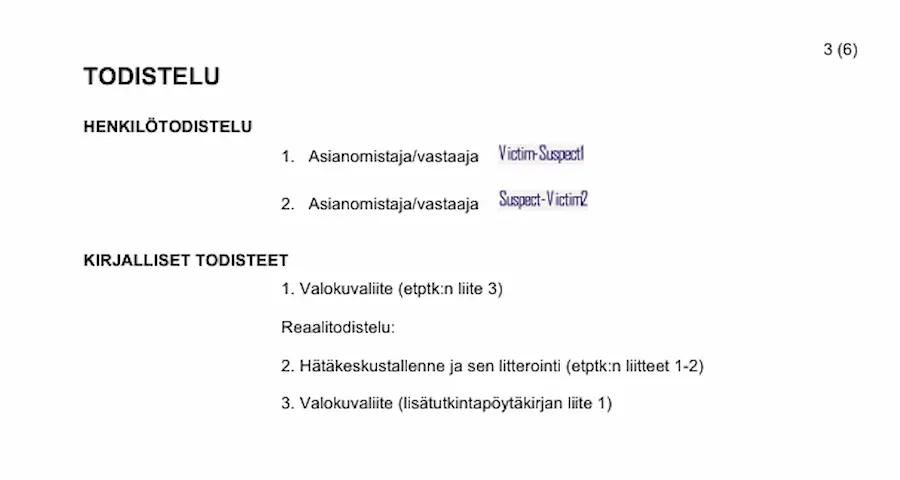
The judgment identifies several categories of evidence relied upon in the proceedings.
The following images reproduce the corresponding sections of the judgment.
The parties stated their positions.
The record identified the evidence.
Now the reasoning can be tested.
Where the judgment’s factual narrative can be compared with the documented record.
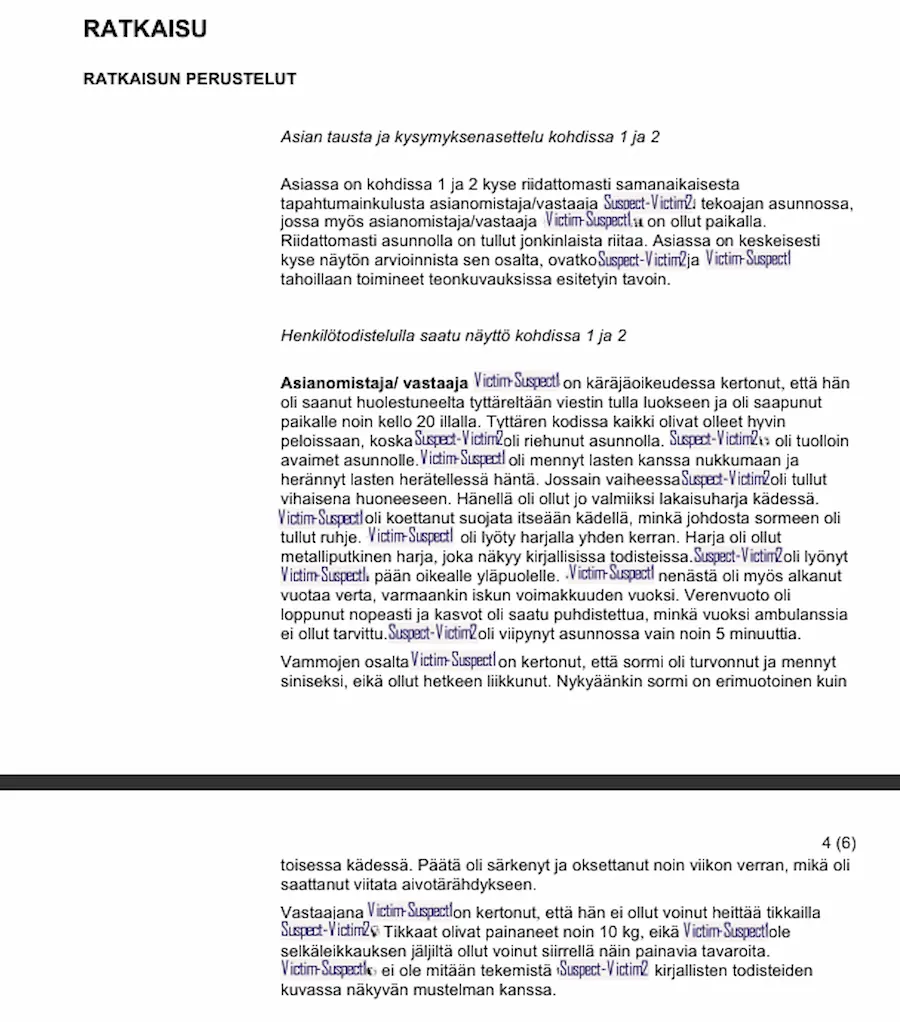
Section 7 of the judgment (Ratkaisun perustelut) sets out the court’s factual and evidential reasoning. This is therefore the point at which the documentary record can be compared directly with the narrative adopted by the court.
The questions below concern specific elements of that reasoning: chronology, physical capability, the reconstruction of the alleged act, and the evidential basis for the conclusions reached.
The judgment constructs a chronology of the parties’ arrival, presence and interaction at the residence. That chronology is central to the court’s reconstruction of how the confrontation developed.
Question for the record:
Does the chronology stated in the judgment correspond with the documented sequence of arrival, presence and departure, or does the wording introduce a sequence that is not established by the underlying evidence?
The defence disputed the alleged handling of the approximately 10-kilogram object and referred to physical limitations following surgery.
The issue is therefore capable of being tested against the evidence rather than resolved by narrative alone.
Question for the record:
What evidence establishes that the defendant was physically capable of lifting, moving or using the object in the manner alleged, given the documented medical circumstances relied upon by the defence?
The critical question is not simply whether the judgment contains a conclusion. It is what evidence supports the conclusion and what intermediate reasoning connects the two.
Documented fact
→
Evidence relied upon
→
Inference
→
Judicial finding
Question for the record:
Can each material finding in Section 7 be traced back to identifiable evidence in the case record, or are any conclusions dependent upon assumptions that are not separately established?
The case record presents a procedural transformation in which the person who initially reported the incident as a victim later appeared as a defendant in the criminal proceedings.
That transformation is a documented procedural fact. The question is what evidential and procedural steps connect the initial status to the later one.
Question for the record:
What evidence and procedural reasoning justified the transition from the original victim position to the subsequent defendant position, and how is that transition reflected in the judgment’s reasoning?
The judgment records the conclusion.
The record allows the reasoning to be examined.
Section 8 of the Helsinki District Court judgment evaluates the evidence concerning the reported incident and the parties’ accounts. The section is particularly important because the judgment describes the original complainant’s testimony as consistent and detailed and refers to objective material, including the emergency call recording and medical documentation.
That creates a specific evidential question. If the court accepted parts of this account and identified supporting material, how were those facts incorporated into the final reconstruction of the event — and which parts of the original account were rejected, displaced, or left without legal consequence?
The emergency call is contemporaneous evidence of what was reported immediately after the incident. The judgment also refers to medical documentation concerning facial injury and a broken finger.
Analytical question:
If these materials corroborate identifiable parts of the original account, which factual propositions do they establish, and how are those propositions reflected in the court’s final reconstruction?
The parties’ accounts describe the object involved in the initial confrontation differently. The documentary record therefore permits a direct comparison between the physical object described, the terminology used in the judgment, and the alleged mechanism of injury.
Analytical question:
What evidence identifies the object, its material, construction, weight, and use — and does the judgment’s description correspond to the object established by the underlying evidence?
The emergency call forms part of the evidential record and contains the contemporaneous account made immediately after the incident. It therefore provides a fixed point against which later descriptions can be compared.
Analytical question:
Does the final judgment address the material contents of that recording consistently with the account it gives of the incident? If particular statements were rejected, where does the judgment explain why?
Documented material
→
Fact established
→
Inference drawn
→
Judicial finding
The critical issue is not whether the court was entitled to evaluate the evidence. It was. The issue is whether each material conclusion can be traced through this chain without an evidential step disappearing between the record and the finding.
The procedural record presents a significant transformation: the person who initially reported the incident as the victim subsequently appears in the proceedings as a defendant.
Analytical question:
What evidential and procedural reasoning in the judgment explains that transformation, and how does the court reconcile the original victim account, the emergency-call material, the medical evidence, and the later criminal finding?

The question is not whether the court evaluated the evidence. The question is whether the final finding can still be traced back to the evidence the judgment itself records.
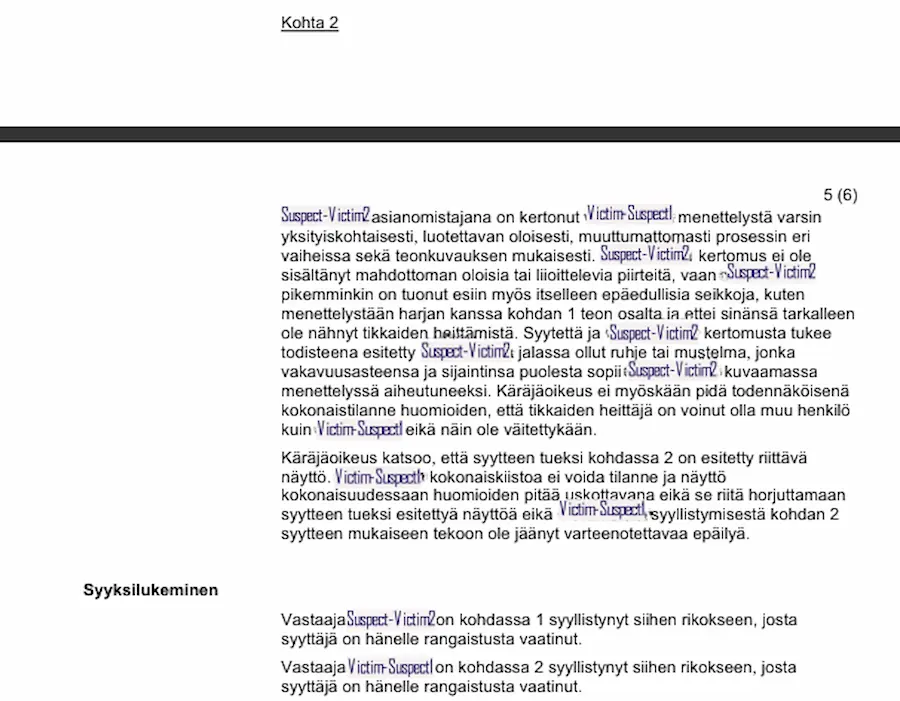
Section 9 addresses the account concerning the alleged use or fall of the ladder and the evidence supporting that account. One point is particularly important: the person whose account is relied upon did not see the critical moment in which the ladder allegedly fell or was thrown.
That does not, by itself, disprove the event. A court may rely on circumstantial evidence. But it makes the reconstruction of the event especially important: what evidence establishes how the ladder moved, from where it came, where it travelled, and how the alleged impact occurred?
The judgment records that the relevant witness did not see the ladder being thrown or falling. This is a documented limitation on direct observation.
Analytical question:
If the critical movement was not observed, what independent evidence establishes the movement itself — rather than merely establishing that the witness was present when its consequences were later observed?
The alleged mechanism involves a heavy object described in the case materials as approximately 10 kilograms. The relevant issue is therefore not simply whether such an object existed, but whether the proposed movement and impact are physically compatible with the documented scene.
Analytical question:
What evidence establishes the object’s position, trajectory, point of release, intervening obstacles, point of impact, and the physical conditions required for the alleged event to occur?
The judgment identifies the alleged point of impact. The photographic material available in the record must therefore be compared with that description rather than treated as interchangeable evidence.
Where an image appears to show an injury on a different part of the leg from the anatomical location described in the judgment, the issue becomes one of evidential identification: what exactly does the photograph depict, and how was its identity and anatomical location established?
Analytical question:
Does the photographic evidence establish the same injury and anatomical location described in the judgment, or does the record require further identification or expert examination?
Starting position
→
Movement / trajectory
→
Obstructions
→
Point of impact
→
Observed injury
Each step requires evidential support. If a physical reconstruction depends on a position, trajectory, or anatomical point that has not been established, that assumption should be identified rather than silently incorporated into the conclusion.
The record contains more than one account of physical violence and more than one category of supporting material. The emergency call and medical documentation form part of the evidence concerning the initial reported assault; the ladder account concerns a different alleged mechanism and injury.
Analytical question:
Were the competing accounts tested against the same evidential standard — including contemporaneous recordings, medical documentation, photographs, witness limitations, and physical reconstruction — or were some propositions accepted without an equivalent examination of their physical mechanism?
When the critical act was not seen, the physical mechanism becomes part of the evidence. The question is whether the record actually supports the reconstruction.
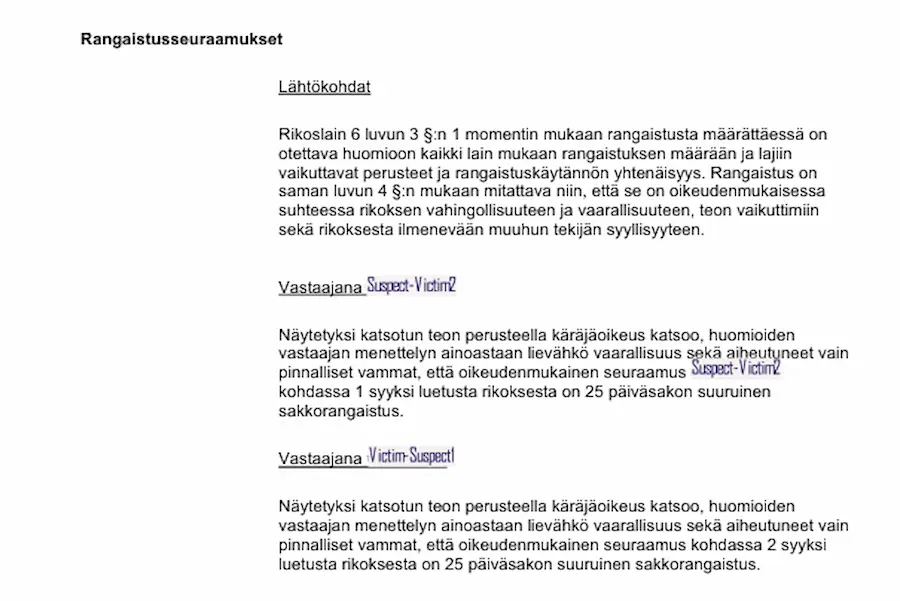
Section 10 addresses the criminal sanctions imposed following the court’s findings. The judgment records an identical sanction of 25 day-fines (päiväsakkoa) for the parties.
The numerical symmetry is clear. The analytical question is whether the underlying conduct, evidential findings, injuries, circumstances, and degrees of responsibility were also treated as equivalent — and, if so, on what reasoning.
The judgment imposes the same number of day-fines on both parties. That is a fact capable of being read directly from the ruling.
Analytical question:
What specific findings led the court to regard the two offences as warranting the same number of day-fines? Does the reasoning identify comparable levels of harm, culpability, intent, and surrounding circumstances?
The judgment addresses the injuries relied upon in the proceedings. The evidential question is not simply whether injuries existed, but how the court classified their seriousness and how that classification affected the final sanction.
Analytical question:
How does the judgment characterise the documented head injury, finger injury, and other medical findings, and how are those findings reflected in the assessment of the seriousness of the offence?
The second offence rests on the court’s findings concerning the alleged ladder incident. As examined in Section 9, the critical movement of the object was not directly observed.
Analytical question:
If the ladder mechanism depends on circumstantial reconstruction, how did the court assess the evidential strength of that reconstruction when determining the seriousness of the offence and the appropriate sanction?
An identical penalty does not by itself establish that the underlying cases were identical. Nor does numerical symmetry by itself establish unequal treatment.
The documentary question:
Does the court’s reasoning explain why materially different factual and evidential circumstances nevertheless produced the same sanction?
The judgment moves from factual findings to legal classification and then to criminal sanctions. Each transition can therefore be examined independently.
Analytical question:
Can the 25-day-fine outcome be traced through a clear chain from the proven conduct, to the seriousness assessment, to the applicable sentencing reasoning — without relying on factual equivalence that the preceding sections do not establish?
Equal punishment is a conclusion. The record should show why the underlying conduct was treated as equivalent.
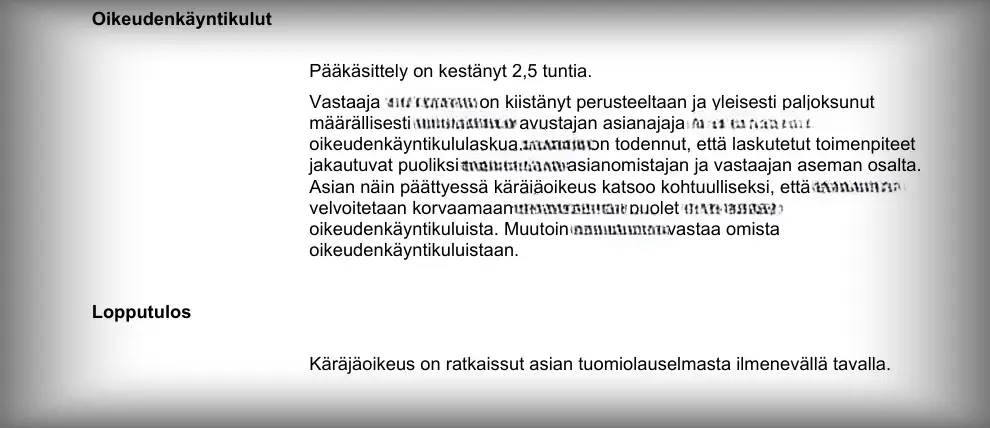
The judgment records the main hearing as lasting 2.5 hours, equivalent to 150 minutes. The audio material supplied for the appeal consists of two files with a combined duration of approximately 77 minutes.
That produces a straightforward numerical difference: 73 minutes. The existence of the difference can be calculated directly. What cannot be assumed from the difference alone is what happened to the missing time.
Judgment: 2.5 hours = 150 minutes
Supplied audio: approximately 77 minutes
Difference: 73 minutes
The supplied recording does not account for the full 150-minute duration recorded in the judgment.
The documentary question:
What accounts for the remaining 73 minutes? Are they contained in another recording, excluded because of breaks or administrative intervals, preserved in a different format, or otherwise absent from the material supplied for the appeal?
A hearing record should permit the proceedings relied upon in the judgment to be identified and, where necessary, checked against the underlying material. A shorter supplied recording is therefore not automatically proof that proceedings were omitted.
Analytical question:
Does the supplied audio constitute the complete recording of the main hearing, or only part of the court’s recorded material? If it is incomplete, where is the remainder and how is the completeness of the record verified?
The 73-minute difference matters because the absent portion, if it represents recorded hearing proceedings, could contain testimony, questions, objections, explanations, or other material relevant to the reconstruction of what occurred at trial.
The evidential question:
Which parts of the hearing are actually available for independent verification, and which parts cannot presently be checked against the supplied recording?
The supplied files can also be examined for technical information such as file duration, creation or modification data, format, encoding, and other available metadata.
Analytical question:
What technical information remains in the supplied files, and does it establish whether the 77-minute material is complete, partial, extracted, or otherwise altered from a longer original recording?
The mathematics is simple: 150 minutes are recorded in the judgment, while approximately 77 minutes are present in the supplied audio. The unresolved issue is what accounts for the other 73.

HOSTED BY JULIAN VANCE
Personal experiences navigating unexpected journeys & judicial anomalies.
LawBeat Radio Forensic Audit Verdict: Audio archives fully indexed and ready for direct streaming from AzuraCast infrastructure. Reliability of evidence verified across all serial channels.
Please check this notice for updates. Any changes to the hearing date or time will be published here.
The Helsinki District Court and the Helsinki Court of Appeal are located in the same courthouse, sharing the same main entrance and ground-floor cafeteria.
LawBeatRadio invites journalists, legal professionals, researchers, students and members of the public to attend the public hearing.
Independent legal media platform focusing on structural judicial monitoring and criminal case analysis. We examine international standards of justice, from the presumption of innocence to the rigorous evaluation of the standard of proof and in dubio pro reo principles.
All analytical materials and legal case reviews on this website are published for informational and educational purposes only under freedom of expression. Content does not constitute professional legal advice.