
Independent monitoring of systemic procedural violations
The secrecy surrounding the investigation file creates a de facto barrier to a fair trial. Where evidence central to the defence remains inaccessible, the ability to examine, challenge, and independently assess that evidence is materially restricted.
This situation raises serious concerns under Article 6 of the European Convention on Human Rights (ECHR) and the principle of equality of arms.
The complete removal of the secrecy classification covering the pre-trial investigation materials.
In the alternative, should the Court consider full disclosure impossible, the demand seeks access at least to the materials indispensable for independent technical and expert analysis.
Demand: Immediate disclosure of the audio recording and original interrogation protocol.
The interrogation record contains critical deficiencies that call its procedural validity into question:
If no audio recording exists, the Court is requested to explain how the authorities verified that the rights were understood in circumstances where the signature is absent and the linguistic safeguards were allegedly not observed. Secrecy must not prevent the examination of this serious procedural concern.
Demand: Removal of the secrecy classification from the police photographs, particularly Photo No. 4, documenting the structural obstacles at the scene. The defence must have unrestricted access to this material to conduct an independent technical assessment.
Thesis: The alleged dropping of an object weighing approximately 10 kg is structurally impossible under the conditions documented at the scene. The account of the second complainant concerning the position of the door, together with the fixed obstacles, excludes the action described in the charge.
Structural obstruction above the doorway. The photographic evidence shows large cat-climbing structures projecting directly above the doorway. This obstruction blocks the vertical line of descent. A 10 kg stool could not pass through the described trajectory without striking the structure.
Geometric constraint created by the door. The complainant states that the door was only partially open. In that position, the door leaf creates an additional obstruction, further narrowing the available space. The combined geometry of the climbing structure, door, and frame leaves insufficient clearance for the movement alleged in the charge.
Absence of physical damage. Police Photo No. 4 shows the climbing structures upright and apparently undamaged. The absence of visible impact damage is inconsistent with the alleged trajectory of a heavy object and requires a technical explanation.
Article 6 ECHR; Article 47 of the EU Charter of Fundamental Rights; Section 21 of the Finnish Constitution; Section 17 of the Act on the Publicity of Court Proceedings in General Courts.
Thesis: The location and characteristics of the injury described as being on the lower leg are incompatible with the alleged mechanism of a ladder or stool strike.
Location versus trajectory. A 10 kg stool falling from above would be expected to produce a substantial impact injury, potentially including severe bruising or fracture. The two small superficial scratches visible in the photograph identified as Annex 1 are inconsistent with the alleged impact energy.
Mechanical incompatibility. The geometric obstruction prevents an unobstructed fall along the alleged trajectory toward the lower leg. The location of the scratches appears more consistent with lateral friction than with a vertical impact from a heavy object.
Unreliability of the visual evidence. The photograph is unclear and does not independently establish when the injury occurred or whom it depicts. Its evidentiary limitations prevent it from conclusively demonstrating the alleged cause or mechanism.
Demand: Removal of the secrecy classification from the injury-related evidence to permit independent biomechanical expert analysis.
The Court is requested to take into account a material change in the complainant’s account:
Reactive awakening in response to a sound.
A premeditated ambush allegedly planned over several hours.
These descriptions are psychologically and legally incompatible. The change in the account raises the question of whether the facts were deliberately reshaped.
Demand: Access to the original recordings for an expert in forensic psychology or cognitive analysis to assess the reliability and consistency of the testimony.
Demand: The Court is requested to provide an official explanation for the 22-month delay in the proceedings.
The delay raises concerns under Article 6 ECHR and the standards developed by the European Court of Human Rights. It threatens legal protection, weakens the defence’s ability to analyse evidence, and forces the defendant to live under the continuing shadow of a wrongful conviction, functioning in practice as an additional punishment outside the formal sentence.
The Court is also requested to confirm the final hearing date.
The issues raised in the demand are not isolated requests for access to documents. They concern the ability to test the reliability of the investigation, examine the physical feasibility of the prosecution narrative, obtain independent expert scrutiny, and secure a procedurally fair opportunity to challenge the evidence.
The continued secrecy of central materials, the absence of an accessible record of the disputed interrogation, and the unresolved questions surrounding the physical and testimonial evidence together raise concerns about institutional accountability and the effective administration of justice.
The formal demand submitted to the Helsinki Court of Appeal on 23 April 2026 remains unanswered. The absence of a response leaves the requested disclosure and procedural questions unresolved and reinforces concerns about institutional maladministration.
A formal demand to remove the secrecy classification from the investigation materials in a domestic case was submitted on 23 April 2026. The demand concerns a case in which, according to the applicant, the investigation relied on a single interrogation and proceeded without forensic examinations such as DNA analysis or fingerprint analysis.
The original Finnish police report bears a 100-year secrecy classification.
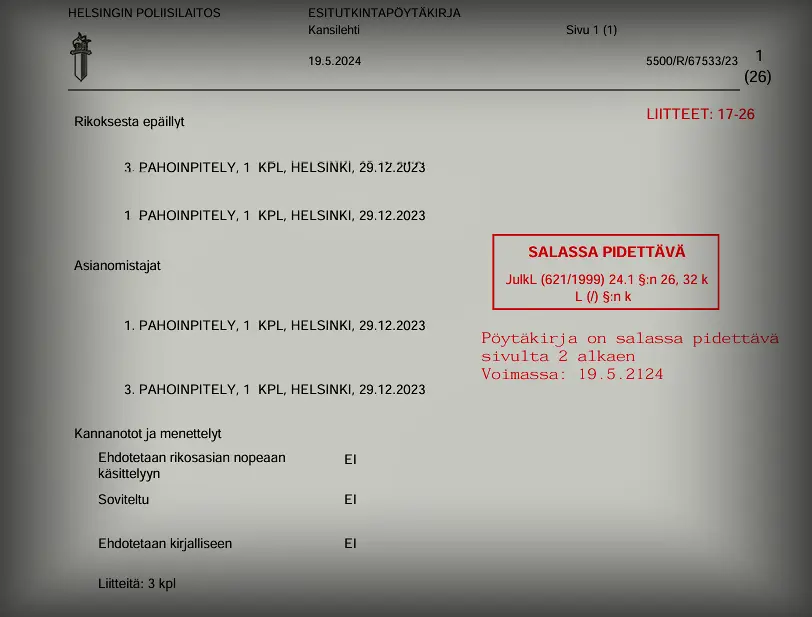
A demand for transparency is not a demand for preferential treatment. It is a demand for the materials necessary to examine the evidence, test the prosecution’s account, and make the right to a fair trial effective.
Tämä on Helsingin hovioikeudelle 23. huhtikuuta 2026 toimitetun vaatimuksen alkuperäinen suomenkielinen teksti. Asiakirja esitetään alkuperäisessä muodossaan, eikä kyseessä ole englanninkielinen käännös tai toimituksellinen uudelleenkirjoitus.
Tällä asiakirjalla esitän hovioikeudelle perustellun vaatimuksen esitutkinta-aineiston salassapidon purkamisesta. Nykyinen tilanne, jossa keskeinen näyttö on salattu puolustukselta, muodostaa tosiasiallisen esteen oikeudenmukaiselle oikeudenkäynnille ja rikkoo Euroopan ihmisoikeussopimuksen (EIS) 6 artiklan mukaista aseiden tasavertaisuusperiaatetta.
Vaadin esitutkinta-aineiston salassapidon poistamista kokonaisuudessaan.
Mikäli hovioikeus katsoo, ettei aineistoa voida avata kokonaisuudessaan, vaadin salassapidon poistamista vähintään seuraavilta osin, jotka ovat välttämättömiä teknisen ja asiantuntija-analyysin suorittamiseksi:
Vaadin 24.04.2024 pidetyn puhelinkuulustelun audiotallenteen ja alkuperäisen pöytäkirjan välitöntä avaamista salassapidosta.
Kyseisessä kuulustelupöytäkirjassa on kriittisiä puutteita, jotka tekevät siitä lainvastaisen todisteen:
Allekirjoituksen puuttuminen: Pöytäkirjaan on merkitty ”Luettu, annettu tarkastettavaksi ja hyväksytty”, mutta siitä puuttuu allekirjoitukseni. Kiistän hyväksyneeni pöytäkirjan sisältöä.
Kielellisten oikeuksien loukkaus: Pöytäkirjan esitäytettyä osiota (oikeudet ja velvollisuudet) ei ole käännetty minulle. Pöytäkirjasta puuttuu vahvistus siitä, että tulkki olisi kääntänyt kyseisen oikeusturvan kannalta olennaisen osan.
Olosuhteet: Kuulustelu suoritettiin puhelimitse liikkuvassa junassa, mikä esti tosiasiallisen mahdollisuuden oikeusturvan toteutumiseen ja avustajan käyttöön.
Asiantuntija-arvion tarve: Tarvitsen tallenteen ja pöytäkirjan riippumattomalle asiantuntijalle menettelyvirheen ja itseinkriminointisuojan loukkauksen vahvistamiseksi (EIS 6 §, EU:n perusoikeuskirja 47 artikla).
Mikäli audiotallennetta ei ole, vaadin selvitystä siitä, miten viranomainen on varmistanut oikeuksien ymmärtämisen tilanteessa, jossa allekirjoitusta ei ole ja kielellinen oikeus on laiminlyöty. Salassapito ei saa estää tämän vakavan prosessuaalisen virheen tutkimista.
Vaatimus: Vaadin poistamaan salassapidon poliisin ottamista valokuvista (erityisesti kuva nro 4), jotka osoittavat tapahtumapaikan rakenteelliset esteet. Puolustuksella on oltava esteetön pääsy tähän aineistoon teknisen asiantuntija-analyysin suorittamiseksi.
Teesi: Syytteessä kuvattu 10 kg painavan esineen pudottaminen on rakenteellisesti mahdotonta. Asianomistaja-2 kertomus oven asennosta ja tapahtumapaikan kiinteät esteet sulkevat pois syytteen mukaisen toiminnan.
Perustelut:
Rakenteellinen yläeste (Yläpuolinen este): Valokuvatodisteet osoittavat, että massiiviset kissan kiipeilypuut muodostavat ulkoneman suoraan oviaukon yläpuolelle. Tämä este tukkii pystysuoran pudotuslinjan. 10 kg painoinen jakkara ei voi fyysisesti ohittaa tätä estettä osumatta siihen.
Oven lehden muodostama geometrinen lukko: Asianomistaja väittää, että ovi oli vain raollaan. Tällöin oven reuna muodostaa lisäesteen, joka kaventaa entisestään vapaata tilaa. Näiden kolmen elementin — kiipeilypuun, oven ja karmin — välinen tila on liian ahdas syytteessä kuvatulle liikkeelle.
Fyysisten jälkien puuttuminen: Poliisin ottama kuva nro 4 vahvistaa, että kiipeilypuut ovat täysin pystyssä ja ehjiä. Jos 10 kg painoinen esine olisi pudotettu kuvatulla tavalla, se olisi vaurioittanut rakenteita. Koska vaurioita ei ole, tapahtumainkulku on fyysisesti mahdoton.
EIS 6 artikla, EU:n perusoikeuskirja 47 artikla, Suomen perustuslaki 21 §, Laki oikeudenkäynnin julkisuudesta 17 §.
Teesi: Vamman sijainti ja laatu sääressä sulkevat pois mahdollisuuden, että se olisi syntynyt syytteessä kuvatulla tavalla.
Perustelut:
Sijainti vs. Liikerata: 10 kg painoinen jakkara putoamassa ylhäältä päin aiheuttaisi vakavan ruhjevamman tai murtuman. Valokuvassa (Liite 1) näkyvät kaksi pientä pintanaarmua ovat ristiriidassa väitetyn iskuenergian kanssa.
Mekaaninen mahdottomuus: “Geometrinen lukko” estää vapaan putoamisradan sääreen. Naarmujen sijainti viittaa sivusuuntaiseen hankaumaan, ei pystysuoraan iskuun massiivisella esineellä.
Näytön epäluotettavuus: Valokuva on epäselvä, eikä siitä voida varmistaa vamman syntyaikaa tai kohdetta.
Vaatimus: Vaadin vammadataan liittyvän salassapidon poistamista biomekaanista asiantuntija-analyysia varten.
Huomautus: Pyydän hovioikeutta huomioimaan, että asianomistaja on muuttanut kertomustaan olennaisesti:
Reaktiivinen herääminen ääneen.
Ennalta suunniteltu tuntikausien väijytys.
Nämä kaksi kuvausta ovat psykologisesti ja juridisesti toisensa poissulkevia. Kertomuksen muuttaminen osoittaa pyrkimystä muokata totuutta.
Vaatimus: Vaadin asiantuntijalle (oikeuspsykologia/kognitiivinen analyysi) pääsyä alkuperäisiin tallenteisiin kertomuksen uskottavuuden arvioimiseksi.
Vaadin hovioikeudelta virallisen selvityksen asian 22 kuukauden viivästymisestä. Tämä viive ylittää EIS 6 artiklan ja EIT:n suositukset, vaarantaa oikeusturvan ja heikentää puolustuksen mahdollisuuksia analysoida näyttöä.
Vaadin myös vahvistusta lopullisesta istuntopäivästä.
Alkuperäinen vaatimus Helsingin hovioikeudelle — 23.04.2026
Original Finnish-language submission · Case R 706/2025/5226
Independent legal media platform focusing on structural judicial monitoring and criminal case analysis. We examine international standards of justice, from the presumption of innocence to the rigorous evaluation of the standard of proof and in dubio pro reo principles.
All analytical materials and legal case reviews on this website are published for informational and educational purposes only under freedom of expression. Content does not constitute professional legal advice.
© 2026 LawBeatRadio. All rights reserved.