
Independent monitoring of systemic procedural violations
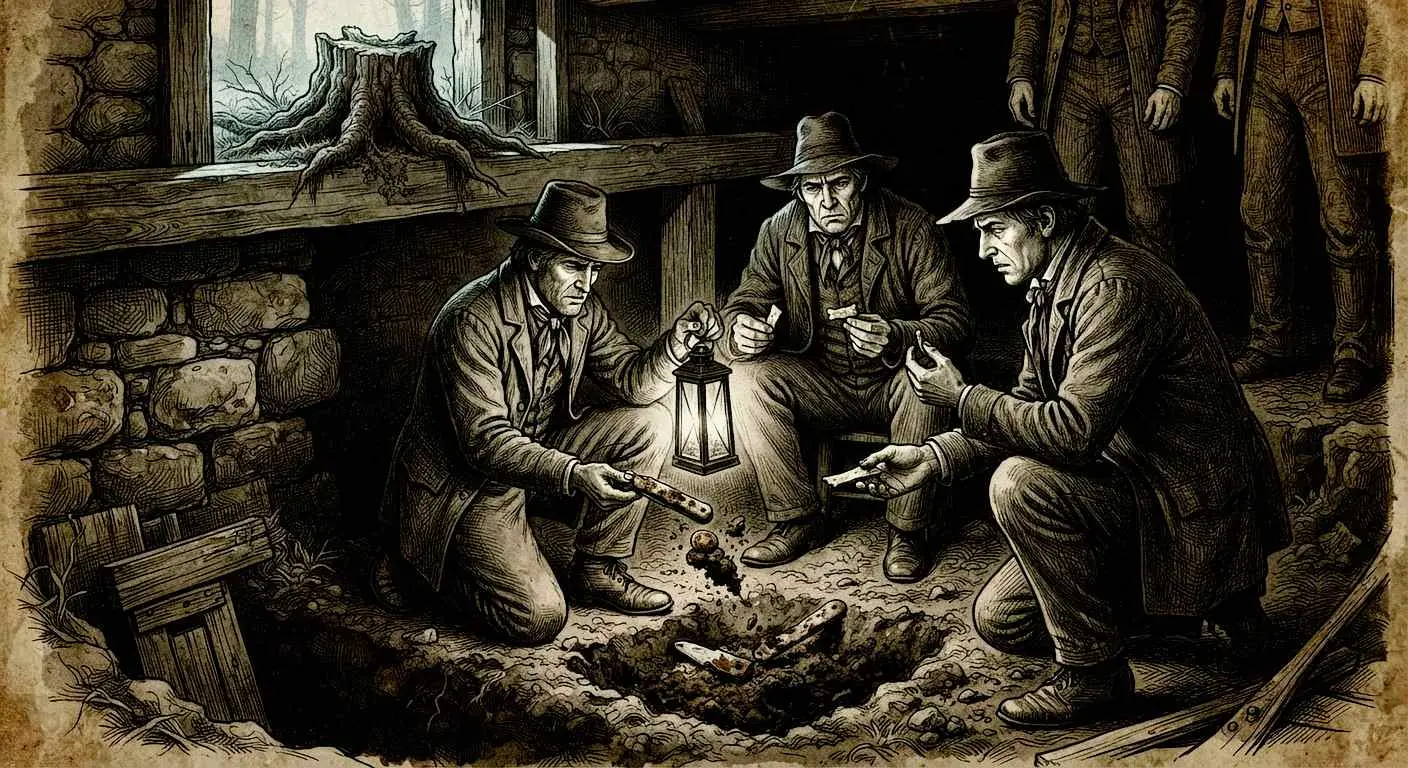
Russell Colvin disappeared from Manchester, Vermont, in 1812. His brothers-in-law, Stephen and Jesse Boorn, later became suspects in his alleged murder.
Seven years later, in 1819, the case was revived. Stephen and Jesse Boorn were arrested, tried before the Vermont Supreme Court in Manchester, convicted, and sentenced to death.
The surviving 1819 trial publication identifies the proceeding as an adjourned term of the Supreme Court of Vermont, begun at Manchester on October 26, 1819.
According to historical accounts, the investigation intensified after a relative reported a recurring dream in which Colvin appeared and indicated that his remains had been buried near an old cellar hole.
The cellar was searched. Items said to have belonged to Colvin, including a pocketknife and a button, were found during the investigation. No body was found there.
Bones were subsequently discovered beneath a tree stump near the Boorn property. Three local physicians examined them and pronounced them human. Later accounts identify the bones as non-human.
The evidentiary question:
What level of independent verification was available in 1819 for physical evidence presented as proof of a murder when the alleged victim had not been found?
Jesse Boorn made statements implicating himself and his brother Stephen. Stephen was subsequently arrested and also made a confession, while maintaining that he had acted in self-defence.
Historical accounts describe pressure surrounding the confessions and the circumstances in which they were obtained. The surviving record therefore raises a question that remains central to the history of wrongful convictions:
When a confession becomes the principal bridge between suspicion and conviction, what independent evidence is required to establish that the underlying crime actually occurred?
The Boorn brothers were convicted and sentenced to death. Jesse’s sentence was later commuted to life imprisonment, while Stephen remained under sentence of death.
The case had reached this stage despite the absence of Colvin’s body and before Colvin himself had been located.
In late 1819, newspaper reports seeking information about Colvin reached a man in New Jersey who recognized the description. Colvin was located alive, working on a farm in New Jersey.
He was brought back to Vermont, where his identity was established. The discovery demonstrated that the murder for which Stephen and Jesse Boorn had been convicted had not occurred.
The brothers were released, and the case became a landmark historical example of a wrongful conviction involving a crime that had not occurred.
The Boorn case illustrates a basic evidentiary problem: suspicion, physical objects, witness accounts and confessions can accumulate into a persuasive narrative without establishing that the underlying crime actually occurred.
The decisive fact arrived outside the courtroom: the alleged murder victim was alive.
The enduring audit question:
Before testing who committed a crime, what evidence establishes that the crime itself occurred?
The victim was alive.
The conviction was real.
Two centuries separate the Boorn case of 1819 from Case R 706/2025/5226 in Finland. The legal systems, evidentiary technologies and procedural safeguards are different. The historical comparison is therefore not a claim that the two cases are identical.
The comparison concerns a narrower question: what happens when a criminal case narrative is maintained despite unresolved questions concerning the underlying evidence?
In the Boorn case, Stephen and Jesse Boorn were convicted in Vermont in 1819 in connection with the alleged murder of Russell Colvin, who had disappeared seven years earlier. The prosecution relied on statements, physical objects recovered during searches, purported human bones and other evidence presented at trial.
Colvin was subsequently located alive in New Jersey. The convictions were therefore based on a homicide that had not occurred.
Case R 706/2025/5226 presents a fundamentally different evidentiary setting. There is no allegation here that the Finnish case involved the disappearance or death of a person. The relevant comparison concerns the evidentiary foundation of the accusation and the extent to which that foundation can be independently examined.
The documented case material raises questions concerning the number and nature of witnesses, the available physical evidence, the interpretation of the crime-scene photographs, and the accessibility of the underlying pre-trial material.
One of the central features of the Boorn case was the later discovery that the alleged victim was alive. The physical evidence that had been treated as supporting the murder theory could therefore no longer establish the crime that the prosecution had alleged.
In R 706/2025/5226, the relevant issue is different but equally concrete: whether the physical configuration documented by the police is compatible with the mechanism alleged in the case.
The police photographs record the doorway, surrounding structures and other physical obstacles at the location. Those photographs can therefore be examined against the alleged sequence of events rather than treated only as background documentation.
Do the documented dimensions, obstructions and positions at the scene permit the physical sequence described in the case record, and can that conclusion be independently reproduced from the available evidence?
The Boorn case illustrates a basic evidentiary problem: statements, objects and apparent physical findings may acquire considerable weight before their reliability has been adequately established.
The same principle can be examined in a modern case using modern standards. The question is not whether evidence exists on paper, but whether the underlying material can be identified, tested, challenged and independently verified.
For R 706/2025/5226, this question extends to material placed under exceptionally long-term secrecy. Where underlying photographs, interview records or other pre-trial material cannot be publicly examined, the practical question becomes how independent verification is to take place.
The Boorn case demonstrates the consequences of allowing a criminal narrative to solidify before the underlying factual premise has been established. The alleged victim was eventually found alive.
Modern criminal procedure operates under a different legal framework, including the presumption of innocence and the requirement that guilt be established according to the applicable standard of proof.
In R 706/2025/5226, the relevant audit question is therefore specific: where the evidence contains unresolved contradictions or where important underlying material cannot be independently examined, how were those uncertainties treated in the determination of guilt?
The historical Boorn case involved a false premise about the alleged victim’s fate: Russell Colvin was believed to have been murdered, but he was alive.
R 706/2025/5226 presents a different procedural phenomenon. The person initially treated as the victim was subsequently also treated as a criminal suspect in the same proceedings. The change in procedural status is therefore itself part of the evidentiary and procedural record.
The central question is not whether the two cases are historically identical. They are not. The question is whether modern procedural safeguards provide sufficient transparency to show when the narrative changed, on what evidence, and how the change was communicated and documented.
The Boorn case belongs to a very different legal era. Its evidentiary failures cannot simply be transferred to a twenty-first-century Finnish proceeding as though nothing had changed.
But the historical record provides a useful test. In 1819, the central factual premise of the prosecution was eventually disproved by a simple fact: the alleged victim was alive.
In a modern proceeding, the corresponding safeguard is not a prophetic dream, a recovered object or a later discovery. It is the ability to reconstruct the evidentiary chain and test the material on which the decision rests.
What independent mechanism allows the evidentiary foundation of a criminal judgment to be reconstructed and tested when the underlying material is incomplete, disputed, or subject to long-term secrecy?
Listen to the complete audio investigation as we draw the historical line from the 1819 Boorn brothers show trial straight into the modern evidentiary vacuum of Case R706/2025/5226. Discover how physical impossibilities, 100-year state secrecy stamps, and institutional cover-ups undermine the very core of judicial integrity.
Independent legal media platform focusing on structural judicial monitoring and criminal case analysis. We examine international standards of justice, from the presumption of innocence to the rigorous evaluation of the standard of proof and in dubio pro reo principles.
All analytical materials and legal case reviews on this website are published for informational and educational purposes only under freedom of expression. Content does not constitute professional legal advice.