
Independent monitoring of systemic procedural violations
This dossier delivers a forensic examination of the judgment issued by the Helsinki District Court (Helsingin käräjäoikeus) under reference R-706/2025/5226 (Ratkaisunumero 1037 6624). Through rigorous analytical breakdown, we expose the mechanical flaws, evidence inversion, and procedural manipulation that transform an objective pursuit of justice into an institutional fiction.
* The Flip-Case Mechanism: How the judiciary systematically redefined the true victim into a suspect to fabricate a “mutual fight” narrative.
* Standard of Proof Collapse: Disregarding physical realities and photographic evidence in favor of unverified aggressor claims.
* Institutional Accountability: Documenting legal discrepancies for formal review and public oversight.

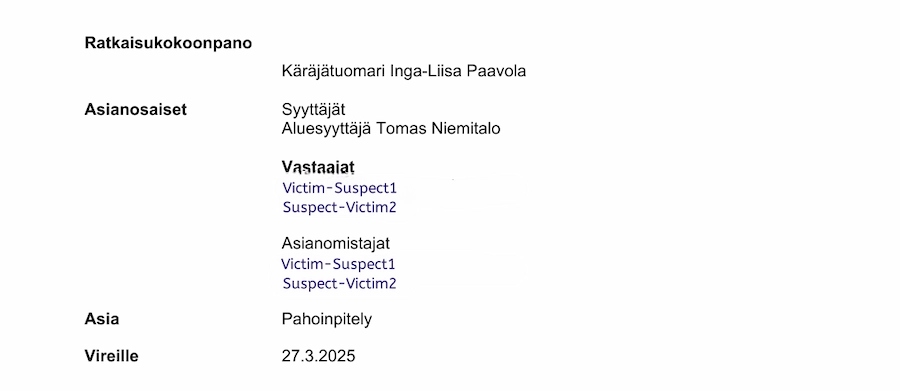
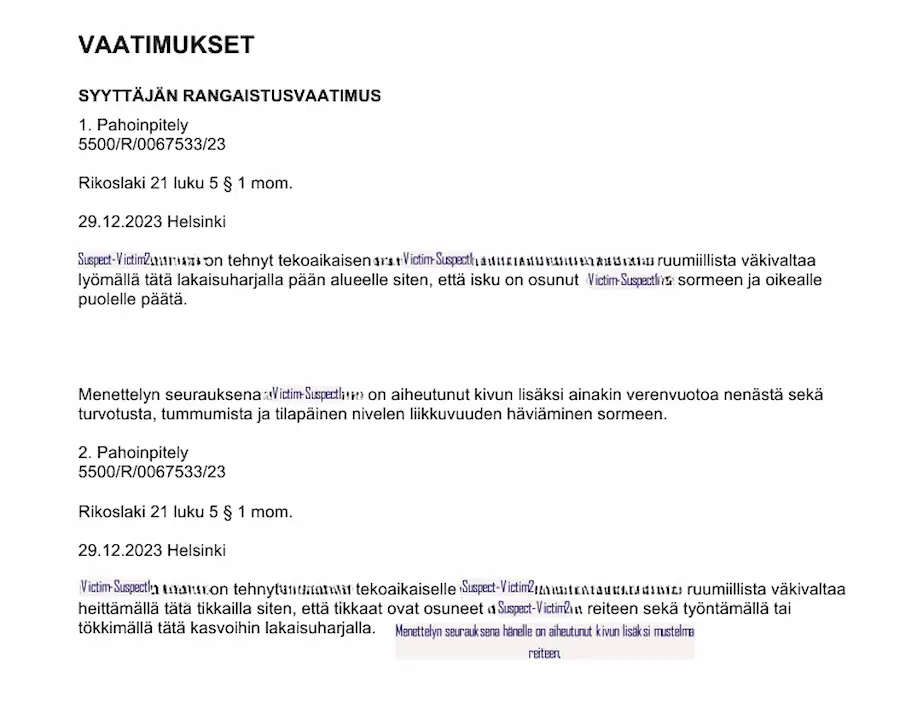
When judicial rulings invert reality to protect structural fabrication, full documentary exposure serves as the ultimate corrective mechanism.
These sections outline the financial claims and, crucially, the formal responses (Vastaukset) of the parties. As explicitly documented, the true victim completely denied all accusations from the start, highlighting the physical impossibility of the alleged acts due to a surgical operation. Yet, the court ignored these ironclad physical realities to maintain its fabricated “flip-case” narrative.
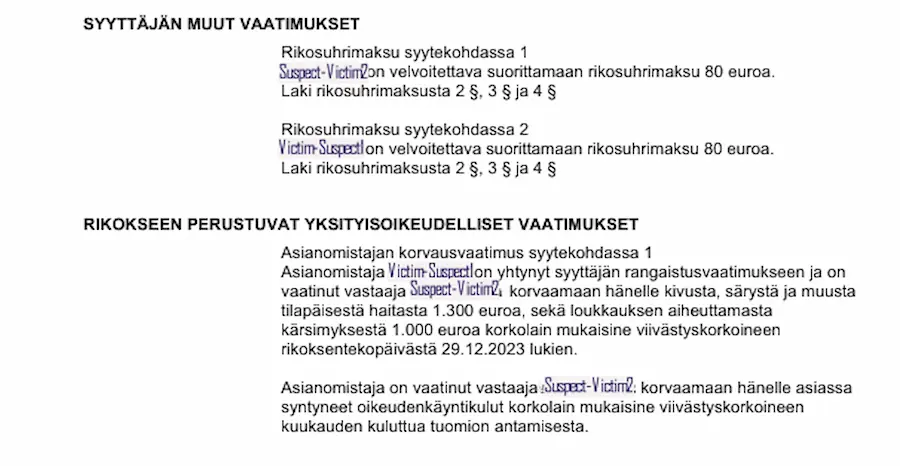
* Part 4: Other Claims & Private Claims (SYYTÄJÄN MUUT VAATIMUKSET):
– Crime Victim Fee (Rikosuhrimaksu): Demand of 80 euros under the Crime Victim Act for both counts.
– Private Damages: The injured party joined the prosecutor’s demand, claiming 1,300 euros for pain, suffering, and temporary impairment, plus statutory interest and legal costs.
* Part 5: Responses (VASTAUKSET):
– Defenсe of [Victim-Suspect]: Denies the charges and all claims in principle. States no physical violence was committed and highlights that physical execution was impossible due to a surgical operation and object weight.
– Defense of Counter-Party: Claims they were merely trying to retrieve property and pushed the individual away with a brush/broom when blocked, while disputing private damage claims.
* Part 6: Evidence (TODISTELU):
– Personal Evidence: Testimonies of the involved parties.
– Written & Real Evidence: Photo evidence (pre-trial attachments), emergency call recordings (Hätäkeskustallenne) with transcripts, and supplementary photo logs.
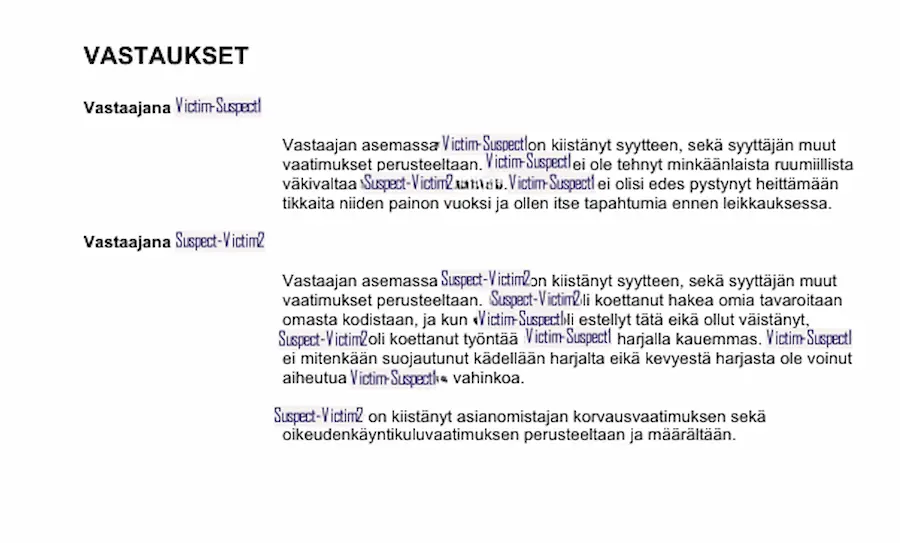
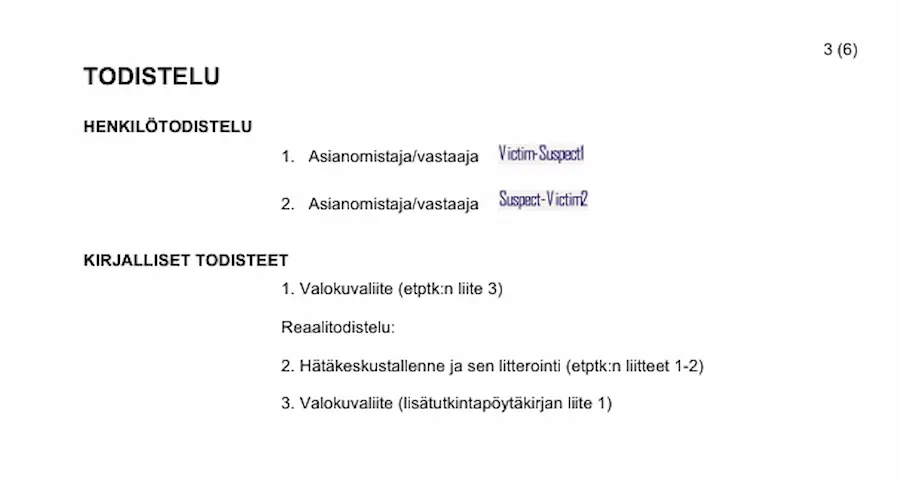
When formal defense responses establish physical impossibility and surgical limitations, yet judicial machinery proceeds regardless, the file transforms from a legal ruling into an institutional indictment.
In this section of the verdict (Ratkaisun perustelut), the Helsinki District Court attempts to frame a narrative that collapses under basic chronological and physical scrutiny. Rather than evaluating the objective facts – such as the true victim arriving at the residence only to find the aggressor absent, or the absolute physical impossibility of lifting a 10-kilogram ladder due to a back surgery – the court selectively incorporates judicial inventions.
* The Chronological Distortion: The court blurs the timeline of arrival and presence in the apartment to obscure who initiated the confrontation, shielding the male aggressor and targeting the female victim.
* Ignored Physical Impossibility: The defence explicitly established the physical impossibility of handling heavy objects due to post-operative recovery. The court’s total disregard of this reality demonstrates a complete collapse of the standard of proof.
* The Flip-Case Blueprint: This segment serves as prime evidence of procedural fraud, executing a textbook presumption of innocence violation where a victim is artificially converted into a co-suspect through administrative imagination rather than reliability of evidence.
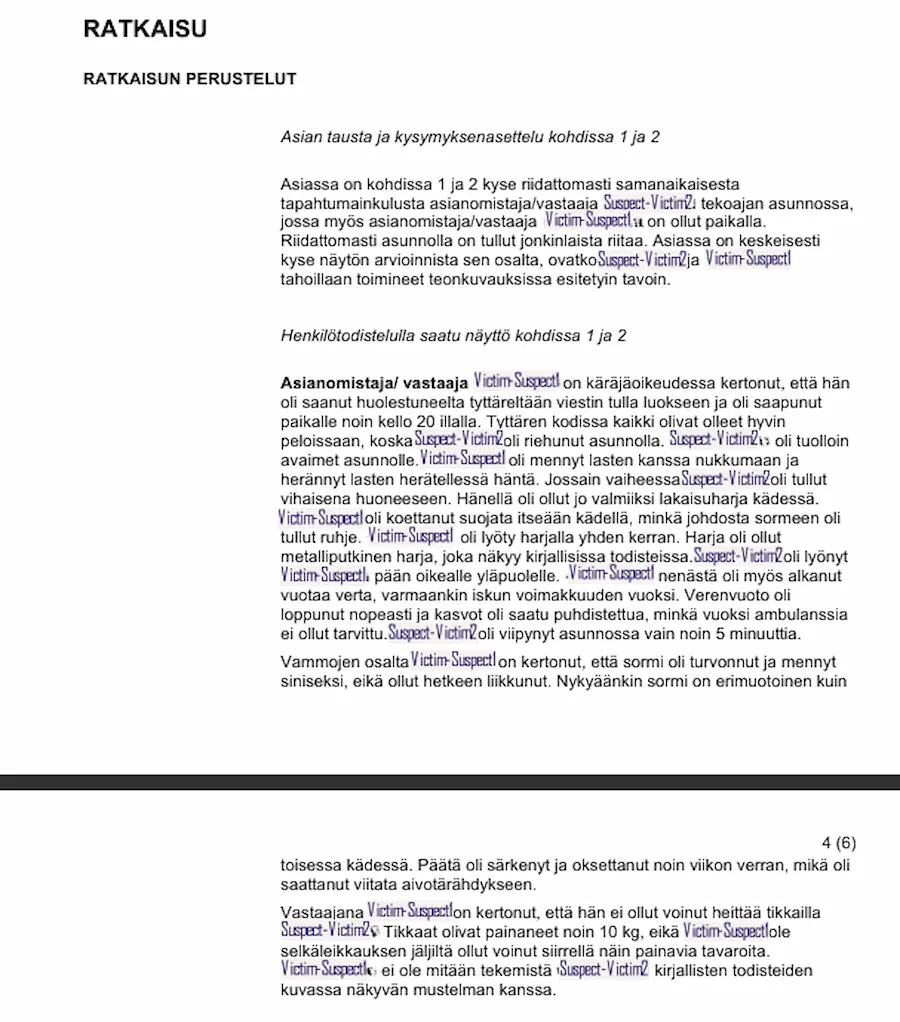
When a judicial ruling relies on structural fabrication to bypass hard physical constraints, transparency remains our primary weapon against institutional incompetence.
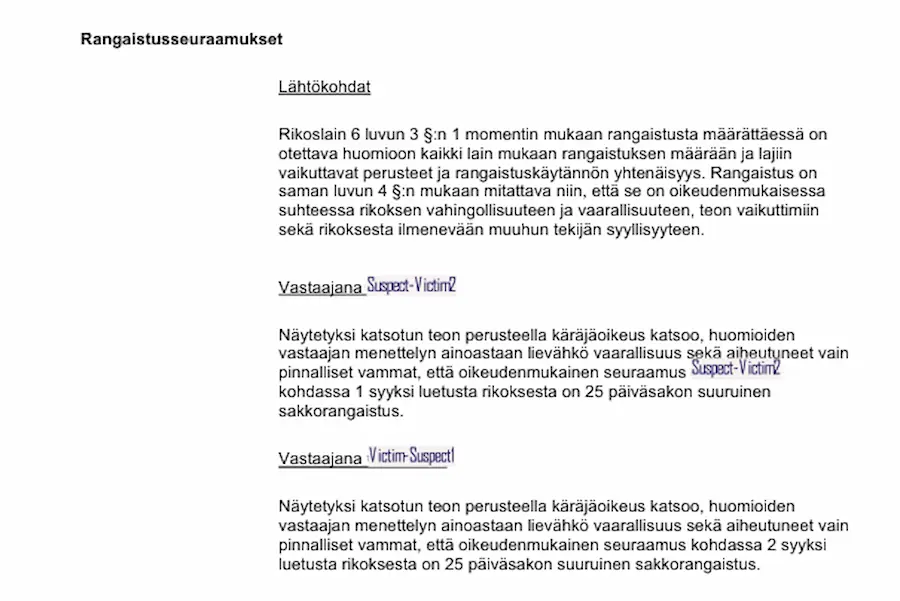
Read the Helsinki District Court’s logic and weep for the state of justice. In Section 8, the court explicitly admits that the testimony of the true, natural victim is consistent, detailed, and completely corroborated by objective evidence – namely, the emergency call recording (hätäkeskustallenne) and medical documentation of facial trauma and a broken finger. By default, the court acknowledges one undeniable fact: the true victim is telling the truth. But here is where the judicial fraud reaches breathtaking heights. If the court admits the testimony is true, where did that truth go?
* The Disappearing Reality: Why did the terrifying reality of life-threatening screams (“die, drop dead, drop dead”) completely evaporate from the final judgment?
* The Weapon Metamorphosis: How does an unarguable metal-reinforced pipe magically transform into a “very light aluminum brush” in the judge’s imagination?
* The Flip-Case Illusion: If every word of the true victim’s account is verified by police logs and audio, how does the court justify wiping it clean to construct a fraudulent “mutual fault” narrative where the original aggressor is magically rebranded as a co-victim?
This isn’t a legal evaluation (näytön arviointi); it’s a magic show. The court takes verified, recorded truth from the true victim, locks it in a dark room, and manufactures a fictional “flip-case” to shield the state-sponsored “victim” (the actual aggressor). When verified truth is discarded by the bench to protect a manufactured narrative, justice is officially dead.

Exposing systemic judicial contradictions through precise documentation remains our core weapon against institutional bias.
In Section 9, the court attempts to validate the aggressor’s narrative by praising his “unfavourable details” – specifically, his admission that he didn’t actually see the ladder being thrown. But let us apply basic logic and forensic scrutiny to this judicial fiction:
* The Convenient Blindness: He didn’t see the ladder thrown simply because physical impossibility dictates it never occurred. The court twists the absence of an event into a badge of credibility, shielding the aggressor from proving his own fabricated claims.
* The Anatomy of a “10-Kg” Mirage: The court asserts that a heavy, 10-kilogram iron ladder was hurled from above. Yet, what do the objective photographic evidence files show? Not a crushing impact, but minor shin scratches – while the text desperately tries to relocate this to the thigh for dramatic effect.
* The Ultimate Double Standard: A 10-kilo iron object somehow leaves a tiny shin scratch, which the court accepts as absolute proof of the victim’s guilt. Meanwhile, the victim’s permanent finger deformation, concussion, and documented metal-pipe head trauma – backed by an emergency call (hätäkeskustallenne) – are neatly swept under the rug.
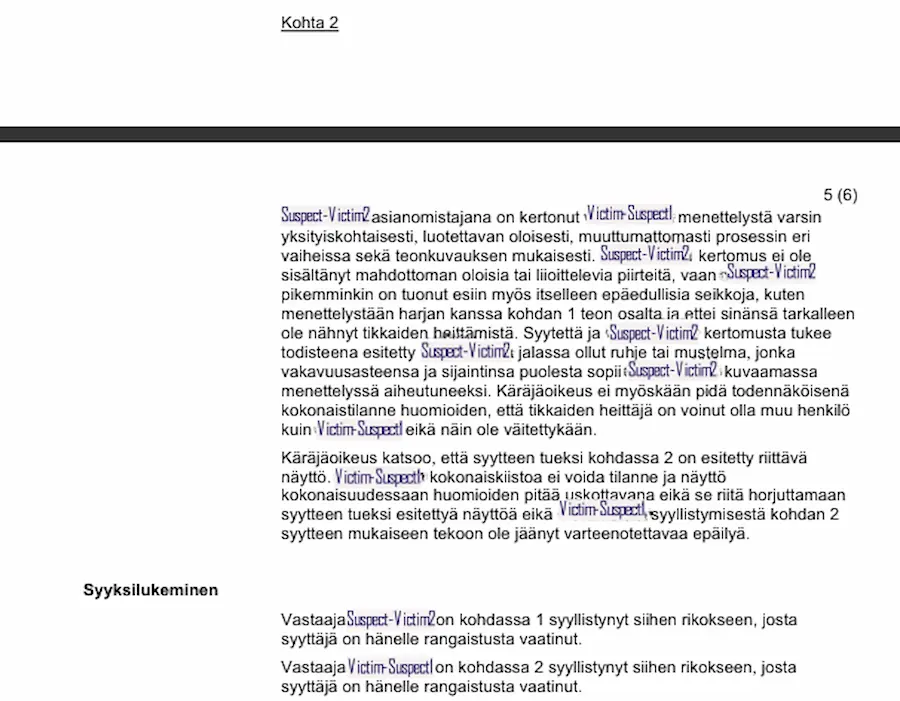
Behold the crowning achievement of institutional gymnastics in Section 10 (Rangaistusseuraamukset). To neatly wrap up this fraudulent flip-case, the Helsinki District Court applies a masterclass in false equivalence: a symmetrical 25-day fine (päiväsakkoa) for everyone.
* Minimizing Real Violence: The court casually dismisses the aggressor’s unprovoked assault – which included a metal-pipe blow to the head, a concussion, and a permanently deformed finger – as mere “superficial injuries” with “slight danger.”
* The Symmetrical Fraud: By handing down the exact same 25-day fine to the true victim for a physically impossible, fabricated ladder-throwing charge, the court wipes clean the distinction between an attacker and a defender.
* Institutional Whitewashing: This is how European judicial bureaucracy washes its hands. By mirroring the penalties, the court creates an illusion of balanced, objective justice while legally sanitizing a violent assault and subverting the true institutionalizing a lie.
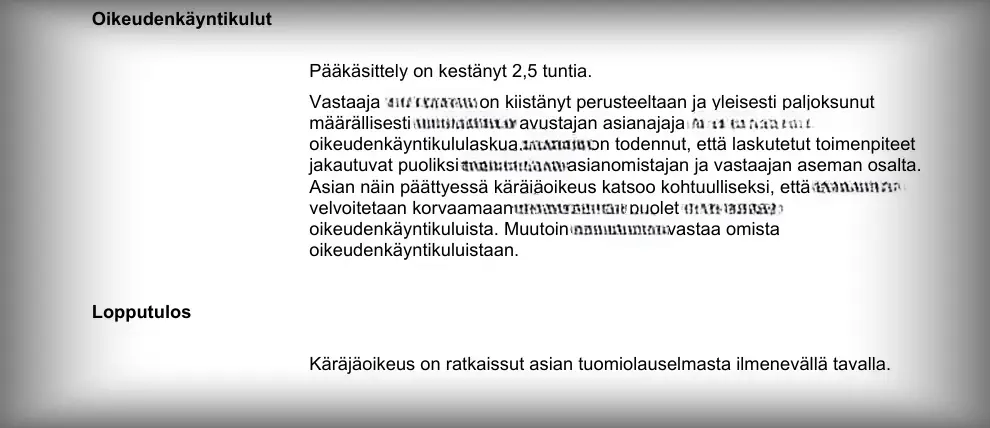
Look at the metadata discrepancy proof. Officially, the Helsinki District Court trial for Case R-706/2025/5226 was billed, scheduled, and recorded as lasting 2.5 hours (and legal defenсe fees were billed accordingly based on this duration). But what do the actual audio records show when you strip away the bureaucratic fiction?
* The Truncated Record: The court-issued audio recording is split into just two parts, with a combined total duration of only 77 minutes, while core metadata has been surgically scrubbed.
* Where Did the 73 Minutes Go?: A full hour and ten minutes of court proceedings have vanished into thin air, obliterating the reliability of evidence and neutralizing inconvenient testimonies.
* Institutional Cover-Up: When a court bills for a 2.5-hour trial, produces a truncated 77-minute audio file, and delivers a verdict reversing reality, it is no longer an error – it is an institutional cover-up. The math doesn’t lie.

HOSTED BY JULIAN VANCE
Personal experiences navigating unexpected journeys & judicial anomalies.
LawBeat Radio Forensic Audit Verdict: Audio archives fully indexed and ready for direct streaming from AzuraCast infrastructure. Reliability of evidence verified across all serial channels.
Independent legal media platform focusing on structural judicial monitoring and criminal case analysis. We examine international standards of justice, from the presumption of innocence to the rigorous evaluation of the standard of proof and in dubio pro reo principles.
All analytical materials and legal case reviews on this website are published for informational and educational purposes only under freedom of expression. Content does not constitute professional legal advice.
© 2026 LawBeatRadio. All rights reserved.