
Independent monitoring of systemic procedural violations
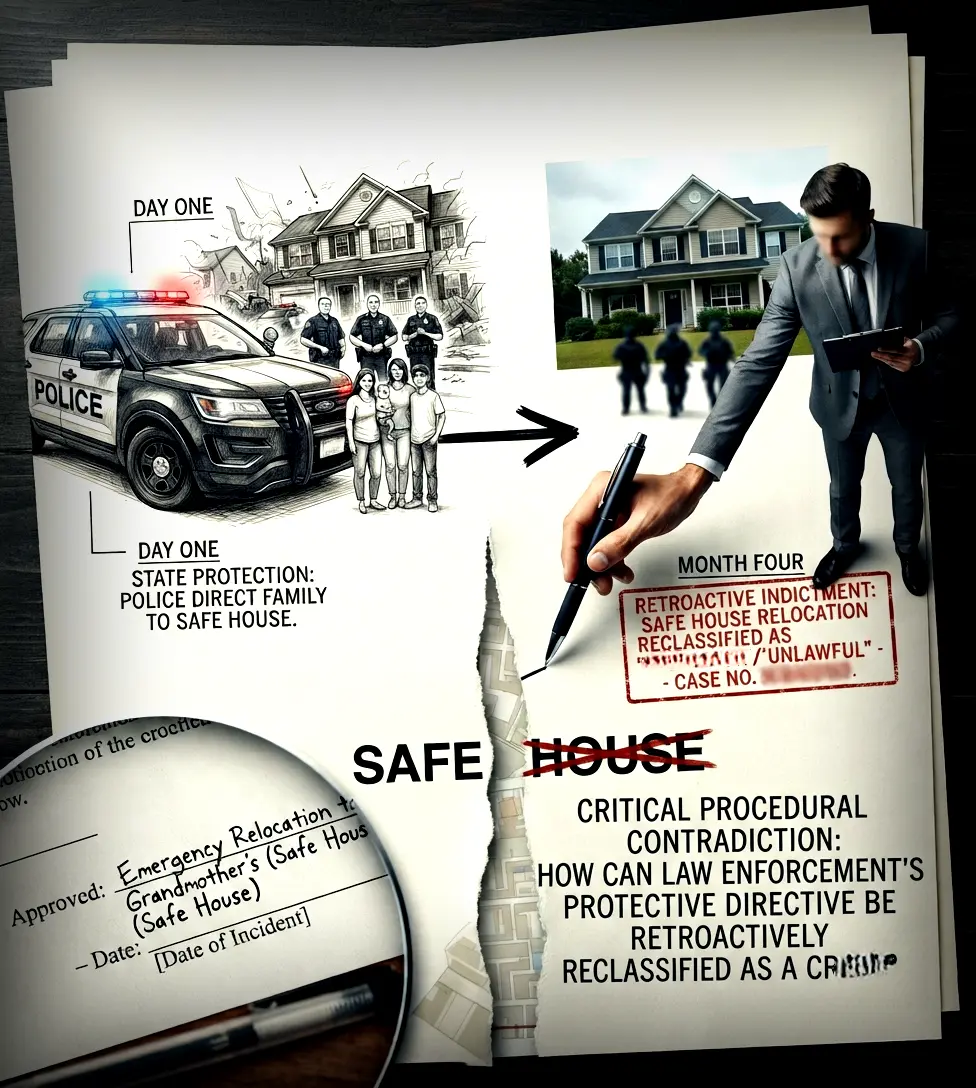
There is a particular kind of procedural contradiction that becomes visible only when the same night is viewed from two different points in time. On the night itself, police officers act on what they see. Months later, an investigator may reconstruct the same events from documents, interviews and a developing prosecution theory.
The question raised here is unusually simple: what happens when the later theory appears difficult to reconcile with the protective decision made by the officers who were physically present?
The incident unfolded in the early hours of the morning, amid escalating threats and an immediate need for assistance. According to the documented sequence, the person alleged to have caused the danger left the scene after becoming aware that law enforcement was being called.
Then the police arrived. Three officers entered the situation in real time — not from an office months later, but at the location itself. They could see the physical environment, the people involved and the immediate circumstances confronting the family.
The significance of the responding officers is therefore not rhetorical. They were the state’s first direct observers of the scene. Their actions provide an important point of comparison for any later reconstruction of what the situation supposedly required.
At the scene, the responding officers assessed the circumstances and, according to the documented proceedings, directed the family to relocate temporarily to the home of the person identified here as the real victim.
That distinction matters. The location was not selected retrospectively by an investigator. It was selected in the immediate aftermath by officers responding to the incident.
Police arrive → assess the situation → identify the immediate safety concerns → direct the family to a temporary place of safety.
The central issue is whether that sequence remains compatible with the later characterization of the same person or location.
Four months later, the procedural picture had changed. The person whom the responding officers had treated as a safe person for the family’s temporary relocation was subsequently characterized in the investigation in a criminal context.
That development does not, by itself, prove that the later allegation is false. But it creates a question that cannot simply be skipped: what changed between the police assessment on the night and the later investigative theory?
This is where the case becomes more than a chronological curiosity. The two positions appear to pull in opposite directions.
Police officers arrived, assessed the immediate situation and directed the family to a particular home for protection.
The same person subsequently appears in the criminal narrative in a way that raises the question whether the earlier police decision and the later characterization can be reconciled on the evidence.
The difficult question is not whether investigators are permitted to reconsider an initial police assessment. Of course later evidence can change a case. The question is whether the later case record actually explains why the original assessment ceased to be reliable.
There is an uncomfortable human detail underneath the procedural argument. The people being moved to safety were not abstract pieces on an investigative diagram. They were family members, including vulnerable minors, in the immediate aftermath of a frightening incident.
That makes the later reconstruction especially important. If the safe-house decision is now relied upon as evidence of something unlawful, the record should explain how that interpretation fits the contemporaneous actions of the officers who made the decision.
How does a person move from being the person police trusted to shelter a family — to becoming the person the investigation later treats as a criminal?
The answer cannot be found merely by changing the label. It requires an evidentiary bridge between the two versions of events. Where is that bridge in the record?
| CASE MATERIAL | Case record and procedural materials relating to R 706/2025/5226. |
| EDITORIAL ANALYSIS | LawBeat Radio — procedural analysis based on the documented chronology and case materials. |
Source note: The article distinguishes contemporaneous police actions from later investigative characterizations. Questions concerning the consistency of those accounts are editorial and analytical; they do not replace the underlying case record or judicial findings.
Independent legal media platform focusing on structural judicial monitoring and criminal case analysis. We examine international standards of justice, from the presumption of innocence to the rigorous evaluation of the standard of proof and in dubio pro reo principles.
All analytical materials and legal case reviews on this website are published for informational and educational purposes only under freedom of expression. Content does not constitute professional legal advice.