
Independent monitoring of systemic procedural violations
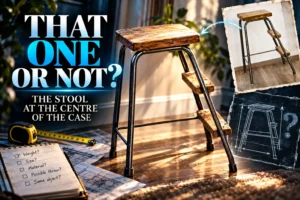
“Erityisesti keittiötikkaat olivat raskaat, varmaan 10 kg, tein ne itse aidosta tammesta. Ne olivat hyvännäköiset mutta raskaat.”
“In particular, the kitchen ladder was heavy, probably 10 kg. I made it myself from real oak. It was good-looking but heavy.”
“Ja sieltä tuli sitten nämä, kutsuin niitä tikkaiksi, joka nyt on ilmeisesti tällainen tuoli tai tikkaat.”
“And then these came from there; I called them a ladder, which apparently is something like a chair or a ladder.”
Analytical questions:
- Did the prosecutor know what the physical object actually looked like?
- Did the prosecutor know its type and construction?
- Did the prosecutor know its dimensions?
- Did the prosecutor know its weight?
- On what documentary or physical evidence was the prosecutor’s description based?
- Was the prosecutor referring to a specific identified physical object, or only to the object as described in N’s account?
Analytical questions:
- Did the prosecutor refer to a photograph showing the alleged object?
- Did the prosecutor refer to any other document containing an image or physical description of the object?
- Was there a photograph showing the object in the case materials?
- Was the object itself physically identified or examined?
- Is there a documented evidentiary link between the object described in the testimony and a specific physical object?
- If such a photograph or document exists, where in the case file is it located, and what exactly does it show?
What objective evidence enabled the prosecution to identify the alleged instrument of injury as a specific physical object, and was that object or its photographic representation disclosed to the accused during the proceedings?
How could the accused meaningfully examine or challenge the identification of the alleged instrument of injury if the specific physical object, or an objective image of it, was not shown to her?
“‘Tikkaat’ ovat ikään kuin jakkara(malliset).”
“‘Tikkaat’ are, as it were, stool-like.”
“Tikkaat/jakkara”
“Ladder/stool”
In the materials reviewed in this case, the physical object at the centre of the alleged throwing incident is surprisingly difficult to identify with precision.
It appears under different descriptions: tikkaat (ladder), keittiötikkaat (kitchen ladder), jakkara (stool), and a stool-like or IKEA object. In the pre-trial record, N described a heavy kitchen ladder weighing approximately 10 kg and said that he had made it himself from real oak. In the court account, the object is described differently.
This is the point that should be made as simply as possible.
The charge is not about an imaginary object. It alleges that TG threw a particular physical object at N and that this object struck his leg and caused the documented injury. Once that object becomes part of the alleged mechanism of the offence, the object is no longer a decorative detail in the story. It becomes an evidentiary link.
And an evidentiary link has to be identifiable.
Imagine a criminal case in which the prosecution says: “This particular object was thrown, it hit the victim, and it caused the injury.” A basic question immediately follows: What particular object?
Not “a ladder.” Not “a stool.” Not “an IKEA jakkara.” Not “a kitchen ladder.” Not simply “the thing that hit the leg.” Those words may describe an allegation at different stages, but they do not by themselves establish the physical identity of the alleged instrument.
In the material reviewed here, the terminology changes:
These are not merely different translations of one perfectly identified object. They raise a preliminary forensic question: was the physical object itself ever identified with enough precision that an independent reader could know exactly what object the evidence is talking about?
This is especially important because the case contains a photograph of N’s leg injury. A photograph of an injury identifies the injury. It does not, by itself, identify the instrument that allegedly caused it.
Those are two different evidentiary questions:
The first question can potentially be answered by a photograph. The second cannot be answered merely by showing the photograph of the bruise.
A reader should be able to look at the case materials and say: “Yes. This is the exact object alleged to have been thrown.”
A sufficiently clear evidentiary identification should allow the reader to understand its form, dimensions, material, construction, approximate weight, distinguishing features, location and—where relevant—how it was documented, preserved or examined.
Not every object in every criminal case must necessarily be seized, fingerprinted or subjected to laboratory testing. The law does not turn every household item into mandatory forensic evidence. But when a specific physical object is relied upon as the alleged instrument by which the charged injury was produced, the investigation must provide a sufficiently clear basis for understanding what object is being relied upon and what evidence connects it to the alleged act. Finnish pre-trial investigation law requires the investigation to clarify the suspected offence, its circumstances and the damage caused, and to take into account evidence both against and in favour of the suspect.
That is the gap this audit examines.
This object-identification problem is not merely a matter of editorial neatness. It has to be examined against the legal duties governing a Finnish criminal investigation.
Section 2 of the Esitutkintalaki (Criminal Investigation Act) states that the investigation must, as required by the nature of the matter, clarify the suspected offence, the circumstances in which it was committed, the damage caused by it, the parties, and the other circumstances necessary for consideration of the prosecution and determination of the consequences of the offence.
In other words, the investigation is not limited to recording one person’s version of events. It is supposed to establish the circumstances of the suspected offence and the damage alleged to have resulted from it.
In this case, if the alleged mechanism of injury is a particular physical object being thrown at N’s leg, the identity and circumstances of that object are directly relevant to the alleged offence and its consequences.
The statute expressly requires that facts and evidence both against and in favour of the suspect be clarified and taken into account in the criminal investigation.
This is crucial. An investigation cannot properly ask only: “Can N’s account be made to fit the injury?” It must also ask: “What evidence confirms it, what evidence contradicts it, and what remains unestablished?”
The Act states that a person suspected of an offence shall be treated as innocent during the criminal investigation.
That principle matters particularly where an allegation depends on an inferred chain of events. The burden is not on the suspect to manufacture certainty around an inadequately identified object. The investigation must establish the relevant facts.
The same chapter requires investigative measures to be proportionate to the need to clarify the matter, prohibits unnecessary interference with a person’s rights, and requires participants in the investigation to be treated appropriately.
These provisions reinforce the basic principle: the State’s investigative power is justified by the need to clarify the case, not by the need to preserve a preferred narrative once an accusation has been made.
Section 21 of the Finnish Constitution guarantees everyone the right to have their case dealt with appropriately and without undue delay by a competent court or authority. It also guarantees the protections of a fair trial and good administration.
This is the constitutional backdrop to the investigation. A person facing a criminal accusation is entitled to a process in which the relevant facts are properly examined and the eventual decision is reasoned.
Section 22 provides that public authorities shall ensure the observance of fundamental rights and human rights.
For a criminal investigation, that means the presumption of innocence and the requirement of an impartial, properly conducted investigation are not optional ideals. They form part of the legal framework within which public authority must operate.
Section 6 provides that a prosecutor shall bring a prosecution when the statutory conditions are met, including that there are probable grounds supporting the guilt of the person suspected of the offence.
That does not mean that every disputed detail must have a laboratory report. It does mean that the prosecution decision must rest on an evidentiary foundation, not on a chain in which important physical facts remain unidentified or are supplied only by inference.
The official legislation is available directly from [Finlex — Criminal Investigation Act 805/2011], [Finlex — Constitution of Finland 731/1999], and [Finlex — Prosecution of Criminal Cases Act 689/1997].
None of these provisions says that every household object must automatically be seized, fingerprinted or sent to a laboratory. We should not claim that.
What they do establish is more fundamental: the investigation must clarify the suspected offence, its circumstances and the damage; it must examine evidence both against and in favour of the suspect; and the suspect must be treated as innocent while that investigation is conducted.
Therefore, when the alleged mechanism of injury depends upon one specific physical object, the obvious forensic questions cannot simply disappear:
The point is not that an investigation must manufacture a laboratory result. The point is that it must not manufacture certainty by leaving the physical link undefined.
The allegation requires more than the existence of a bruise. The evidentiary chain would have to connect:
The fact that N attributed the object to TG is evidence of his account. It is not, by itself, independent physical evidence that TG handled that particular object.
In the recorded testimony, N ultimately answered the direct question whether he had seen TG actually throw the object with: “En nähnyt sitä” — “I did not see it.”
He then explained his attribution as an inference: the object struck his leg; he looked up; TG was standing on the upper landing with a cleaning brush; therefore, in his view, it was logical that she had thrown it.
The court itself did not state that N had directly seen the throw. Its wording was qualified: he had not “properly” or “exactly” seen the throwing situation. That distinction matters because direct observation and inference are different evidentiary propositions.
N also pointed to a location in the police photograph and said: “Отсюда она бросила” — “She threw it from here.”
That statement identifies a proposed throwing point. It does not independently establish the object’s identity, its position at the relevant moment, or the trajectory of the alleged throw.
The scene itself raises questions that can be tested only through the physical evidence: the partially obstructed doorway, the narrow passage, objects and barriers near the entrance, and the confined upper landing.
The forensic question is therefore not simply whether a heavy object could cause a bruise. It is whether the particular object described in the evidence could have travelled from the particular point identified by N, through the documented scene, and struck the particular part of his leg in the manner alleged.
Before relying on the object as a physical link in the chain of proof, the record should make its identity and evidentiary status clear.
Here is the problem in first-grade language:
Someone says: “That object hit me.”
There is a photograph showing that the person has a bruise.
But then ask:
Where is the object?
What exactly is the object?
How do we know it is the same object being described at every stage of the case?
How do we know TG handled it?
How do we know that this particular object, rather than some other object or mechanism, caused the photographed injury?
If those questions cannot be answered from the evidence, then the evidentiary chain has a missing physical link.
The issue is therefore not whether a heavy household object could cause a bruise. Of course it could. That is not enough.
The issue is whether the case establishes the complete chain:
N’s statement may provide evidence about what he says happened. His pointing to a place in a police photograph may provide evidence about where he believes the throw originated. But those statements should not be silently converted into independent physical facts.
The forensic task is to separate “N says this happened” from “the physical evidence independently establishes that this happened.”
That distinction is the heart of the object-identification problem.
Independent legal media platform focusing on structural judicial monitoring and criminal case analysis. We examine international standards of justice, from the presumption of innocence to the rigorous evaluation of the standard of proof and in dubio pro reo principles.
All analytical materials and legal case reviews on this website are published for informational and educational purposes only under freedom of expression. Content does not constitute professional legal advice.
© 2026 LawBeatRadio. All rights reserved.