
Independent monitoring of systemic procedural violations
FORENSIC AUDIT • R 706/2025/5226 • FINLAND
When one word can change the evidentiary meaning of a witness’s testimony
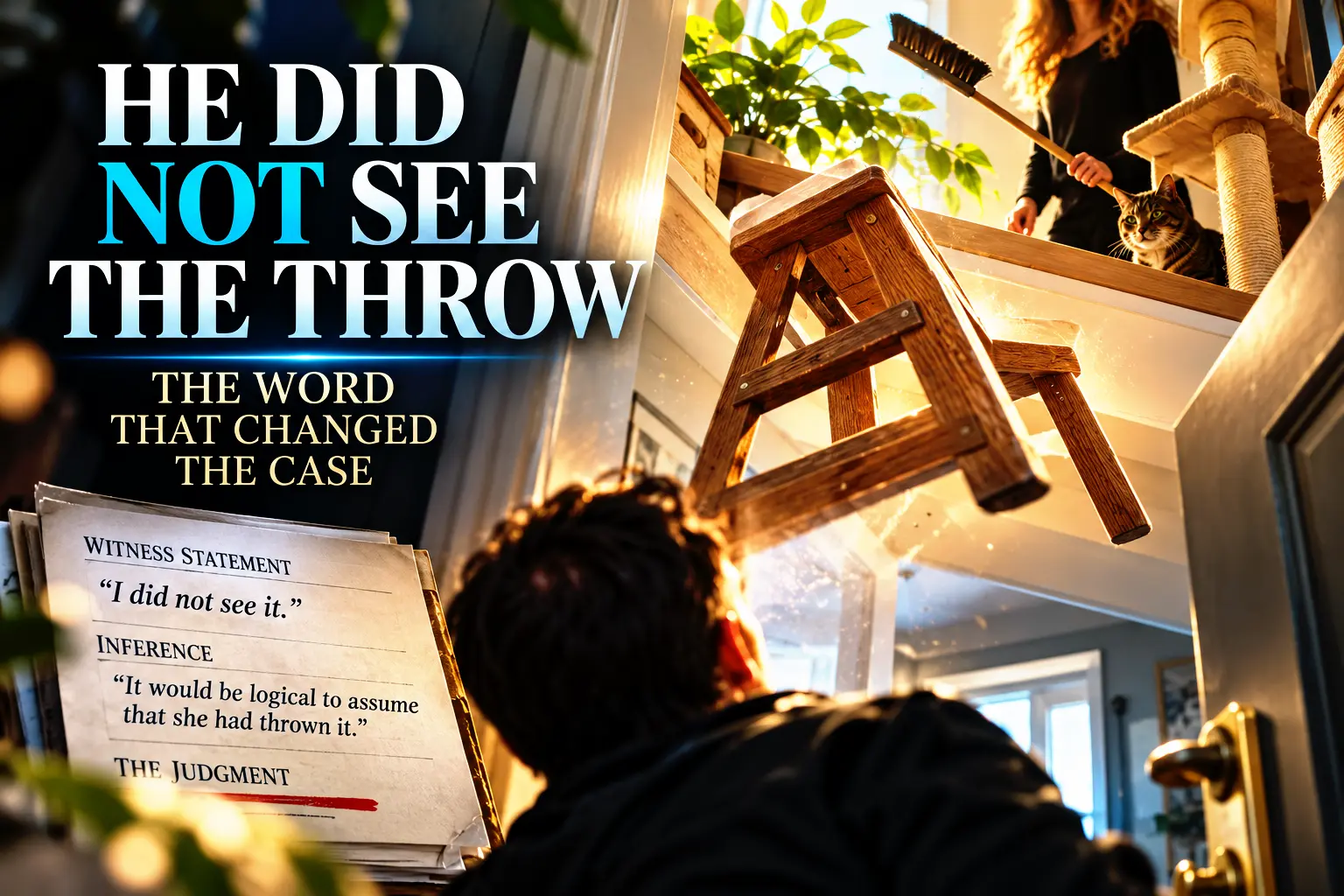
HE DID NOT SEE THE THROW.
So how did the alleged throw become a fact?
The Helsinki District Court judgment in case R 706/2025/5226 treated the allegation that TG threw a kitchen step-ladder at N as proven beyond reasonable doubt. The judgment stated that N had described the event in detail and reliably, and relied in part on a bruise on his thigh.
But the evidentiary record raises a sharper question: what, exactly, did the witness directly observe?
This audit does not ask the reader to choose a side before reading the record. It asks the more basic forensic question: where does direct observation end, and where does inference begin?
In trial, counsel asked N directly whether he had seen TG throw the ladder. His answer was explicit:
“I did not see it.”
He then explained that the object struck his leg while he was trying to enter through a narrow doorway. He said he had put his leg into the doorway first and that his head was still outside. Only after the impact did he raise his head and see TG above him with a broom in her hand.
He did not say: “I saw her throw it.” He said that, from what happened immediately afterward, it was logical to assume that she had thrown it.
WHAT HE SAID HE SAW
The object struck his leg. He raised his head. He saw TG standing above him with a broom.
WHAT HE INFERRED
Because she was there after the impact, he considered it logical to assume that she had thrown the object.
Those propositions are not interchangeable. A witness can draw an inference. A court can evaluate that inference. But an inference is not transformed into direct observation merely because it appears plausible.
N described the object as approximately 10 kilograms and made of solid oak. He described chairs behind the door and a confined entrance area. He also said that if he had entered head-first, the object would have struck his head.
The police scene photograph introduces another question: the doorway was not an empty open space. Structures and obstructions were present around and above the entrance.
This does by itself prove that the alleged throw was physically impossible. It makes the physical sequence testable. Where was the witness? Where was the object? Where was the thrower? What line of sight existed at the instant of impact? And how did the object travel through the confined opening?
No reconstruction should be accepted merely because the narrative sounds coherent. The geometry has to work.
The judgment identifies the evidence relied upon for Count 2: the parties’ testimony, the emergency-call recording and transcript, the patrol photograph annex, and a supplemental photograph showing the alleged bruise on leg.
That list matters.
The judgment’s stated evidence does not identify DNA testing, forensic reconstruction, a forensic examination of the alleged impact mechanism, or a medical examination as the evidentiary bridge proving who threw the object.
The alleged bruise may be evidence that an injury existed. It does not, by itself, identify the person who caused it. That causal link still has to be established.
THE FORENSIC QUESTION
Where is the evidentiary bridge from “a bruise existed” to “this defendant threw the object”?
The judgment says N did not “exactly” see the throwing of the ladder. That wording deserves direct comparison with the trial audio.
The audio contains the unequivocal exchange: counsel asks whether he saw her throw the ladder; N answers, “I did not see it.” He then explains his conclusion as an assumption based on what he saw after the impact.
There is a material difference between NON-OBSERVATION: “I did not see it.” and IMPERFECT OBSERVATION: “I did not see it clearly.”
Those are different evidentiary propositions. The audit question is therefore precise: did the written judgment preserve the original boundary between what the witness did not observe and what he inferred?
N estimated that the entire sequence — from the throwing of the chairs through the later confrontation with the brush — lasted approximately 30 seconds.
That estimate is not itself proof that the sequence could or could not have happened. But it creates another testable question: can the alleged movement of chairs, attempted entry, impact, reaction, change of position, and subsequent confrontation all be reconciled with the witness’s own spatial description and the physical setting?
A forensic audit does not decide that question by rhetoric. It asks whether the record contains the reconstruction needed to answer it.
The investigation record identifies TG’s 24 April 2024 interrogation as a telephone interrogation, with an interpreter named in the document. The form states that she was informed of her rights and that she was being questioned as a suspect.
That documentary fact is important because the chronology shows a procedural transition: she had earlier been questioned as the injured party, while after N’s allegations she was questioned as a suspect.
The record should therefore be read forensically: when did the procedural status change, on what information, and what independent evidence was obtained to test the new allegation?
A judgment is not a creative reconstruction of testimony.
The court is entitled to assess credibility. It is entitled to draw inferences. It is entitled to reject a denial. But the evidentiary chain still has to remain visible:
What was seen.
What was inferred.
What was independently corroborated.
What remained untested.
If those four categories collapse into one narrative, the reader can no longer tell which part of the finding comes from direct evidence and which part comes from inference.
It shows: a witness who expressly said he did not see the throw; a later inference that TG must have thrown the object; an alleged heavy object in a confined entrance; a bruise relied upon by the court; and a judgment that found the evidence sufficient.
It does not, from the materials examined here, independently establish: a direct eyewitness observation of the throw; DNA evidence linking TG to the object; a forensic reconstruction of the trajectory; or an independent forensic mechanism proving that the bruise was caused by the alleged throw.
That is the evidentiary gap this audit puts under the microscope.
THE CORE QUESTION
If the critical act was not seen, if the identification was an inference, if the physical sequence was never independently reconstructed, and if the injury does not identify its cause — what exactly carried the burden from allegation to conviction?
LawBeatRadio • Forensic Audit • Case R 706/2025/5226 • Helsinki District Court • 30 October 2025
Independent legal media platform focusing on structural judicial monitoring and criminal case analysis. We examine international standards of justice, from the presumption of innocence to the rigorous evaluation of the standard of proof and in dubio pro reo principles.
All analytical materials and legal case reviews on this website are published for informational and educational purposes only under freedom of expression. Content does not constitute professional legal advice.
© 2026 LawBeatRadio. All rights reserved.