
Independent monitoring of systemic procedural violations
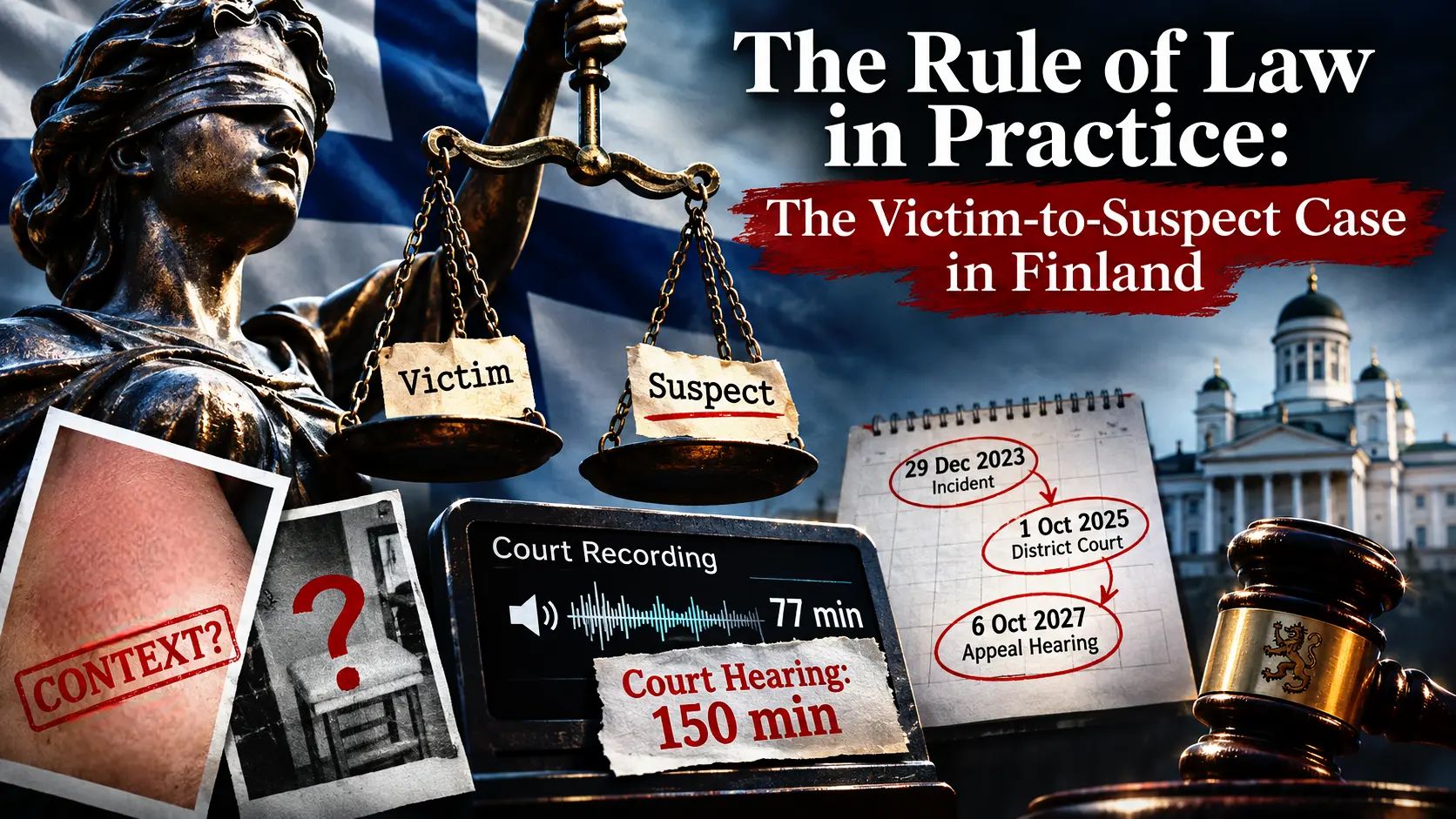
The Rule of Law is not a decorative sign above a courthouse entrance. It is measured by what happens inside: how police handle evidence, how prosecutors assess contradictions, and how judges explain their decisions. What happens when a person who turns to the police for protection ends up facing a criminal conviction? Welcome to the other side of Finland’s justice system.
On paper, the guarantees look impeccable. Section 21 of the Finnish Constitution promises fair proceedings without undue delay. Article 6 of the European Convention on Human Rights guarantees a fair hearing before an independent and impartial tribunal.
But what happens in practice when someone approaches the police as an injured party — seeking protection — and later finds themselves treated as a suspect in the same criminal proceedings?
We are not examining an abstract legal problem. We are examining a specific case: Helsinki District Court case R 706/2025/5226, with an appeal pending before the Court of Appeal under reference HHO R16/2025/2828.
The case raises fundamental questions about investigative neutrality, the identification of physical evidence, the accuracy of witness testimony and the reasoning behind a criminal conviction.
The issue is not whether Finland has laws protecting individual rights. The issue is whether those protections can be seen in the actual handling of this case.
The prosecution’s case includes an allegation that a physical object was thrown and struck a person. Yet before an object can be treated as an instrument of an alleged offence, its identity must be established.
What do the materials examined show?
The judgment itself records the witness’s description of the object as something like a stool. The object is also described in the proceedings as an IKEA item. These descriptions do not, by themselves, establish the precise identity, dimensions or physical characteristics of an actual object.
The distinction matters. A description given in testimony is not the same as an independently verified physical exhibit.
Without an identified object available for examination, its alleged weight, dimensions, shape and physical properties cannot be treated as independently established forensic facts.
A criminal allegation may describe an object. That does not mean the object has been proved to exist in the form alleged.
The case includes a photograph presented as evidence of an injury. But a photograph does not explain itself, and its existence does not automatically establish the facts attributed to it.
The essential issues are straightforward:
A photograph of a bruise cannot, by itself, establish who caused it, what object caused it, when it occurred or under what circumstances.
Nor can an injury photograph independently identify the alleged instrument or reconstruct the mechanism of an impact.
The evidential question is not simply whether a photograph exists. It is whether the photograph has been reliably identified, authenticated and connected to the specific allegation.
Without that foundation, the image cannot carry the weight of conclusions that it does not independently support.
One of the central issues in this case concerns the difference between seeing an act and inferring who performed it.
During the court proceedings, witness N was asked whether he saw who threw the alleged object. The recorded testimony states that he did not see who threw it.
The judgment, however, describes his account in terms of not having properly seen the actual throwing.
These formulations are not interchangeable.
Not seeing who threw an object is not the same as seeing the event but failing to see it clearly. The distinction concerns the witness’s actual opportunity to identify the person responsible.
There is also the physical setting. Police Photograph No. 4 depicts structures and obstacles around the doorway. Their position must be considered alongside the witness’s described location and the alleged movement of the object.
The judgment must therefore be examined not only for the conclusion it reaches, but for how it addresses the relationship between the witness’s testimony and the physical circumstances.
A witness’s inference is not direct identification. A court’s reasoning should make that distinction visible.
The incident occurred on 29 December 2023.
The Helsinki District Court hearing took place on 1 October 2025, in case R 706/2025/5226. The written judgment followed on 30 October 2025.
The Court of Appeal hearing is scheduled for 6 October 2027, under reference HHO R16/2025/2828.
That is two years and five days between the first-instance hearing and the scheduled appellate hearing.
This is not merely a date on a court calendar. It is the period during which a person challenging a criminal conviction must wait for appellate examination.
The consequences of a conviction do not disappear while an appeal is pending. Its effect on reputation and everyday life continues. The right to appeal may exist formally, but its practical value is inseparable from the time required to obtain judicial review.
Article 6 § 1 of the European Convention on Human Rights guarantees a hearing within a reasonable time. The chronology in this case provides a concrete basis for examining that guarantee in practice.
The Helsinki District Court judgment records that the main hearing lasted two and a half hours — 150 minutes.
The lawyer’s invoice also records 150 minutes for the hearing.
However, the audio recordings provided from the court proceedings total only 77 minutes.
This leaves a discrepancy of 73 minutes between the duration recorded in the judgment and the audio material provided.
The figures are straightforward:
This is not a minor technical detail. The audio record is essential for checking what was actually said during the hearing, how testimony was recorded, and whether the judgment accurately reflects the proceedings.
When the official duration of a hearing and the duration of the audio material provided differ by 73 minutes, the completeness of the available record becomes a matter of fundamental importance.
A judgment cannot be meaningfully compared with the hearing if a substantial part of the recorded proceedings is not available for examination.
The Rule of Law is not measured by the number of guarantees written into legislation. It is measured by whether those guarantees shape the conduct of public institutions.
In this case, the central issues are concrete:
These are not decorative legal questions. They go to the reliability of the evidence, the fairness of the proceedings and the effectiveness of judicial protection.
The appeal remains pending. The final appellate assessment has yet to take place. But the issues already visible in the record deserve serious scrutiny.
Independent legal media platform focusing on structural judicial monitoring and criminal case analysis. We examine international standards of justice, from the presumption of innocence to the rigorous evaluation of the standard of proof and in dubio pro reo principles.
All analytical materials and legal case reviews on this website are published for informational and educational purposes only under freedom of expression. Content does not constitute professional legal advice.
© 2026 LawBeatRadio. All rights reserved.