
Independent monitoring of systemic procedural violations
Witness Credibility · Evidentiary Analysis
How did District Court Judge Inga-Liisa Paavola assess the reliability of N’s account — and what evidence supports that assessment?
PRE-TRIAL STATEMENT
In his pre-trial statement, N placed his return at approximately 17:00:
“Kello oli muistaakseni 17.00.”
“The time was, as I recall, 17:00.”
The court proceedings, however, concerned the incident that led to the police being called in the early morning. The evening time given in N’s pre-trial statement therefore does not align with the temporal circumstances of the incident adjudicated by the court. This is not a minor discrepancy of a few minutes. It is a difference of approximately twelve hours.
THE UNRESOLVED TIME DISCREPANCY
17:00
N’s recalled return time
Early morning
The incident adjudicated by the court
If the court nevertheless regarded N’s account as consistent and unchanged, the judgment needed to explain how his stated return at approximately 17:00 could be reconciled with the early-morning incident before the court.
PRE-TRIAL STATEMENT
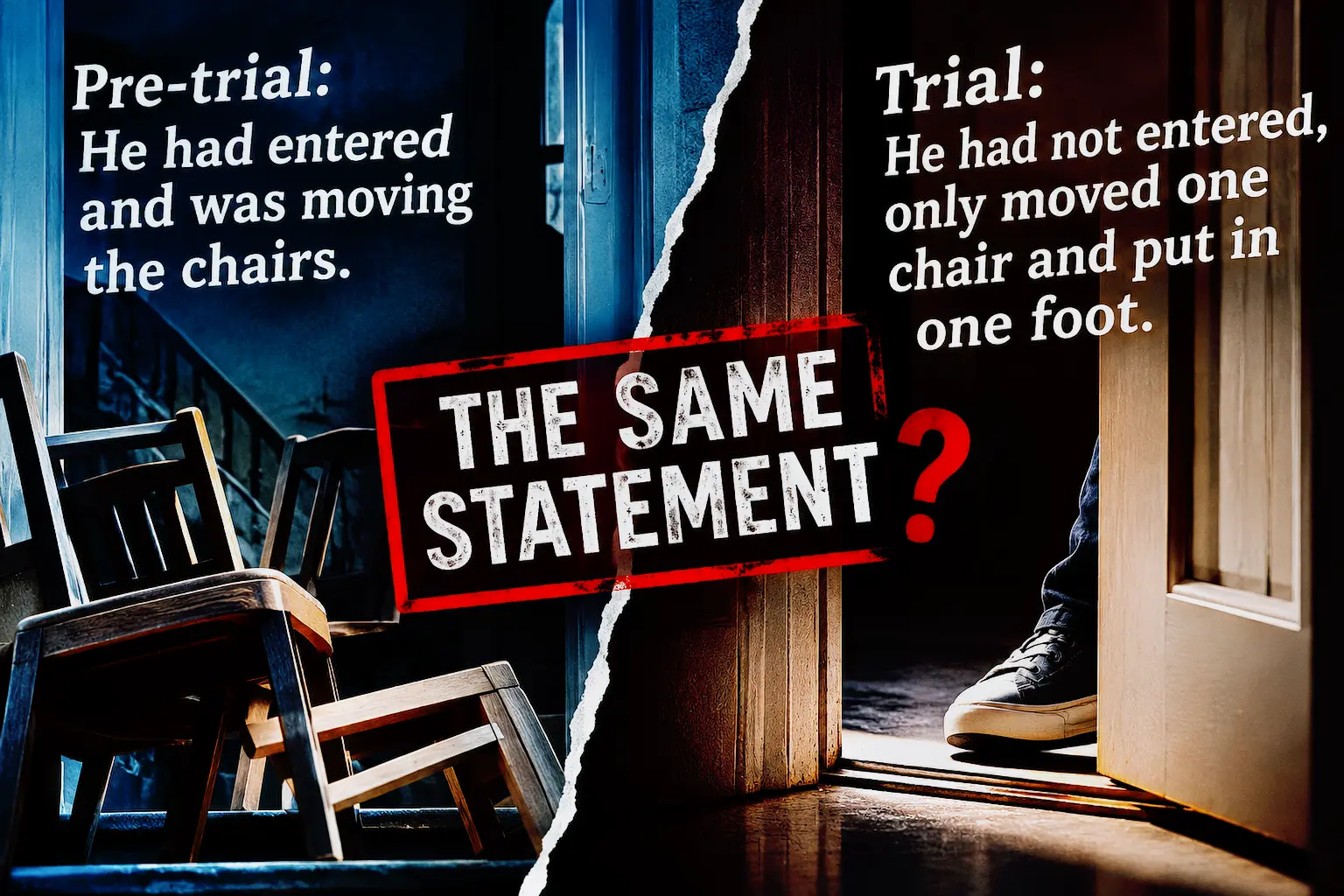
In his pre-trial statement, N described having opened the lower door and already begun moving an obstruction made up of several chairs on the stairs:
“Hän varmaan kuuli että siirrän niitä esteitä ja että avaan sitä ovea portaiden alapäässä.”
“She probably heard me moving those obstacles and opening the door at the bottom of the stairs.”
He then specified:
“TG kuuli sen että avasin alaoven ja sen että ryhdyin siirtämään tuoleista kasattua estettä portailla. Hän tuli kurkkimaan ylhäältä.”
“TG heard that I opened the lower door and that I began moving the obstacle assembled from chairs on the stairs. She came to look down from above.”
This account places N beyond the initial act of opening the lower door: he had proceeded to the obstruction and was already moving the chairs. In other words, his description is of a person who had entered the lower entrance area and was clearing a chair obstruction there. The noise of these actions was, according to N, what caused TG to come out and look down from above.
TRIAL TESTIMONY
At trial, N described a materially different sequence. He no longer described entering the area and moving an obstruction assembled from several chairs. Instead, he stated that a single child’s feeding chair was positioned behind the inner door:
“sisäoven takana oli tuoli, eli oli lasten tuoli.”
“There was a chair behind the inner door, that is, a child’s chair.”
He explained that he moved this chair so that it remained between the inner door and the staircase:
“Silloin kun siirsin sen tuolin niin, että se jäi sisäovin ja portaikon väliin, ja kun laitoin jalkani sisälle, niin ylhäältä lensi Ikeasta aikoinaan hankittu tuoli,”
“When I moved that chair so that it remained between the inner door and the staircase, and when I put my foot inside, a chair that had once been bought from IKEA came flying from above.”
His further description was that he was attempting to enter gradually, first putting his foot into the narrow space in the doorway. His head remained outside the doorway. Thus, at this stage of the trial account, he had not entered the apartment and was not clearing a group of chairs from the stairs. He described moving one child’s feeding chair and then placing his foot into the narrow opening.
The two accounts describe different stages of entry and different actions:
PRE-TRIAL
N had opened the lower door, proceeded to the chair obstruction on the stairs and was already moving several chairs. His account therefore places him inside the entrance area, actively clearing the obstruction.
TRIAL
N did not describe having entered and cleared the obstruction. He described moving one child’s feeding chair away from the inner door, leaving it between the door and the staircase, and only then putting his first foot into the narrow opening. His head was still outside.
THE FUNDAMENTAL DISTINCTION
The distinction is fundamental: in the pre-trial account, N had already entered the area and was moving the chairs; in the trial account, he had not yet entered and had only begun to put one foot through the doorway. The sequence of his own movements, and consequently his position at the moment he says the incident occurred, had changed between the two accounts.
THE QUESTION FOR JUDGE INGA-LIISA PAAVOLA
Judge Inga-Liisa Paavola treated N’s statements as consistent and unchanged. But on what basis?
In his pre-trial statement, N described having opened the lower door and already begun moving an obstruction assembled from several chairs. At trial, he described a different sequence: he moved a single child’s feeding chair and had only begun to put one foot through the narrow opening. He did not describe having entered and cleared the obstruction as he had in his earlier account.
Why, then, did Judge Paavola consider these accounts unchanged? What specific assessment in the judgment explains the difference between the actions N described in the pre-trial statement and those he described at trial?
PRE-TRIAL STATEMENT
N stated that TG heard him moving the chair obstruction, came to look down from above, and that she then threw the chairs at him. His account presents TG as having appeared in response to the noise while he was already moving the obstruction.
TRIAL TESTIMONY
N described having only put his foot into the narrow opening, with his head still outside the doorway. In this position, he did not describe seeing TG emerge above before the alleged impact. He said he raised his head only after the steps struck his leg and then saw her standing above.
THE DISTINCTION
The distinction is straightforward: in the pre-trial account, N describes TG appearing while he was moving the chairs; at trial, he places seeing her only after the alleged impact.
THE QUESTION FOR JUDGE INGA-LIISA PAAVOLA
Where is the consistency between these two accounts? In the pre-trial statement, N describes TG appearing while he was already moving the chairs. At trial, he places seeing TG only after the alleged impact.
On what basis did Judge Paavola regard these statements as unchanged and N’s account as reliable? Where is the consistency, and where is the evidential basis for finding reliability?
N stated that no outside person had witnessed the incident. Nevertheless, Judge Paavola relied on information N attributed to his wife concerning TG’s health. According to the judgment, the wife had allegedly said that TG had not been nauseous, had otherwise appeared normal, and had not remembered how the bruise on her finger had occurred.
REFERENCED COURT DOCUMENT
There is a further inconsistency concerning the photograph of N’s alleged injury. During the pre-trial questioning, N said that he had shown the photograph to his wife and might also have sent it to her by WhatsApp. In her own pre-trial interview, however, his wife said that she did not remember whether he had sent or shown her such a photograph.
TWO DIFFERENT RECOLLECTIONS
N’s account
He said that he had shown the photograph to his wife and might also have sent it to her by WhatsApp.
Wife’s pre-trial interview
She said that she did not remember whether he had sent or shown her such a photograph.
THE QUESTION OF INDEPENDENT CORROBORATION
Why was N’s account of what his wife allegedly said about TG’s health accepted as reliable, when the wife’s own recollection did not confirm the photographic episode? With no independent eyewitness to the incident, where is the independent corroboration of N’s account — and on what basis did Judge Paavola treat this second-hand information as reliable evidence?
A QUESTION TO JUDGE INGA-LIISA PAAVOLA
During the trial, N stated that he did not see who threw the object. However, the judgment presents his statement as meaning that he did not see clearly.
THE MATERIAL DIFFERENCE
“Did not see who threw the object”
“Did not see clearly”
On what evidence, circumstances or legal grounds did Judge Paavola replace N’s statement that he did not see who threw the object with the materially different formulation that he did not see clearly? What justified this alteration of the accuser’s own words in the judgment?
Appeal Case No.: HHO R16/2025/2828
Please check this notice for updates. Any changes to the hearing date or time will be published here.
The Helsinki District Court and the Helsinki Court of Appeal are located in the same courthouse, sharing the same main entrance and ground-floor cafeteria.
LawBeatRadio invites journalists, legal professionals, researchers, students and members of the public to attend the public hearing.
Independent legal media platform focusing on structural judicial monitoring and criminal case analysis. We examine international standards of justice, from the presumption of innocence to the rigorous evaluation of the standard of proof and in dubio pro reo principles.
All analytical materials and legal case reviews on this website are published for informational and educational purposes only under freedom of expression. Content does not constitute professional legal advice.