
Independent monitoring of systemic procedural violations
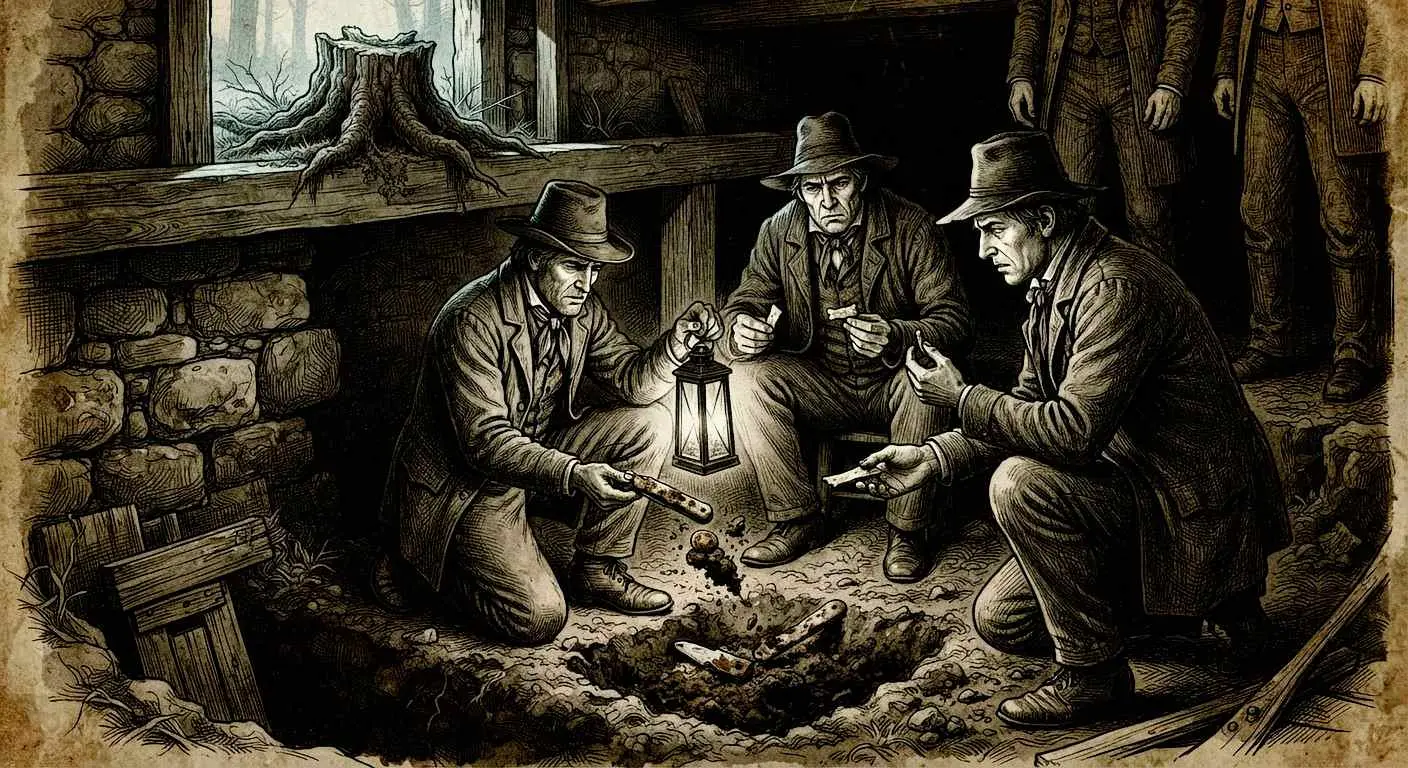
Russell Colvin disappeared in Manchester, Vermont, in May 1812 after a violent argument with his brothers-in-law, Stephen and Jesse Boorn.
For seven years, he remained a missing person until community rumor mills and collective hysteria transformed suspicion into institutional certainty.
Jurisdiction & Court: Supreme Court of Vermont, tried in November 1819 at the Congregational Church in Manchester due to overwhelming public attendance.
* **The “Ghost” Catalyst:**
The investigation was artificially reignited after an uncle reported a prophetic dream in which the victim appeared, claiming he was murdered and buried near an old cellar hole.
* **Junk Science & Flawed Exhibits:**
Townspeople excavated the cellar, finding a pocketknife and a button allegedly belonging to Colvin. Later, animal and unidentified bones discovered under a tree stump were falsely authenticated by local physicians as human remains.
* **Coerced Confessions and Jailhouse Informants:**
Placed under extreme psychological pressure, isolated, and subjected to a hostile public environment, the brothers gave contradictory statements. A jailhouse informant (a convicted forger promised leniency) fabricated a detailed confession on behalf of Jesse. Stephen eventually signed a false confession under duress, hoping to escape the gallows.
* **The Verdict:**
The full bench of the Vermont Supreme Court admitted the dubious confessions into evidence. The jury deliberated for less than an hour and returned a verdict of guilty.
* **Sentencing:**
Both brothers were sentenced to death by hanging. Jesse’s sentence was later commuted to life imprisonment by the legislature, while Stephen’s execution date was locked in.
* **The Collapse of the Case:**
Days before the scheduled execution, a nationwide newspaper advertisement located the “murdered” Russell Colvin alive and well in New Jersey. He returned to Vermont just in time to look at Stephen in iron shackles and ask why he was in chains. The charges were dropped, exposing a catastrophic failure of the judicial system.
When prophetic dreams and coerced confessions substitute for the reliability of evidence, historical precedent proves that manufactured convictions are a systemic pathology.
Two centuries have passed since the courtroom tragedy of 1819. Legal theory has evolved, international standards have been codified, and procedural safeguards are ostensibly plastered across every modern law textbook. Yet, when analyzing the Victim-Criminal Flip Case R706/2025/5226, Finland, the structural machinery of the prosecution operates with the exact same archaic, anti-rational mechanics.
* **1819 Parallels:**
In the Boorn case, the prosecution entirely bypassed the foundational requirement of corpus delicti (proof that a crime actually occurred), substituting public hysteria, superstition, and speculative storytelling for hard physical evidence.
* **Modern Reality (Case R706/2025/5226, Finland):**
The contemporary prosecutorial machinery has taken this historical failure and pushed it into an absolute, clinical vacuum. While the Boorn brothers at least faced a theatrical assembly of fake bones and coerced statements, our case operates in a total evidentiary void. There is not a single witness. There is not a single forensic artifact, no DNA, no objects – zero evidence of any kind. The entire pre-trial framework rests on a single, isolated interrogation, stripped of any objective corroboration.
* **The 100-Year Secrecy Stamp:**
When the absolute lack of an evidentiary base becomes impossible to mask through normal legal channels, the system resorts to ultimate institutional cowardice: the entire pre-trial proceeding has been locked away under a 100-year state secrecy classification. State power is mobilized not to protect society, but to hide a total fabrication from public scrutiny.
* **Smashed Narrative:**
Most catastrophically, the objective police-generated photographic evidence of the crime scene – documents created by law enforcement themselves- smashes the prosecution’s narrative to pieces. The spatial layout, room dimensions, and physical obstacles captured in these photos prove beyond a shadow of a doubt that the alleged actions were a physical impossibility. Yet, the system chooses to maintain the fiction, trading the rigorous burden of proof for administrative convenience and covering up an unmitigated prosecutorial fraud behind a century-long wall of secrecy.
* **1819 Parallels:**
Courts two centuries ago ignored the absolute lack of a body, logical sequencing, and material reality because the system was committed to a pre-determined outcome.
* **Modern Reality (Case R706/2025/5226, Finland):** The objective police-provided crime scene documentation and photographic evidence expose an undeniable physical impossibility. The spatial layout, obstructed geometry, and physical parameters of the location directly contradict the mechanical vectors alleged by the prosecution. Just as 1819 judges ignored the absence of a corpse, today’s system turns a blind eye to fundamental laws of physics to preserve a flawed narrative.
* **1819 Parallels:** The benefit of the doubt was treated as a disposable nuisance, and forced confessions outweighed objective logic.
* **Modern Reality (Case R706/2025/5226, Finland):** The constitutional mandate of presumption of innocence and the rule that all unresolvable doubts must be interpreted in favour of the accused (in dubio pro reo) are systematically discarded. Contradictory evidence and unreliable materials (reliability of evidence) are welcomed by a closed-loop system designed to protect itself rather than administer justice.
The technology changed. The centuries changed. But the institutional reflex to fabricate, ignore physical reality, and push a broken narrative forward remains identical. The machinery of wrongful accusation is still operating unchecked.
Listen to the complete audio investigation as we draw the historical line from the 1819 Boorn brothers show trial straight into the modern evidentiary vacuum of Case R706/2025/5226. Discover how physical impossibilities, 100-year state secrecy stamps, and institutional cover-ups undermine the very core of judicial integrity.
The analysis doesn’t stop at the written word. To dismantle systemic fabrication and dissect every impossible legal vector, our investigative network opens the floor for rigorous public peer review.
Join our live investigative community to analyze the evidence, question the standard of proof, and discuss the case.
Independent legal media platform focusing on structural judicial monitoring and criminal case analysis. We examine international standards of justice, from the presumption of innocence to the rigorous evaluation of the standard of proof and in dubio pro reo principles.
All analytical materials and legal case reviews on this website are published for informational and educational purposes only under freedom of expression. Content does not constitute professional legal advice.
© 2026 LawBeatRadio. All rights reserved.