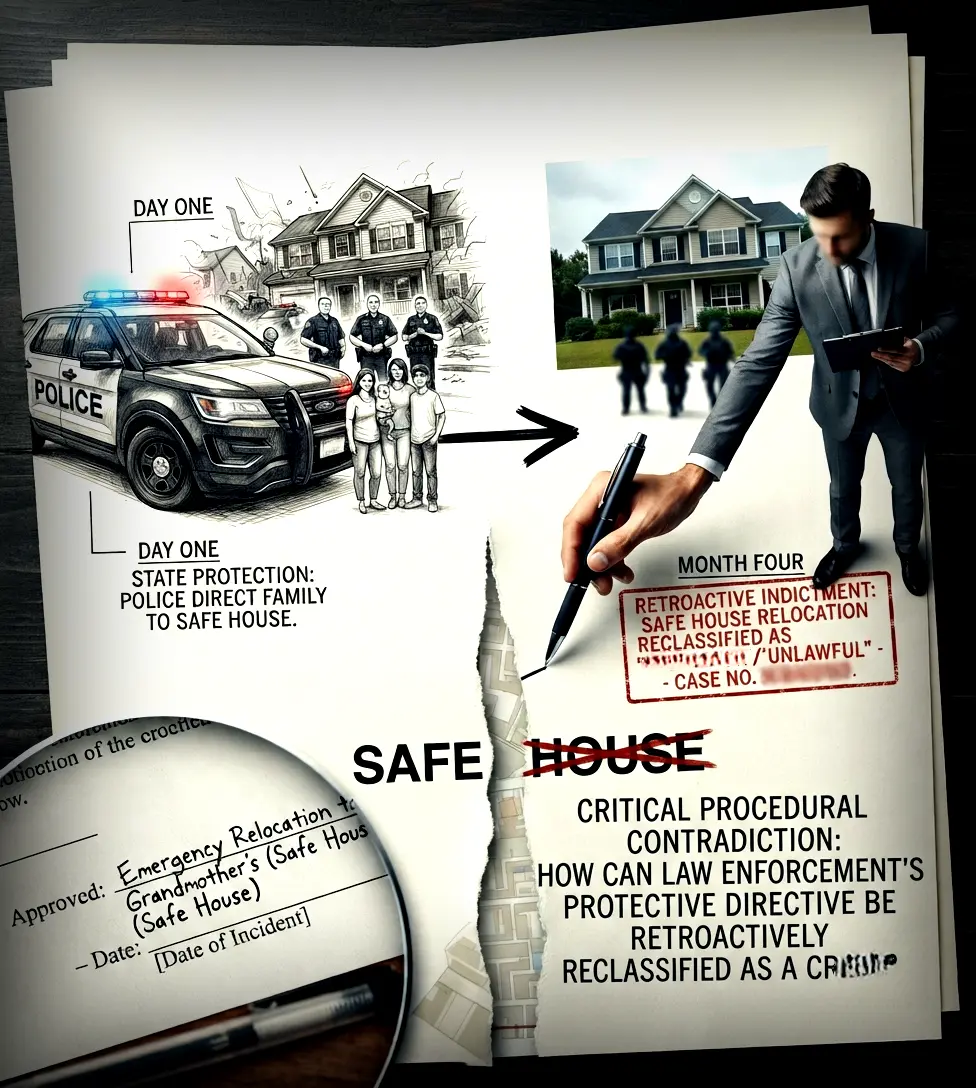
When public safety is officially re-engineered into a criminal offense by the stroke of a prosecutor’s pen, the fundamental contract between the citizen and the state collapses into a bad joke. We are looking at a textbook case of procedural inversion – where a state-sanctioned rescue operation is retroactively rewritten into a criminal indictment.
Ground Zero: The Anatomy of a Setup
Picture the scene at ground zero. The air is thick with tension, heavy with the immediate aftermath of trauma. Threats are escalating rapidly, and the call for emergency assistance goes out into the night. The moment the perpetrator realizes that law enforcement is en route, he bolts from the scene to evade accountability.
Minutes later, a real police patrol arrives. Three officers step right into the chaos. They don’t look at the situation through the sanitized, comfortable lens of an office desk months later; they face the raw, unfiltered reality. They assess the layout, look at the frightened faces of the family, and take immediate control to prevent further escalation.
The Police as the Lifeline
At that critical juncture, the responding officers act as a literal lifeline. They observe the situation first-hand, interact with all parties, and draw a clear line between the aggressor and those in danger.
Crucially, looking directly at the real victim, the officers find zero evidence of aggression, violence, or unlawful behaviour. Recognizing the immediate, tangible hazards within the primary residence, law enforcement makes an explicit, documented operational decision: they advise, direct, and guide the family to relocate temporarily to the real victim’s home for their own protection.
This directive isn’t a casual suggestion – it is officially captured in the pre-trial proceedings. The state itself, through its frontline officers, provided the safe harbor.
The Procedural Contradiction
Months later, the investigator’s desk-bound fantasy turns reality upside down. But this single, unyielding, documented fact shatters their entire narrative:
- The Impossibility of Dual Realities: If the responding officers had perceived even a hint of threat, criminality, or illegality in the real victim‘s actions or her home, they would never have actively directed a mother and vulnerable minors to shelter there.
- The Paradox of Investigator Logic: By later twisting the real victim into a criminal, the investigator creates an impossible and absurd logical trap. If the prosecutor claims the real victim’s home was a dangerous or unlawful place, they are legally and logically forced into an incriminating conclusion: they are inadvertently accusing the responding police officers of intentionally exposing children to harm and acting as accomplices to an illicit transfer.
- The Absurd Reversal: The state cannot simultaneously praise its officers for rescuing a family on Day One and prosecute the very person those officers trusted to keep them safe by Month Four.
- The Fatal Flaw in the Indictment: Either the police officers on the scene acted professionally and correctly by sending the family to a safe haven, meaning the current charges are a complete fabrication – or the investigator is calling the original police patrol incompetent criminals for sending kids into danger. They cannot have it both ways.
- The Four-Month Metamorphosis: Four months down the line, the investigator suddenly decides to rebrand the real victim as a criminal. But this creates an impossible riddle for the prosecution: if the real victim was allegedly a “criminal” or a threat, why did the responding police officers on the day of the incident explicitly trust her and send the children right to her door? You cannot have it both ways. Either the police made a safe, correct choice placing the family with a safe person, then the investigator’s four-month-late accusation is a blatant fabrication that completely shatters on the reality of that night.
Conclusion: The Phantom Crime
Here lies the core absurdity of the entire ordeal. How on earth can a system logic pretend that a person trusted by police to shelter children on Day One becomes a “criminal” by Month Four?
When an investigator rewrites the timeline just to manufacture a phantom crime, common sense is officially outlawed. This case has long ceased to be about an actual offense. It is a clinical, terrifying demonstration of how procedural integrity is dismantled when the raw truth – recorded by the police themselves on the very first day – becomes deeply inconvenient to the state’s narrative.