
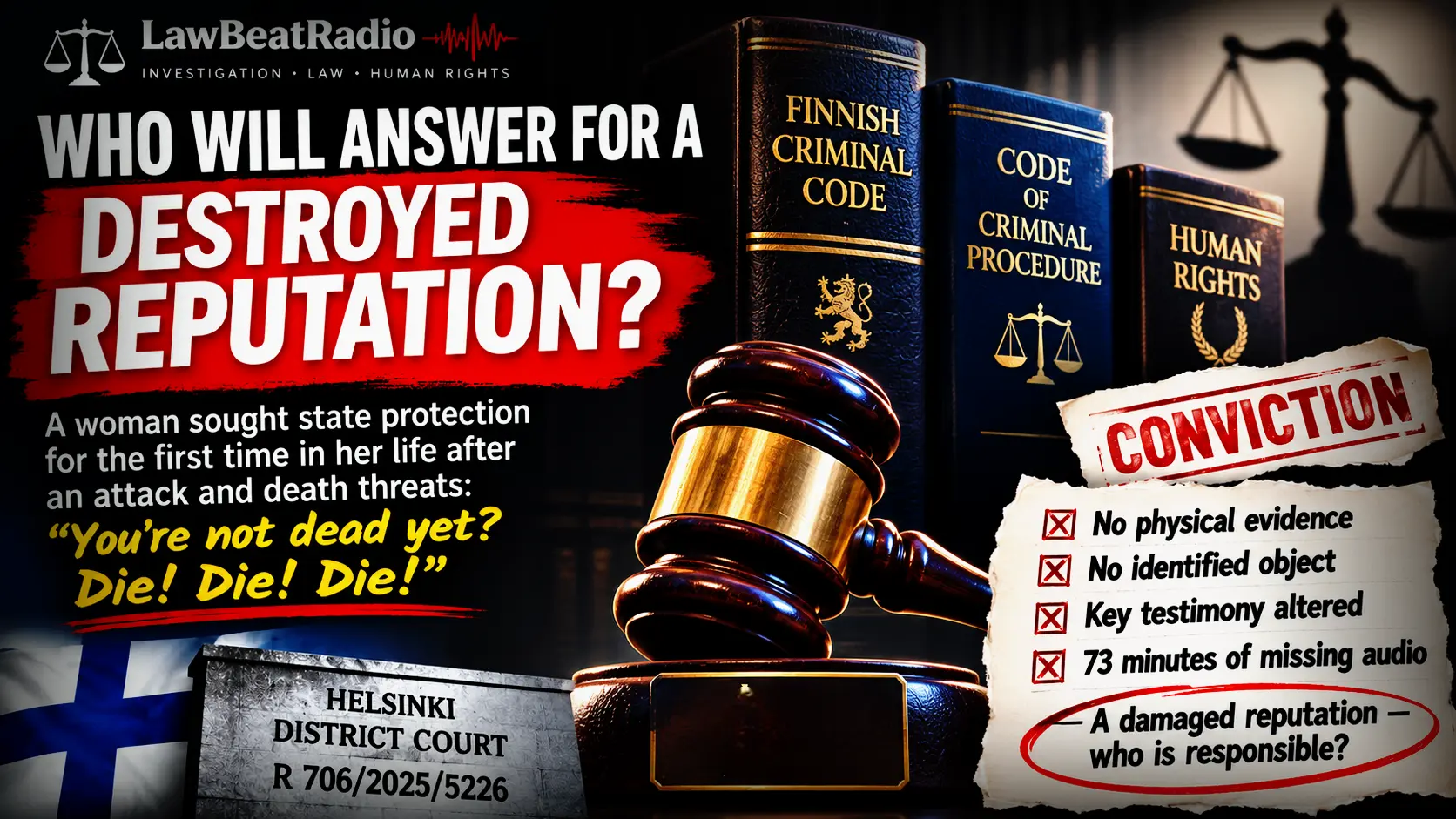
For the first time in her life, TG turned to the state for help and protection. She did so because she had been attacked and feared for her life. She recalls hearing the words: You’re not dead yet? Die! Die! Die!
She went to the authorities seeking protection. Instead, she became a criminal defendant. On 30 October 2025, Helsinki District Court judge Inga-Liisa Paavola issued judgment in case R 706/2025/5226. The result was not merely a legal decision recorded in a file. It was a conviction carrying consequences for a person’s name, dignity, standing and everyday life.
This article is not another attempt to retell every evidentiary issue already examined in LawBeatRadio’s earlier reporting. The central question here is different: who answers when a judgment leaves a person’s reputation destroyed?
THE PERSON WHO ASKED FOR PROTECTION BECAME THE ACCUSED
TG turned to the authorities for protection after an attack and threats. It was the first time in her life she had ever sought state protection. Instead of receiving protection, she became a criminal defendant. On 30 October 2025, the court convicted her.
That reversal is the central fact of this case. The person who initially approached the authorities reporting an attack and threats ended up convicted in the criminal proceedings that followed. The central question is how that transformation happened – and whether the original report was ever properly investigated on its own terms.
The consequences did not end with the verdict. The conviction damaged her reputation and changed how she is seen in public life. A later correction of a judgment cannot automatically restore a name, dignity and trust already lost.
A REPUTATION IS NOT RESTORED BY A FILE NUMBER
The judgment identifies the case as R 706/2025/5226 and bears the name of Judge Inga-Liisa Paavola. Those details make the ruling traceable in the court archive. But no file number can measure the damage done when an innocent person is given a criminal conviction to carry.
On paper, the judgment is a formal court document: a case number, a judge’s name, and a conclusion recorded in the official archive. In real life, that conclusion attaches the stigma of criminal guilt to an innocent person. The judgment records the court’s decision. It does not record the human cost of that decision – or the burden of having to defend one’s innocence against it.
The legal process may describe the case as concluded at first instance. For TG, the consequences continue every day. A file can be closed. The damage to an innocent person’s name does not close with it.
THE QUESTIONS BEHIND THE VERDICT HAVE NOT DISAPPEARED
A criminal conviction must rest on evidence, not assumptions built around one person’s allegations. In this case, serious questions remain about an object that nobody ever saw or independently identified, a photograph that does not establish whose body is shown, a discrepancy between the accuser’s recorded words and the wording in the judgment, and the difference between the hearing time listed on the lawyer’s invoice and the available audio recordings. These are not minor details. They go to the reliability of the evidence on which Judge Inga-Liisa Paavola based the conviction.
The judgment of 30 October 2025 refers to the alleged object as tikkaat/jakkara – a ladder or stool. But nobody ever saw this object. It was never presented, physically examined or independently identified. Its very description, including its supposed nature and characteristics, was built on the accuser’s words. There was no established object whose dimensions, construction or weight could be examined. The court treated an object described by the accuser as though its identity and existence had been established.
Whose body is actually shown in this photograph?
The only photograph of the alleged injury raises a separate and fundamental question. It shows a small reddish mark on a fragment of a leg, but no face and no identifying features. The image itself does not establish the person’s identity, when or where the photograph was taken, when the mark appeared, what caused it, or whether it had any connection to the alleged object. A photograph of an unidentified body fragment cannot, by itself, prove that TG caused an injury.
There is an equally serious discrepancy in the treatment of the accuser’s testimony. In the recorded statement, he said: “I did not see who threw it.” The written judgment instead describes him as not having properly seen the throwing itself. These are not equivalent statements. Not seeing who threw an object is different from seeing the act but failing to observe it clearly. Judge Inga-Liisa Paavola’s wording changes the meaning of what the accuser said – a difference that matters directly to the question of whether TG committed the alleged act.
The time discrepancy raises another serious question. In her judgment, Judge Inga-Liisa Paavola recorded the duration of the main hearing as 2.5 hours – 150 minutes. The lawyer also issued an invoice charging for 2.5 hours of the hearing, stating that this was the time spent in court. Yet the available court audio recording totals only approximately 77 minutes. That leaves a discrepancy of 73 minutes between the duration recorded in the judgment and the actual length of the available recording.
Why do the judgment and the lawyer’s invoice both record 150 minutes when the court audio accounts for only 77?
This discrepancy requires a clear explanation.
When a person’s liberty, reputation and future depend on a criminal judgment, these questions cannot be brushed aside. An alleged object is not physical evidence simply because someone describes it. An unidentified photograph does not establish whose injury it depicts. And a court’s wording cannot turn testimony into something the accuser did not say.
WHO ANSWERS FOR THE CONSEQUENCES OF A JUDICIAL DECISION?
Judge Inga-Liisa Paavola’s judgment did not remain inside the courtroom. It followed the person named in it out the doors and into everyday life. A ruling may be written in formal judicial language, but its consequences are carried by a living person – while the institution that issued it moves on to the next case.
Who answers when a criminal conviction rests on unresolved questions about an object nobody ever saw, a photograph that does not establish whose body it depicts, and a discrepancy between the accuser’s recorded words and the account written into the judgment?
Who takes responsibility for the consequences when the judge’s written findings are challenged by the evidence on record? Who answers for the time, effort and expense required to challenge a conviction that should have been supported by reliable evidence in the first place?
An appeal must examine the evidence, the contradictions in the record and the grounds on which this conviction was reached. But who will answer for the consequences already imposed on an innocent person? And who will take responsibility for the damage that a later correction of the judgment cannot simply undo?
A QUESTION TO JUDGE INGA-LIISA PAAVOLA
Judge Paavola, did you consider the human consequences of your judgment – not only the public mark of a criminal conviction, but the physical and psychological burden imposed on an innocent person?
Did you consider what it means to take a person who turned to the state for protection for the first time in her life and turn her into a convicted criminal?
Did you consider who would answer for the consequences of a conviction based on evidence that raises such serious unresolved questions? Who will take responsibility for the damage to her life that no later correction of the judgment can simply undo?
WHO WILL ANSWER?
The issue is not whether Judge Inga-Liisa Paavola had the authority to sign a judgment. The issue is whether the institutions entrusted with justice are prepared to accept responsibility for the consequences of that judgment.
TG was innocent. The conviction against her rests on evidence that raises serious, specific and still unanswered questions: an alleged object nobody ever saw, a photograph that does not establish whose body it depicts, a written account that differs from the accuser’s recorded words, and unexplained discrepancies in the hearing time. These are not abstract procedural concerns. They go to the very basis of the conviction.
A court judgment carries the authority of the state. But that authority does not place its consequences beyond scrutiny, and a judge’s signature must not become a shield against questions about the evidence and the reasoning behind a conviction.
An appeal must examine the record. The institutions responsible for justice must answer for the consequences already imposed on an innocent person.
Who will take responsibility – and how many more people must bear the consequences of questionable judicial decisions before the system is prepared to hold itself accountable?
SOURCES & DOCUMENTATION
- Helsinki District Court, case R 706/2025/5226, judgment dated 30 October 2025, decision number 1037 6624.
- LawBeatRadio, The Rule of Law in Practice: The Victim-to-Suspect Case in Finland.
- LawBeatRadio, The Word That Changed the Case.
- LawBeatRadio, The Object at the Heart of the Case.
- LawBeatRadio, Falsification of Evidence.
- Hearing transcript and audio materials; lawyer’s invoice No. 2003/25 dated 1 October 2025.
FROM VICTIM TO DEFENDANT: HOW THE CASE BECAME “MUTUAL ASSAULT”
The police were called after an incident in which T.G. sought protection. She reported an attack and threats to her life, including the words: “You’re not dead yet? Die! Die! Die!”
Four months later, the original account of an attack and threats to life had been transformed into a case of mutual assault. Both sides received the same punishment. The person who had called the police seeking protection was placed on equal terms, in the outcome, with the person she had identified as her attacker.
That is not a minor change in the way a case is described. It changes the centre of the case. An allegation of an attack accompanied by threats to kill should not simply disappear into a symmetrical account of mutual violence.
Why was the original report of an attack and threats to life not pursued as a separate and serious matter? Why did the investigation end with both parties treated as equally responsible? And how did the person who sought state protection become a defendant punished on the same terms as the person she had reported?
The label “mutual assault” does more than place two people in the same legal category. It can bury the original allegation – including the reported threats to life – beneath a formula that makes the two sides appear equivalent.
The central question remains: what happened to the original report of the attack and death threats, and why did it cease to be the focus of the case?
THE PERSON BEHIND THE CASE FILE
Did the Court See a Human Being – or Only a Defendant?
Before this case, TG had no criminal record, no documented history of unpaid debts, and no documented involvement in fraudulent schemes. These are not claims about her character or attempts to win sympathy. They are matters that can be checked against documentary records.
TG is a songwriter, lyricist and author of children’s books. Her creative identity is reflected in her published work and her public presence. She is not merely a name in a court file: she has a body of creative work and an established public identity of her own.
Did the court see the person behind the case file – a creator with a documented history and a public body of work – or did it see only a defendant?
For a songwriter and children’s book author, public identity is built through years of words, stories and creative work. A criminal conviction places a radically different label beside that identity. The contrast is not a detail of her biography. It is part of what makes the consequences of this judgment so serious.